

“Revolutionize your practice with AI for dental practice management. Automate recall, reduce cancellations, and fill chairs 24/7.”
The landscape of dentistry is shifting rapidly. Clinical advancements continue to improve patient care, yet many practices struggle behind the scenes. The real challenge today is not always clinical skill; it is often operational efficiency and strategic business management. Dentists face increasing competition, rising costs, and a shrinking pool of available administrative talent. Relying on traditional methods for managing a practice is no longer sustainable if growth is the primary objective. The introduction of Artificial Intelligence (AI) into dental practice management represents a seismic shift. This technology is moving away from the realm of science fiction and becoming an essential component of the modern dental office.
You likely already use technology in your clinical work. Digital sensors, CBCT scans, and intraoral cameras are standard. However, the business side of your practice relies heavily on manual processes. Your team spends hours on the phone. They chase down patients who have gone cold. They spend valuable time trying to fill last-minute openings in the schedule. This creates a reactive environment where you only address problems as they arise.
Integrating AI for dental practice management transforms this dynamic. It changes the approach from reactive management to proactive strategy. AI takes over the monotonous, time-consuming tasks. This frees your human team to focus on what matters most: patient relationships. This discussion moves beyond simple digital marketing. We are analyzing how AI provides the operational backbone needed for sustained, predictable growth. We will examine how AI optimizes your current workflows, leverages your existing database, and increases production without requiring you to find a single new patient.
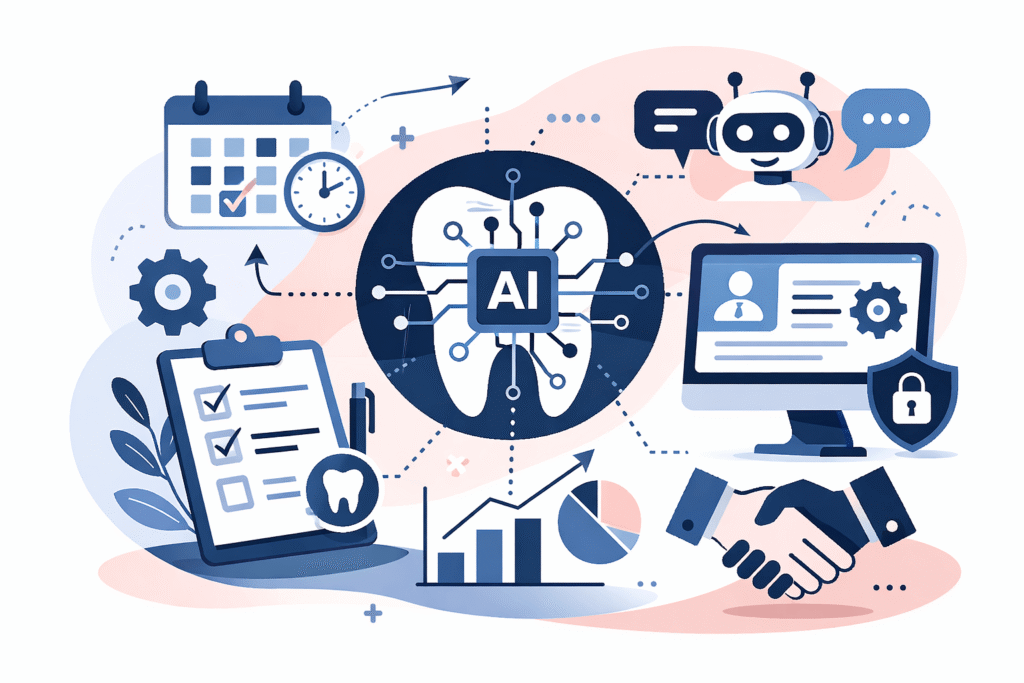
The Operational Strain on Traditional Dental Practices
Many dental practices operate under significant administrative pressure. The front desk team often bears the brunt of this strain. Their daily to-do list is formidable: checking patients in and out, verifying insurance, answering phone calls, scheduling appointments, and managing billing. When these critical tasks overwhelm the team, other essential growth activities suffer.
Consider your current recall system. It likely relies on manual reports generated by your practice management software (PMS). A staff member prints a list once a month and starts making phone calls. This method is incredibly inefficient. It is also highly subjective. The staff member might call some patients but miss others. They might leave a voicemail that goes unanswered. This approach creates a leaky bucket situation. Patients quietly drift away from your practice because they simply forgot to schedule, and you lacked a robust system to remind them effectively.
The financial consequences of these operational inefficiencies are substantial. An empty hygiene chair does not just represent lost revenue for that specific hour. It represents a missed opportunity to diagnose future restorative work. When your recall system fails, your entire production pipeline suffers. This operational strain directly impacts your bottom line and limits your ability to scale.
Furthermore, traditional systems cannot easily predict patient behavior. Your team handles cancellations reactively. When a patient calls to cancel at the last minute, the front desk scrambles. They might send a generic “we have an opening” blast, but these attempts are often too little, too late. This reactive scramble disrupts the flow of the entire day, causing stress for the team and reducing profitability.
Revolutionizing Hygiene Recall Systems with AI
The hygiene department is the engine of most successful dental practices. It provides stable, recurring revenue. More importantly, it is the primary source of diagnostic opportunity for the doctor. A well-managed hygiene department ensures you consistently identify the restorative, cosmetic, or periodontal treatments needed. However, keeping the hygiene schedule full is often a manual, tedious struggle.
AI for dental practice management completely redefines how practices approach hygiene recall systems. Instead of relying on manual lists and generic efforts, AI analyzes decades of patient data. It does not treat every patient the same. AI understands individual patient behaviors and preferences.
An AI-driven system analyzes when a patient last visited, what treatments they received, and how they interact with previous communications. Does Mrs. Smith always prefer a morning appointment? Does Mr. Jones usually respond better to texts than emails? AI knows this. It does not just send reminders; it sends the right reminder, at the right time, via the right channel.
This level of intelligent automation yields significantly better results. It leads to higher response rates and, consequently, a more consistently filled hygiene schedule. But the benefits extend beyond just filling slots. An AI recall system optimizes the scheduling itself. It can intelligently group certain types of appointments or schedule based on production value, ensuring the day is not just busy, but also productive.
Consider the time your team saves. They no longer spend hours leaving voicemails. Instead, they manage incoming bookings facilitated by the AI. Their role shifts from administrative chasing to high-value patient interaction. This optimization reduces staff burnout and focuses their energy on providing an exceptional in-office experience.
Tackling the Cancellation Crisis Head-On
Cancellations and no-shows are devastating to a dental practice’s productivity. When an appointment slot opens up with less than 24 hours’ notice, the chances of filling it are slim. The practice loses not just the production from that appointment but still bears the fixed overhead costs for staff, rent, and utilities during that hour. It is a total loss.
Traditional reminder systems (even automated ones) typically treat every patient the same. They send a confirmation 48 hours before the appointment and perhaps again two hours before. This is helpful, but it is not sufficient. A generic reminder does not stop the patient who is likely to cancel regardless.
AI for dental practice management takes a fundamentally different approach. It leverages predictive analytics to address cancellations before they happen. The AI analyzes historical data and patient history to assign a “risk score” to every appointment on the schedule.
It examines numerous variables:
- How many times has this patient cancelled in the past?
- Are they late payers?
- What is the type of treatment scheduled (high-anxiety procedures like root canals have higher cancellation rates)?
- What is the day of the week and the time of the appointment?
When the AI identifies an appointment as high-risk, it can trigger proactive measures. Instead of just sending a standard automated appointment reminder, the system might prompt the front desk team to make a personal confirmation call. Alternatively, it might accelerate the reminder sequence for that specific patient.
Furthermore, if a high-risk appointment does cancel, the AI immediately searches your database for the perfect replacement patient. It does not just blast your entire patient list. It might find a patient nearby with a flexible schedule or someone who has been on the waitlist for weeks. This allows the team to fill the opening in minutes, rather than hours. This proactive risk assessment is a game-changer for stabilizing practice production.
Identifying Dormant Treatment Plans: Mining Your Own Database
The most significant overlooked opportunity to increase production lies within your Practice Management Software. Every dental practice has thousands, or even millions, of dollars in unscheduled treatment sitting in its database. These are treatment plans that the doctor has diagnosed, but the patient has not yet accepted or scheduled.
Traditional software is very bad at managing this data. The lists are overwhelming. Running a report on unscheduled treatment often yields a spreadsheet with hundreds of names and no clear way to prioritize them. There is no nuance. It treats a $20,000 full-mouth reconstruction the same as a single-surface filling.
AI excels at solving this problem. AI for dental practice management scans your entire patient base instantly. It analyzes these unscheduled plans far more effectively than any human can. It can filter these lists based on custom parameters, identifying exactly where the highest-value opportunities lie.
The AI analyzes data points such as:
- The total production value of the treatment plan.
- The age of the diagnosis (plans over six months old need a different approach than those from last week).
- The patient’s insurance eligibility (identifying patients who are about to lose or reset their benefits).
- The patient’s past behavior (do they accept cosmetic treatment easily?).
This capability is essential for increasing case acceptance. The AI doesn’t just generate a list; it segments patients for highly targeted outreach. It might identify patients who are interested in cosmetic dentistry but hesitate due to cost, and then trigger a personalized message about financing options.
Instead of generic marketing efforts trying to generate leads externally, you are mining the rich data you already possess. You are re-engaging patients who already trust you and are familiar with your practice. This is highly effective patient reactivation that costs a fraction of standard marketing and delivers a vastly higher return on investment.
Enhancing Lead Generation and Reactivation Through Internal AI
While the core focus of this discussion is on internal operational efficiency, the benefits of AI for dental practice management naturally extend to patient acquisition. Understanding how your internal systems work allows you to optimize your external efforts.
The information AI gathers during recall and reactivation campaigns provides invaluable insights for dentist lead generation. If the AI consistently shows that your demographic is highly interested in cosmetic dentistry marketing, you can shift your external marketing budget to focus heavily on procedures like veneers, whitening, and clear aligners. You are no longer guessing what patients want; the data tells you precisely what services are in demand.
Furthermore, AI-driven marketing automation can nurture new leads more effectively. When a new potential patient visits your website, an AI chatbot can answer basic questions 24/7. It can pre-qualify leads by asking about their insurance or their specific dental needs. If they aren’t ready to book yet, the AI can place them in a targeted email nurture sequence to maintain engagement over time.
This seamless dental software integration means that marketing efforts and operational procedures work in perfect harmony. A new lead captured on your website flows directly into your PMS, where AI immediately analyzes how best to engage and schedule them. This cohesive approach eliminates lead leakage and maximizes the efficiency of your marketing spend.
Driving Dental Office Efficiency: Data vs. Guesswork
The overall impact of AI is a massive increase in dental office efficiency. Traditionally, dental practices have been managed on intuition and “gut feelings.” Dentists might feel busy, but they are not sure whether they are profitable. Office managers might feel like they are making progress, but they can’t measure the impact of their efforts.
AI provides clarity through data-driven practice analytics. These analytics remove the guesswork from management decisions. AI dashboards display the key metrics that truly drive growth, not just superficial numbers.
You can see instantly:
- What is your actual case acceptance rate (and which types of treatment are being accepted most)?
- How effective is your recall system in retaining patients?
- Which team members are most effective at converting calls into appointments?
- What is the true cost of cancellations and no-shows each month?
This data allows you to make informed decisions. If the analytics show your acceptance rate for major restorative cases is low, you can invest in training for your clinical team or refine your financial presentation process. If your cancellation rate is high on Fridays, you can adjust your scheduling protocols.
Managing on data rather than intuition creates a stable, predictable business model. It allows you to set realistic goals and track your progress with precision. The AI does not just tell you what is happening; it provides a deep understanding of why it is happening, empowering you to make strategic adjustments that lead to sustainable growth.
The Future: Seamless Dental Software Integration and Artificial Intelligence
For AI to be truly effective, it cannot exist as an isolated, siloed tool. It must integrate completely with the software you use daily. Dental software integration is crucial. AI needs direct access to the data in your Practice Management Software (such as Dentrix, Eaglesoft, or Open Dental) to perform its complex analysis.
The most advanced AI systems now operate directly within your existing workflow. They do not require you to learn a complicated new program or constantly switch between tabs. The insights and recommendations appear right on your schedule or patient files.
The front desk knows exactly which patients need special confirmation calls. The business manager receives a list of high-value unscheduled treatment plans to review. The doctor sees a summary of a patient’s treatment acceptance probability during the morning huddle.
This deep integration makes AI an invaluable member of your team. It is not replacing anyone; it is providing your human staff with superpowers. It processes information faster, identifies patterns they would miss, and allows them to focus their energy where it matters most: delivering high-touch, personalized care to your patients. The future of dentistry is not just digital; it is profoundly intelligent, powered by seamless AI integration.
Scaling Your Practice and Filling Chairs
The ultimate goal of integrating AI for dental practice management is not just efficiency for its own sake. The true objective is scale and predictability. You want your chairs consistently filled with productive appointments and to increase your revenue without burning out your team.
AI provides the framework to achieve this. By automating recall, reducing cancellations, and mining your database for unaccepted treatment, you maximize the productivity of every hour. You stop relying solely on a constant influx of expensive new patient leads to sustain production. You unlock the dormant value already present within your current database.
Scaling a practice using traditional methods means hiring more staff, which increases overhead and management complexity. Scaling with AI means optimizing your existing resources first. It allows you to increase production before you need to add headcount significantly. When you eventually do need to expand your team, you are doing so from a position of data-driven stability, not reactive desperation.
This operational optimization also increases the valuation of your practice. A prospective buyer (or DSO) is far more interested in a practice with documented, automated systems and a predictably full schedule than one that relies heavily on manual effort and guesswork. AI integration makes your practice a more valuable, stable, and attractive business asset.
Conclusion: Partnering with Specialized Experts for Dental Growth
The path to integrating these sophisticated AI tools and digital strategies is complex. Successfully leveraging AI requires specialized knowledge that general marketing firms or software providers often lack. To achieve the maximum return, you need a partner who understands both the technology and the unique operational dynamics of a dental practice.
InvigoMedia understands that AI is a catalyst, but it must be combined with a robust, targeted marketing and operational strategy. InvigoMedia specializes specifically in the dental market. They do not use generic, cookie-cutter templates. They analyze your specific practice, database, and goals. They then design a comprehensive growth strategy that expertly combines advanced AI tools with targeted digital marketing initiatives.
InvigoMedia’s strategies go beyond just generating leads; they ensure those leads are nurtured and converted effectively through the AI tools we have discussed. Their goal is sustained, predictable scaling. They help you build the systems necessary to fill your chairs consistently, increase your case acceptance, and significantly grow your production, all while optimizing your internal efficiency. If you are ready to stop guesswork and start utilizing data to build the practice you’ve always envisioned, InvigoMedia has the specialized expertise to get you there. Contact them today to discuss how they can implement these exact AI solutions and strategic approaches to help you scale your dental practice effectively and fill your chairs predictably.
Frequently Asked Questions (FAQs)
1. Will AI replace my front desk team?
Absolutely not. The primary purpose of AI for dental practice management is not to replace your team but to empower them. AI takes over the boring, repetitive, and time-consuming tasks, such as making hundreds of recall calls, analyzing data, and sending basic reminders. This allows your team to focus on what they are truly skilled at: interacting with patients, building relationships, providing exceptional service, and closing cases. AI makes their jobs less stressful and more focused on high-value human interaction.
2. Is this technology expensive for a single practice owner?
While there is an initial investment, the perspective should be on Return on Investment (ROI). Consider the financial impact of just one or two prevented no-shows per month, or filling one high-value dormant treatment plan. These actions alone can often pay for the AI software several times over. Furthermore, AI helps increase production without requiring a massive increase in external marketing spend. In almost all cases, the increase in revenue and saved staff time significantly outweighs the cost of the technology.
3. How difficult is it to integrate AI into my current dental software (PMS)?
Integration is actually simpler than many dentists think. Leading AI providers are designed for seamless integration with major Practice Management Systems, including Dentrix, Eaglesoft, Open Dental, and others. The AI provider’s technical team typically handles the setup process. Once installed, the AI operates in the background, analyzing data without disrupting your existing clinical or administrative workflows. The insights and recommendations often appear directly within the software your team uses daily.
4. How long does it take to see results from integrating AI?
You can often see noticeable results relatively quickly. For instance, an optimized hygiene recall system and AI-driven automated appointment reminders can start filling schedule gaps and reducing cancellations almost immediately. Identifying and reaching out to patients with dormant treatment plans can also yield quick increases in production. Generally, within the first 90 days of implementation, practices will see measurable improvements in critical metrics such as case acceptance rates, recall consistency, and overall production per hour.
5. My patient base is older; will they respond well to AI communications?
This is a common concern. However, AI does not rely solely on texting and email. It is highly effective because it analyzes each patient’s preferred communication style. If an older patient responds better to phone calls or physical mailers, the AI identifies that pattern and guides your team accordingly. Furthermore, older demographics are increasingly using smartphones and texting for communication. An intelligent system adjusts to their preferences, rather than forcing them to adapt to its methods. AI ensures you communicate effectively with every patient, regardless of their age.