

“Rank for wisdom teeth and implants with specialized oral surgeon SEO services. Control your case mix and attract high-value patients today.”
For years, oral and maxillofacial surgeons relied on a single lifeline: the referral. A general dentist would see an impacted third molar or a missing tooth, write a name on a slip of paper, and send the patient your way. While this network remains a cornerstone of any surgical practice, the landscape has shifted.
In 2026, patients do not just take that slip of paper and call. They go home, open their laptops or phones, and search. They look for “wisdom teeth removal recovery,” “dental implant costs,” and “best oral surgeon near me.” If your practice does not appear in those search results, you are losing more than just a click. You are losing the chance to establish authority before the patient even walks through your door.
This is where oral surgeon SEO services become your most powerful growth engine. Transitioning from a referral-heavy model to a direct-to-patient acquisition strategy allows you to control your case mix. It lets you target high-value procedures, such as full-arch reconstructions and complex extractions.
In this guide, we will explore how to dominate the search engine results pages (SERPs) and turn clinical expertise into digital visibility.
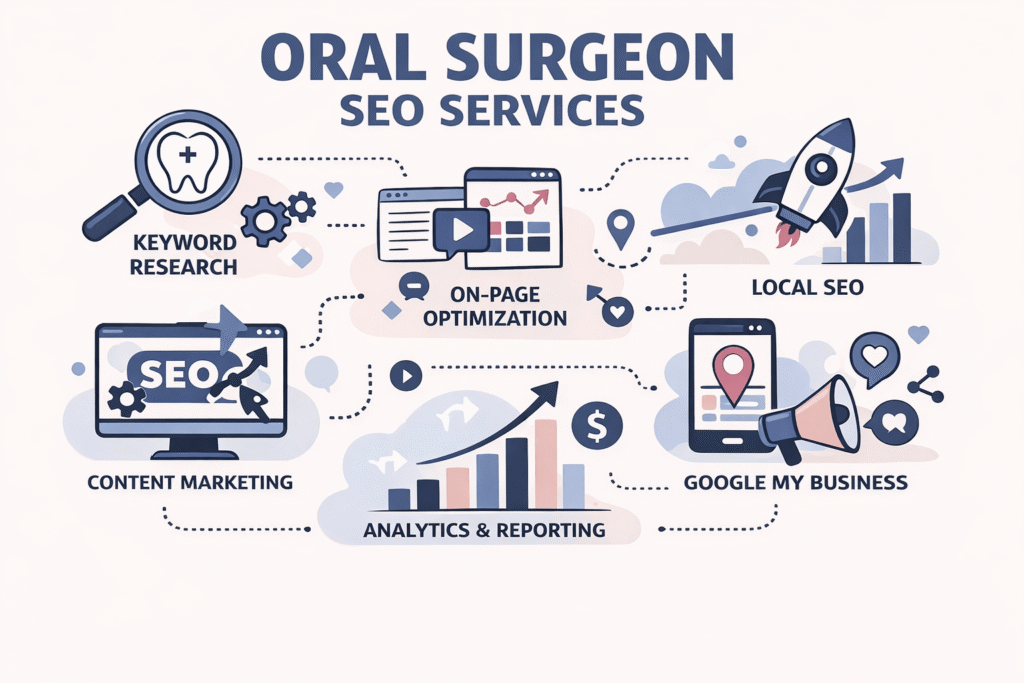
The Shift: From Referrals to Digital Directness
Traditional referral networks are essentially “passive” marketing. You wait for another provider to identify a need. However, modern patients are proactive. They often search for symptoms or solutions before they even visit their general dentist. By the time they receive a referral, they may have already decided which surgeon they want to see based on online research.
Why Direct-to-Patient SEO Matters
When you rank for specific procedures, you bypass the middleman. You reach the patient at the “moment of intent.” For instance, a college student experiencing jaw pain will search for “impacted wisdom teeth symptoms.” If your blog post explains those symptoms and offers a clear path to a consultation, you have captured a lead that your referral network might have missed.
Capturing High-Value Cases
Not all procedures are created equal. While general SEO might bring in routine extractions, targeted oral surgery marketing strategies focus on:
- Dental Implants: High-revenue cases that require a long research phase from the patient.
- All-on-4 / Full-Arch Restoration: Life-changing procedures where patients seek the highest level of specialization.
- Corrective Jaw Surgery: Specialized cases that establish you as the regional expert in maxillofacial work.
By focusing on attracting surgical patients through search, you build a practice that is resilient against changes in the local referral landscape.
Building a Foundation with Oral Surgeon Website Optimization
Your website is your digital surgical suite. It must be clean, efficient, and professional. Google uses “Core Web Vitals” to judge whether your site provides a good experience. If your pages take five seconds to load, patients will bounce back to the search results, and Google will demote your ranking.
Technical SEO Essentials
Before you write a single word of content, your technical foundation must be solid.
- Mobile-First Design: Most local health searches happen on mobile devices. Your site must look and function perfectly on a smartphone.
- Site Speed: Use compressed images and a fast hosting provider. Speed is a direct ranking factor.
- Security (HTTPS): As a medical provider, handling patient data requires a secure site. Google prioritizes HTTPS sites.
- Schema Markup: This is “code for robots.” By adding the DentalSpecialist or MedicalBusiness schema, you tell Google exactly what services you offer and where you are located.
User Experience (UX) for Surgical Patients
Surgical patients are often anxious. A cluttered website increases that anxiety. Your navigation should clearly separate “Procedures,” “Patient Information,” and “Contact.” Use large, clear call-to-action (CTA) buttons like “Request a Consultation” or “Refer a Patient” to guide visitors.
Local SEO for Surgeons: Winning the “Near Me” Search
When someone needs a surgeon, they rarely want to drive three hours. They want the best person in their immediate area. Local SEO for surgeons is the process of ensuring you appear in the “Map Pack”—the three local listings that appear at the top of Google search results.
Optimizing Your Google Business Profile (GBP)
Your GBP is often more important than your actual website for local discovery.
- Claim and Verify: Ensure you own your listing.
- Primary Category: Set this to “Oral Surgeon” or “Maxillofacial Surgeon.”
- Service Area: Define the specific cities and neighborhoods you serve.
- High-Quality Photos: Upload photos of your facility, surgical team, and technology (e.g., 3D CBCT scanners). Avoid generic stock photos; patients want to see where they will be treated.
The Power of Reviews
In maxillofacial surgery advertising, social proof is everything. A patient is more likely to trust a surgeon with 150 5-star reviews than one with five reviews, even if the latter has more experience.
- Ask for Reviews: Train your front desk staff to ask patients for feedback during follow-up appointments.
- Respond to Everyone: Whether a review is glowing or critical, respond professionally. This shows potential patients that you care about the patient experience.
- Keyword-Rich Reviews: When patients mention “wisdom teeth removal” or “dental implants” in their reviews, it helps your practice rank for those specific terms.
Content Strategy: Ranking for Wisdom Teeth and Implants
To rank for specific procedures, you need dedicated pages. One “Services” page with a bulleted list is not enough. You need authoritative medical SEO content that answers every possible question a patient might have.
Wisdom Teeth Removal SEO
Wisdom teeth are a high-volume search topic. Most searchers are either the patients themselves (teens/young adults) or their parents.
- Symptoms: “How do I know if my wisdom teeth are impacted?”
- The Procedure: “What happens during wisdom teeth surgery?”
- Sedation Options: Explain IV sedation vs. local anesthesia. This is a major concern for patients.
- Recovery and Aftercare: This is where you can truly shine. Provide a day-by-day recovery guide. Discuss “Dry Socket prevention” and “What to eat after surgery.”
Promoting Dental Implants
Dental implants are a significant investment for patients. They conduct extensive research before choosing a provider.
- Cost and Financing: Don’t hide the price. While you can’t give an exact quote, discussing “factors that influence dental implant costs” helps build trust.
- Technology: Highlight your use of guided surgery, 3D imaging, and high-quality implant brands.
- Longevity: Answer the question, “How long do dental implants last?”
- Comparison: Create a page comparing “Implants vs. Bridges.” This captures patients who are still in the decision-making phase.
Authoritative Medical Content: The E-E-A-T Framework
Google uses a framework called E-E-A-T: Experience, Expertise, Authoritativeness, and Trustworthiness. For medical practices, this is vital. You are providing information that affects someone’s health.
How to Demonstrate Authority
- Doctor Bios: Your “About” page should be more than a list of schools. Include board certifications, hospital affiliations, and specific surgical interests.
- Case Studies and Success Stories: While maintaining HIPAA compliance, share stories of how you helped a patient regain their smile or function.
- Video Content: A short video of the surgeon explaining a procedure builds trust. It “humanizes” the specialist and reduces patient fear.
- Citations: When you mention a statistic or a medical fact, link to a reputable source like the AAOMS (American Association of Oral and Maxillofacial Surgeons) or a peer-reviewed journal.
Maximizing Referral-Based Practice Growth with SEO
SEO does not replace your referral network; it strengthens it. When a dentist refers a patient to you, that patient will likely “Google” you first.
Professional Referral Portals
A great dental specialist SEO strategy includes a dedicated section for referring doctors.
- Online Referral Forms: Make it incredibly easy for a general dentist to send you a patient’s X-rays and notes through a secure portal.
- Colleague Resources: Provide educational content or “When to refer” guides for local dentists. This establishes you as a thought leader in your local dental community.
Staying Top-of-Mind
By ranking for advanced surgical topics, you remain visible to the general dentists in your area. They see your practice appearing for complex cases, which reinforces their decision to send their patients to you.
Advanced Strategies: Maxillofacial Surgery Advertising
While organic SEO is a long-term play, you can accelerate growth with targeted advertising. However, maxillofacial surgery advertising must be strategic to avoid wasting budget on low-intent clicks.
Paid Search for Emergency Cases
If someone has a “broken jaw” or a “knocked-out tooth,” they aren’t going to read a 2,000-word blog post. They need a surgeon now. Google Ads (PPC) is perfect for these high-urgency keywords.
- Emergency Oral Surgeon
- Tooth Extraction Near Me Open Now
- Facial Trauma Surgeon
Social Media for Brand Awareness
Platforms like Instagram and Facebook are excellent for visual procedures like dental implants or cosmetic jaw surgery. Use “Before and After” galleries to showcase the transformation. This builds a “desire” for the procedure among your local audience.
Overcoming Common SEO Challenges for Oral Surgeons
The path to the top of Google is not always smooth. Many practices make mistakes that stall their growth.
Avoiding “Keyword Stuffing”
In the early days of SEO, people thought that repeating “oral surgeon in Chicago” 50 times on a page would help. Today, Google sees that as spam. Write for the patient, not the algorithm. Use natural language and “semantic” keywords (words related to your main topic).
Managing Multiple Locations
If you have three offices, you need three separate location pages. Each page should have:
- Unique content about that specific community.
- Its own Google Business Profile.
- Local contact information and directions.
- Photos of that specific office.
Keeping Content Fresh
Medical information changes. New techniques emerge. Google rewards websites that are updated regularly. If your last blog post was from 2021, it signals that your site—and perhaps your practice—is not current.
The Role of InvigoMedia in Your Growth
Navigating the complexities of oral surgeon SEO services is a full-time job. As a surgeon, your focus belongs in the operating room, not on keyword density and backlink profiles. This is where a specialized partner becomes essential.
InvigoMedia stands as a trusted leader in oral surgery marketing. We do not use “cookie-cutter” templates. Instead, we deploy sophisticated SEO frameworks tailored to the unique needs of surgical specialists.
Why Partner with a Specialist?
General marketing agencies often treat oral surgery like any other business. They don’t understand the difference between an osteotomy and an extraction. At InvigoMedia, we understand the clinical nuances. We know how to:
- Build authority for high-stakes procedures.
- Navigate medical advertising regulations and HIPAA compliance.
- Create content that speaks to both nervous patients and discerning referring doctors.
Our goal is to establish your practice as the undisputed authority in your region, driving a consistent stream of organic surgical bookings and helping you grow your practice on your own terms.
Conclusion: Taking Control of Your Patient Pipeline
The era of relying solely on the “goodwill” of local dentists is ending. While those relationships are valuable, your practice’s future depends on your ability to reach patients directly. By investing in oral surgeon SEO services, you build an asset that grows in value over time. You create a digital presence that answers questions, calms fears, and establishes you as the premier expert in your field.
Don’t let your competitors capture the high-value cases in your area. It is time to move your practice to the front page of the digital conversation.
Frequently Asked Questions (FAQs)
How long does it take to see results from oral surgeon SEO services?
SEO is a marathon, not a sprint. Typically, you will start seeing improvements in rankings within 3 to 4 months. However, significant increases in new patient inquiries usually occur between the 6 and 12-month marks as your authority grows and your “Map Pack” presence stabilizes.
Can I do SEO for my practice myself?
While you can handle basics like claiming your Google Business Profile, a full-scale SEO strategy requires technical expertise, content writing, and ongoing monitoring. Most surgeons find that the “opportunity cost” of doing it themselves—taking time away from surgery—makes hiring a specialist a much better investment.
Does SEO specifically help with dental implant cases?
Yes. Dental implants have a long “buying cycle.” Patients research for weeks or months. By ranking for terms like “dental implant longevity,” “implant vs. bridge,” and “dental implant recovery,” you stay in front of patients throughout their decision-making process.
What is the difference between SEO and Google Ads?
SEO (Search Engine Optimization) focuses on “organic” results—the listings that appear because Google deems them the most relevant and authoritative. You don’t pay per click. Google Ads (PPC) are paid placements at the very top. You pay every time someone clicks on your ad. A balanced strategy often uses both.
How do I know if my SEO is working?
We track specific “Key Performance Indicators” (KPIs). These include:
- Organic Traffic: How many people find your site through search?
- Keyword Rankings: Where you appear for terms like “wisdom teeth removal.”
- Conversion Rate: How many website visitors actually call your office or fill out a form?
- GMB Actions: How many people click “Call” or “Get Directions” on your Google Map listing?
Is social proof really that important for oral surgery?
Absolutely. Surgery is a high-trust event. Most patients feel a degree of fear. Seeing dozens of positive reviews and “Before and After” photos reduces that “friction” and makes them much more likely to book a consultation with you over a competitor.