
“Accelerate your enrollment with this guide on How to Market Clinical Trials, featuring digital strategies to find and recruit qualified participants.”
Introduction
The statistics are alarming. And if you work in clinical research, you are unfortunately familiar with them. A significant percentage of clinical trials fail to meet their enrollment goals on time. Some sources suggest this number is as high as 80%. Even worse, many trials are forced to terminate early because they simply cannot find enough qualified participants.
This isn’t just a logistical headache. It has real-world consequences. Delays in recruitment mean delays in bringing potentially life-saving treatments to market. It means ballooning budgets for sponsors and frustration for research sites.
Why is this happening?
In many cases, the science is sound. The protocol is solid. The problem lies in the outdated methods used to find participants. Relying solely on posters in hospital waiting rooms, newspaper ads, or untargeted radio spots no longer works effectively. We live in a digital world. Your potential participants are online. They are searching for answers to their health problems right now.
If your recruitment strategy doesn’t meet them there, your trial will likely struggle.
This article outlines a modern, digital-first approach to participant recruitment. We will move beyond traditional methods and explore exactly how to market clinical trials using today’s digital tools. We will cover the essentials of creating high-converting landing pages, running targeted ad campaigns on Google and social media, and using content to build trust.
This isn’t just about getting clicks. It’s about building a reliable engine for clinical trial participant recruitment that delivers qualified, screened, and eager volunteers.
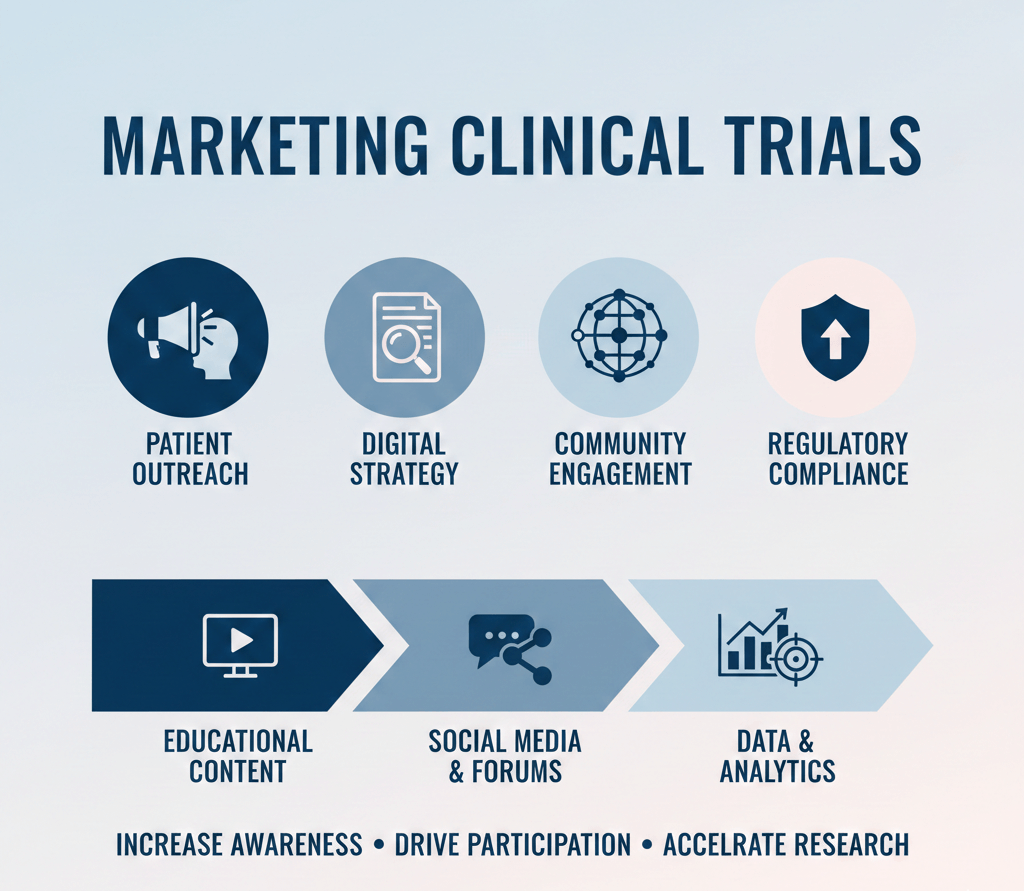
Section 1: The Shift to Digital Patient Recruitment
Traditionally, recruitment was a passive process. Sites waited for patients to show up at the clinic, or they relied on a physician’s existing database. While investigator databases remain valuable, they are rarely sufficient for larger studies or those requiring specific, hard-to-find inclusion criteria.
The modern patient is an empowered consumer of healthcare information. When someone receives a diagnosis or when they are struggling with chronic symptoms, their first step is almost always the same: they turn to Google.
They search for symptom checkers. They look for new treatment options. They join Facebook groups dedicated to their specific condition to connect with others.
If your clinical trial is not visible during these digital journeys, it effectively doesn’t exist to them.
Digital marketing for clinical research offers several distinct advantages over traditional media:
- Precision Targeting: Instead of broadcasting a radio ad to an entire city and hoping a patient with a specific rare disease hears it, digital tools let us show ads only to people who show interest in that disease.
- Measurable Results: With digital campaigns, you know exactly what is working. You can track how many people saw your ad, clicked it, completed the pre-screening questionnaire, and eventually enrolled. This data allows for real-time optimization.
- Cost-Efficiency: Because you are targeting only relevant audiences, you waste less budget on people who will never qualify for your study. The cost per lead is often significantly lower than traditional advertising.
- Speed: A digital campaign can be launched in a matter of days. If initial results are slow, copy and creative can be adjusted almost instantly to improve performance.
To succeed today, we must view patient recruitment through the lens of healthcare lead generation. We need a structured digital funnel that attracts, educates, screens, and converts prospective participants.
Section 2: The Foundation – Your Study’s Dedicated Landing Page
Before spending a single dollar on ads, you need a place to send the traffic. This is where many sponsors and sites make a critical error. They send ad traffic to their corporate homepage or a generic “current studies” list.
This is a recipe for failure.
When a user clicks an ad for a specific diabetes study, they expect to land on a page dedicated specifically to that diabetes study. If they have to navigate menus to find the information they need, they will leave. Bounce rates will soar, and your ad budget will go to waste.
You need a dedicated, standalone landing page for each study. This page has one job: to convince the visitor to see if they qualify.
The Anatomy of a High-Converting Study Landing Page
A successful landing page blends persuasive copywriting with strict ethical and regulatory compliance (IRB/EC approval is mandatory, of course). Here are the essential elements:
Clear, Empathetic Headline: The headline should immediately confirm they are in the right place. Avoid overly technical jargon. Instead of “Protocol XYZ-123 Phase III Study,” try something like “Research Study Evaluating a Potential New Treatment for Chronic Migraines.”
The “Why” (The Value Proposition): Why should they participate? Altruism is a factor, but patients also care about their own health. Clearly state the potential benefits. This might include access to investigational treatments, close medical staff monitoring, or compensation for time and travel. Be honest and never overpromise results.
Simple Eligibility Criteria: Don’t list the entire 20-point inclusion/exclusion protocol. List the top 5-7 major deal-breakers in plain language. For example:
- Must be between 18 and 65 years old.
- Must have a confirmed diagnosis of Type 2 Diabetes.
- Must not be currently pregnant.
This helps unqualified visitors weed themselves out quickly, saving your site staff time.
Trust Signals: Clinical research can be intimidating. Build trust by displaying the logos of the involved research institutions, clearly mentioning IRB approval, and including a brief bio of the Principal Investigator. A phone number they can call to speak to a real human is also a powerful trust signal.
A Prominent Call to Action (CTA): What do you want them to do next? Usually, this is “Check My Eligibility” or “See If I Qualify.” This button should be big, bright, and obvious.
The Digital Pre-Screener: When they click the CTA, they should be taken to a short digital questionnaire. This form asks the basic inclusion/exclusion questions. If they pass, their information is routed to the site for follow-up. If they fail, they are politely thanked and perhaps given the option to join a database for future studies. This automated vetting is absolutely vital for efficient online patient recruitment.
SEO Considerations for Your Landing Page: To attract organic (unpaid) traffic, your landing page needs SEO for clinical trials. This means using keywords that patients actually type into search engines. They aren’t searching for “randomized double-blind placebo-controlled trial.” They are searching for “migraine clinical trials near me” or “new treatments for eczema.”
Section 3: Capturing High Intent with Google Ads
When someone types a query into Google, they are demonstrating intent. They have a problem, and they are actively seeking a solution.
This makes Google Ads (formerly Google AdWords) one of the most powerful tools for finding trial participants online. You can place your study directly in front of people at the exact moment they are looking for it.
Keyword Strategy is Everything. The success of a Google Ads campaign hinges on selecting the right keywords. You need to bid on terms that indicate a willingness to participate in research, not just general information gathering.
- Good Keywords: “clinical trials for depression,” “paid research studies near me,” “join an asthma study,” “investigational medication for Crohn’s disease.”
- Broad/Weak Keywords: “what is depression,” “asthma symptoms,” “Crohn’s disease causes.” People searching these broad terms are likely just researching the condition, not looking to join a trial. Bidding on them will burn through your budget fast.
Writing Compliant Ad Copy: Google has strict policies regarding healthcare advertising, and your IRB has even stricter ones. Ad copy must be accurate, non-coercive, and must not promise a cure.
Your ad needs to balance these restrictions with the need to be compelling. Focus on the opportunity to contribute to science and access new care options.
Example of good ad copy: Headline: Struggling with Eczema? Description: Local research study enrolling adults with moderate to severe eczema. Study medication is provided at no cost. Compensation may be available for time and travel. Check eligibility today.
Geotargeting: Most clinical trials require participants to visit a physical site. Therefore, you must use geotargeting to show ads only to people within a reasonable driving distance of your research sites. Showing an ad for a study in Boston to someone living in Seattle is a waste of money. You can target by radius around a zip code, by city, or by region.
Negative Keywords Just as important as the keywords you target are the ones you choose to ignore. “Negative keywords” tell Google not to show your ad for specific searches.
For recruitment, you should add negative keywords like “jobs,” “careers,” “statistics,” or “definition.” You don’t want to pay for clicks from people looking for a job at a research center or students writing a paper about a disease.
Section 4: Generating Demand with Paid Social Media (Facebook & Instagram)
While Google Ads capture existing demand, social media ads generate demand. This is often called “interruption marketing.” Users are scrolling through their feeds, looking at photos of friends or funny videos, and your ad appears.
They weren’t actively seeking a clinical trial at the time. Therefore, your ad must be engaging enough to stop their scroll and capture their attention.
Facebook and Instagram (both run through Meta Ads Manager) are excellent platforms for clinical trial ads. Despite recent privacy changes affecting targeting, they still offer powerful ways to reach specific demographics.
Targeting Strategies on Social Media: You cannot target people based on “health status” directly due to privacy policies. However, you can use proxy targeting to reach relevant audiences.
- Interests: You can target people interested in relevant non-profit organizations, health and wellness topics related to the condition, or specific dietary requirements often associated with a condition (e.g., gluten-free for celiac studies).
- Demographics: Age- and gender-targeting are crucial for many study protocols.
- Lookalike Audiences: If you have a list of past participants (and appropriate consent to use their data for marketing), you can upload it to Facebook. The platform will then find new users who share similar characteristics and behaviors to those in your existing list. This is often highly effective.
Creative that Connects. On social media, visuals are paramount. Stock photos of smiling doctors in white coats are generally ignored. They look too generic.
Use imagery that feels authentic and relatable to the patient experience. Sometimes, simple graphics with clear text work best. Video ads are increasingly effective. A short, compliant video explaining the study purpose can drive high engagement.
Facebook Lead Forms vs. Landing Pages Meta offers an ad format called “Lead Generation” ads. When a user clicks the ad, a form pops up directly within Facebook or Instagram, pre-filled with their contact information. They don’t have to leave the app.
This reduces friction and often leads to a higher volume of leads. However, the quality of these leads can sometimes be lower than that of those who take the effort to click through to a landing page. A good strategy often involves testing both approaches to see which yields the best cost-per-randomized-patient.
Section 5: Content Marketing to Build Trust and Educate
Recruitment isn’t always about the immediate “ask.” Sometimes, you need to build a relationship first. This is especially true for conditions that are sensitive or for populations skeptical of medical research.
Content marketing involves creating valuable, educational content that attracts your target audience without immediately trying to enroll them.
Blogging and Educational Articles: Create a blog on your research site’s website dedicated to the conditions you study. Write articles that answer common patient questions. For example, if you run Alzheimer’s studies, write articles about “Tips for Caregivers of Alzheimer’s Patients” or “Understanding the Stages of Memory Loss.”
When people search for this information, they find your site. They see you as a credible resource. Within these articles, you can gently introduce the concept of clinical trials as an option and link to your current study landing pages.
Debunking Myths: A significant barrier to recruitment is fear. Patients often misunderstand what a clinical trial is. They fear being treated like “guinea pigs” or getting a placebo when they need real help.
Use content to address these fears head-on. Write articles or create videos explaining:
- The rigorous ethical oversight of trials (IRBs).
- Patient safety is the top priority.
- How placebos are used (and when they are not).
- That they can withdraw at any time for any reason.
By educating the public, you warm them up to the idea of participation.
Building an Opt-In Database: Use your content to build an email list. Offer a free guide or newsletter in exchange for their email address. When a new study opens up, you already have a warm audience to contact. This “owned audience” is incredibly valuable and reduces reliance on paid ads over time.
Section 6: The Follow-Up – Where Recruitment is Won or Lost
You have built great landing pages. Your ads are bringing in traffic. People are filling out the pre-screener. You are generating leads.
Now what?
This is the most critical juncture in patient recruitment strategies. The speed and quality of your follow-up determine success.
If a patient fills out a form on Tuesday at 10:00 AM indicating interest, and your site staff doesn’t call them back until Friday, that patient is gone. They have lost interest, forgotten they applied, or found another option.
Speed to Lead is Vital. Best practices suggest contacting a digital lead within minutes, not hours or days.
Automation and Call Centers. Most research sites are understaffed and overworked. Coordinators are busy seeing patients, not sitting by the phone waiting for internet leads.
This is where technology and external support come in. You need an automated system that immediately sends a confirmation email or text to the applicant acknowledging their interest.
Ideally, these digital leads should be routed to a dedicated call center team trained in study-specific pre-screening. This team handles the initial outreach, verifies the pre-screening answers, answers basic questions, and then—and only then—schedules a baseline visit with the clinical research coordinator at the site.
This ensures site staff only spend their valuable time with high-potential prospective participants.
Conclusion
The era of relying on passive recruitment methods is over. To meet enrollment goals in today’s environment, sponsors, CROs, and research sites must embrace a proactive, multi-channel digital approach.
Knowing how to market clinical trials effectively requires a unique blend of skills: technical expertise in platforms like Google and Facebook Ads, persuasive copywriting that adheres to strict regulatory guidelines, deep knowledge of medical SEO, and a robust system for managing patient data and follow-up.
It’s a complex ecosystem. Trying to manage all these moving parts internally while also running a study’s clinical operations can be overwhelming and inefficient.
This is where specialized expertise becomes invaluable.
At InvigoMedia, we serve as a strategic recruitment partner for clinical research organizations. We don’t just run ads; we build comprehensive digital recruitment engines. Our team specializes in advanced PPC Management tailored for patient recruitment and Medical SEO strategies designed to connect trials with qualified participants ethically and efficiently. We handle the digital complexities so your team can focus on what matters most: the research and the patients.
Frequently Asked Questions (FAQs)
Q: How much does digital patient recruitment cost?
A: The cost varies significantly depending on the condition being studied, the competitiveness of the ad market in your target locations, and the strictness of the inclusion/exclusion criteria. Rare diseases generally have a higher cost-per-lead than common conditions like hypertension. However, digital recruitment is often more cost-effective than traditional media because you only pay to reach relevant audiences.
Q: Are digital ads for clinical trials ethical and compliant?
A: Yes, absolutely. All digital advertising materials, including ad copy, images, and landing page text, must be submitted to and approved by the Institutional Review Board (IRB) or Ethics Committee (EC) overseeing the study before launch. Experienced digital marketers know how to write compliant copy that is persuasive without being coercive or making false promises.
Q: How quickly can a digital recruitment campaign launch?
A: Once IRB approval is secured for the marketing materials, digital campaigns on Google or Facebook can technically be launched within 24-48 hours. However, we recommend allowing a few weeks for proper strategy development, landing page creation, and the IRB submission process beforehand.
Q: What if our research site doesn’t have a marketing team?
A: This is very common. Most sites do not have dedicated marketing personnel. That is why partnering with a specialized agency like InvigoMedia is often the best route. We handle the entire digital marketing process and deliver pre-screened referrals directly to your study coordinators.
Q: Doesn’t digital recruitment only target younger people?
A: This is a common misconception. Data shows that seniors are one of the fastest-growing demographics on platforms like Facebook. Furthermore, adult children often use Google to research health options for their aging parents. Digital strategies can effectively reach nearly all age groups suitable for clinical research.