

“Bring those lost visitors back safely. Learn how to execute retargeting strategies for healthcare while maintaining strict HIPAA compliance.”
Imagine a potential patient actively searching for a medical specialist. They find your practice online. They browse your doctor profiles. They read your treatment pages. Suddenly, their phone rings. They close their web browser. You just lost a valuable lead.
In the retail world, marketers solve this problem easily. They track the user. They show the user a picture of the exact item they left in their shopping cart. They follow them across the internet. Healthcare marketers face a completely different reality. You cannot follow a patient around the internet with ads about their specific medical condition. Doing so violates strict privacy laws. It also makes patients incredibly uncomfortable.
You need effective healthcare retargeting strategies. You must bring those lost visitors back. However, you must do it legally and ethically. This comprehensive guide breaks down how to balance aggressive marketing with strict privacy laws. We will explore safe ways to re-engage your audience, protect their data, and grow your practice.
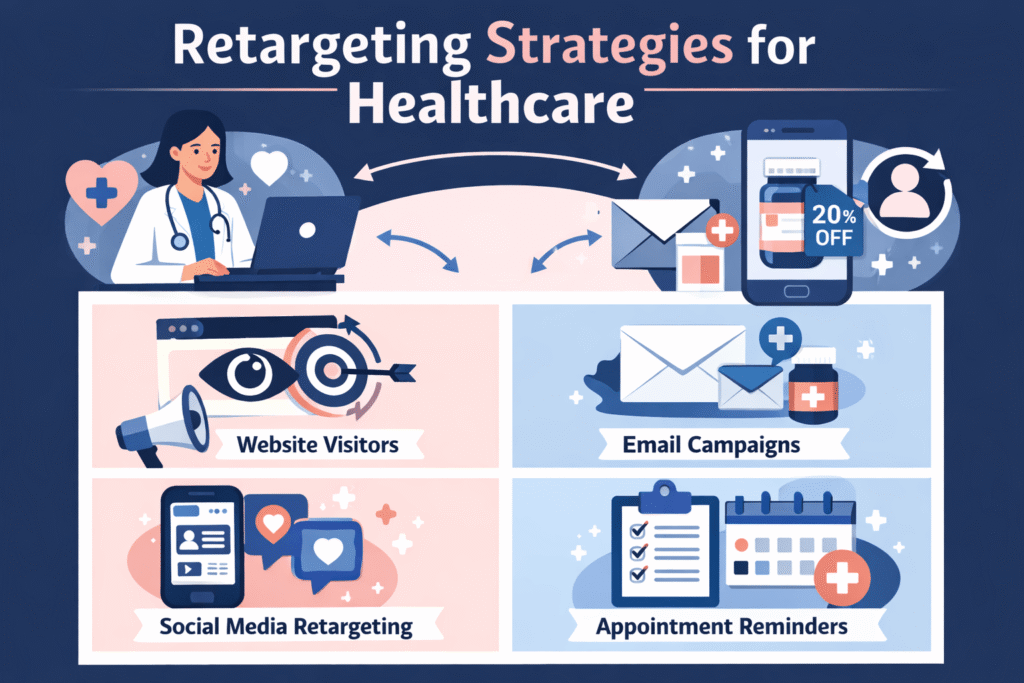
The Core Problem with Standard Tracking
First, you must understand how standard remarketing works. You place a small piece of code on your website. This code often takes the form of a tracking pixel. When a user visits your site, the pixel drops a cookie in their browser. This cookie tracks their movements. When they visit another site, the cookie tells an ad network to display your advertisement. This process works perfectly for selling shoes or software. It fails in the medical field.
Healthcare providers deal with Protected Health Information (PHI). The Health Insurance Portability and Accountability Act (HIPAA) heavily regulates the use and disclosure of PHI. A simple website visit does not count as PHI. You would be wrong. The Department of Health and Human Services (HHS) recently issued strict guidance on website tracking technologies. They stated that linking a user’s IP address to a visit to a specific health-related webpage constitutes PHI. If your website sends this data to Facebook or Google, you commit a direct HIPAA violation.
Furthermore, standard retargeting relies on specific messaging. If someone looks at a page about anxiety treatments, a standard retargeting campaign would show them an ad for anxiety therapy. This approach creates massive legal liabilities. It also destroys patient trust. Medical ad compliance requires a completely different approach.
The Danger of “Creepy” Advertising
Privacy matters to everyone. It matters specifically to people seeking medical help. Patients expect discretion from their doctors. They expect that same discretion from your marketing. When you use aggressive remarketing tactics, you violate that expectation.
Consider a patient researching treatments for a sensitive issue. They leave your site. Later, they read a news article on their phone. A giant banner ad appears, asking them if they still need help with that sensitive issue. Their family members might see the screen. Co-workers might glance over their shoulder.
This scenario destroys your brand reputation. Patients will not click the ad. Instead, they will block your clinic. They will find a provider who respects their boundaries. Therefore, your patient re-engagement campaigns must prioritize subtlety. You must replace specific medical references with broad, welcoming messages. You must shift your focus from the specific condition to the clinic as a whole. Privacy-first advertising builds trust. Trust ultimately drives patient conversions.
Defining HIPAA Compliant Remarketing
What exactly makes a marketing campaign compliant? HIPAA-compliant remarketing requires you to strip all identifiable health data before targeting an audience. You cannot target users based on the specific treatments they researched. You cannot target users based on the specific doctors they viewed. Instead, you must target users based on their general interest in your brand.
To achieve this, you must control your tracking pixels. You cannot use standard Facebook or Google tracking codes on pages detailing specific medical conditions. If you place a standard pixel on a page about oncology, that pixel tells the ad platform that the visitor is interested in cancer treatment. The ad platform then uses that data to build an audience. This data transfer constitutes a severe privacy breach.
Consequently, you must properly configure your analytics and ad platforms. You must use tools that can sign a Business Associate Agreement (BAA). A BAA legally binds the software vendor to protect PHI. Unfortunately, major platforms like Google Analytics and Meta will not sign BAAs for their standard tracking products. Therefore, you must use secure, compliant middleware to filter data before it reaches the ad networks. You sanitize the data. You send the ad network an anonymous signal. This signal simply states that a user visited your main website. It never specifies which medical pages they viewed.
Navigating Google Ads Healthcare Restrictions
Google dominates the digital advertising space. Consequently, healthcare marketers rely heavily on Google Ads. However, Google enforces strict policies regarding personalized advertising. Google Ads healthcare restrictions exist independently of federal privacy laws. Even if you manage your data perfectly, Google will still restrict your campaigns if you violate its rules.
Google explicitly bans marketers from using sensitive health information to target ads. You cannot build a remarketing audience based on a user’s perceived health status. Google defines “health status” broadly. It includes physical conditions, mental health conditions, and medical procedures. If you create a remarketing list called “Users interested in depression treatment,” Google will suspend your account.
Furthermore, Google scans your ad copy and your landing pages. If your display ad mentions a specific ailment, Google will flag it. If your ad links to a page detailing a specific disease, Google might restrict its delivery. You cannot use dynamic remarketing. Dynamic remarketing automatically shows users the exact product or service they viewed. Google bans this entirely for healthcare providers.
Therefore, your Google strategy must focus on the highest level of your marketing funnel. You can build a generic audience of “All Website Visitors.” However, you can only use this audience if your entire website complies with Google’s personalized advertising policies. If your website focuses solely on treating a single, highly sensitive condition, Google might reject your remarketing lists. You must carefully audit your Google Ads setup to ensure full compliance.
Overcoming Facebook Retargeting Medical Hurdles
Meta (formerly Facebook) presents another massive opportunity for patient re-engagement. Meta also presents massive compliance risks. Facebook retargeting medical campaigns require extreme caution. Meta’s Business Tools Terms specifically prohibit advertisers from sending sensitive health data to their platform. If the Facebook pixel detects that you are sending URLs related to specific health conditions, Meta will immediately penalize your account.
Many clinics make a critical mistake here. They install the standard Facebook pixel across their entire website. The pixel tracks every page view. When a user visits a page about fertility treatments, the pixel sends that URL back to Facebook. Facebook then logs that user’s interest in fertility. This violates both Meta’s terms of service and federal privacy laws.
To run compliant campaigns on Facebook, you must limit your tracking. You should only place the Meta pixel on generic pages. Place it on your homepage. Place it on your “Contact Us” page. Place it on your general “About the Team” page. Do not place the pixel on specific condition pages. Do not place the pixel on specific treatment pages.
Once you capture a generic audience, you must design a compliant ad creative. Meta rigorously reviews healthcare ads. Your ads cannot make assumptions about the user’s personal attributes. You cannot use the word “You” in relation to a medical condition. For example, you cannot say, “Are you suffering from back pain?” Facebook will reject this ad immediately. Instead, you must say, “We offer comprehensive physical therapy services.” You must focus on your services, not the user’s perceived problem.
Privacy-First Advertising: The Future of Healthcare Marketing
The digital marketing landscape changes rapidly. Third-party cookies are disappearing. Consumers demand more control over their data. Legislators pass stricter privacy laws every year. In this environment, privacy-first advertising is no longer optional. It is absolutely mandatory.
Privacy-first advertising means respecting the user’s boundaries at every digital touchpoint. It means moving away from aggressive tracking. It means focusing on building relationships through value and trust. For healthcare providers, this shift presents a unique advantage. Patients naturally gravitate toward clinics that protect their privacy. If your marketing feels secure, patients will assume your medical care is secure as well.
You must rely heavily on first-party data. First-party data includes information patients willingly provide. This includes email addresses, phone numbers, and appointment histories. However, you must handle this data with extreme care. You cannot simply upload your patient email list to Facebook to create a Custom Audience. Uploading an unencrypted patient list violates privacy laws. You must use secure, compliant platforms to hash and anonymize this data before you use it for any marketing purposes.
Privacy-first advertising also means obtaining explicit consent. Your website must feature clear cookie banners. You must explain exactly what data you collect. You must explain how you plan to use that data. You must give users an easy way to opt out of tracking entirely. Transparency builds trust. Trust drives patient loyalty.
Retargeting Strategy 1: Brand Awareness Dominance
How do you effectively retarget visitors without mentioning their specific needs? You focus entirely on your brand. Brand awareness retargeting serves as the cornerstone of safe, compliant campaigns. When a visitor leaves your site, you want them to remember your name. You want them to remember your logo. You want them to remember your core values.
Instead of promoting a specific surgery, promote your clinic’s overall reputation. Create healthcare display ads that feature your award-winning staff. Showcase your state-of-the-art facility. Highlight your commitment to the local community. Use vibrant images of smiling, healthy individuals interacting with your medical team.
Your messaging should emphasize trust and expertise. Use phrases like, “Providing trusted care to our community for 20 years.” Use phrases like, “Meet our team of board-certified specialists.” These messages do not target specific conditions. They target the user’s general need for a reliable healthcare provider.
This strategy works exceptionally well for multi-specialty practices. A patient might visit your site looking for a cardiologist. They leave without booking an appointment. Later, they see a display ad highlighting your clinic’s overall excellence. They remember your brand. When they finally feel ready to book an appointment, they search directly for your clinic’s name. You successfully brought them back without violating their privacy.
Retargeting Strategy 2: Generic Service Reminders
Sometimes, brand awareness is not quite enough. You want to prompt a specific action. You can achieve this safely through generic service reminders. This strategy involves promoting broad, universally applicable services to your retargeting audience.
Every patient needs basic, ongoing care. Every patient needs an annual checkup. Many patients need routine dental cleanings. Many patients need general wellness consultations. You can safely promote these broad services to your entire website audience without crossing compliance lines.
For example, a user visits a dental website. They read an article about the high cost of dental implants. They leave the site without contacting the clinic. The clinic absolutely cannot retarget them with dental implant ads. That is too specific. Instead, the clinic retargets them with a generic service reminder. The ad simply says, “Is it time for your bi-annual cleaning? Schedule your appointment today.”
This approach effectively re-engages the lost visitor. It reminds them of their oral health needs. Once they click the ad and call the clinic to book a cleaning, the receptionist can gently guide the conversation. The receptionist can ask if they have any specific concerns. The patient will likely bring up the dental implants on their own terms. You successfully converted a high-value lead using a low-risk, compliant advertisement.
Retargeting Strategy 3: Educational Content Funnels
Patients rarely book a major medical procedure on their very first website visit. They require thorough education. They need to understand their options. They need to feel completely comfortable with the proposed treatment. You can use retargeting to deliver this education safely.
Instead of asking for an appointment immediately, ask for their attention. Use retargeting ads to promote your educational content. Promote your latest blog posts. Promote your informational videos. Promote free, downloadable resources.
This strategy works perfectly within strict compliance constraints. You are not promising a specific cure. You are not diagnosing a medical problem over the internet. You are simply offering valuable, general information.
Let us examine a real-world example. A user visits a physical therapy website. They leave. The clinic retargets them with a simple display ad. The ad promotes a free guide titled “5 Daily Stretches for Better Posture.” The user clicks the ad. They land on a secure page to download the guide. They read the content. They recognize the clinic’s obvious expertise. The clinic stays top of mind. By consistently providing value without high-pressure sales tactics, you build a powerful relationship with the prospective patient. When they finally decide to seek professional help, they will choose the clinic that educated them first.
Retargeting Strategy 4: Patient Retention Strategies
Retargeting does not apply only to brand-new website visitors. It applies equally to your existing patient base. Patient retention strategies rely heavily on keeping your clinic visible to people who already know and trust your team.
You can build secure, compliant audiences of past patients. You must use HIPAA-compliant Customer Relationship Management (CRM) software to manage this list securely. Once properly anonymized and securely uploaded to the ad platforms, you can deliver targeted messages based on seasonality or broad health recommendations.
During the fall season, you can retarget your general audience with reminders about flu shots. At the beginning of the year, you can run campaigns to remind patients to use their renewed health insurance benefits. During the summer, a dermatology clinic can promote general skin safety and daily sunscreen use.
These campaigns keep your schedule full. They demonstrate proactive, caring communication. They show your patients that you care about their ongoing wellness. Furthermore, returning patients cost significantly less to acquire than brand new patients. By investing heavily in safe patient retention strategies, you maximize the lifetime value of every individual who walks through your clinic doors.
Crafting Compliant Healthcare Display Ads
The visual components of your advertisements matter immensely. Healthcare display ads must strike a very delicate balance. They must capture the viewer’s attention quickly. They must look highly professional. Most importantly, they must remain fully compliant with the platform’s strict rules and federal privacy laws.
First, evaluate your imagery carefully. Avoid graphic medical images completely. Avoid extreme close-ups of specific medical conditions. Ad networks frequently reject these images for violating their user experience policies. Instead, use bright, welcoming, and positive photography. Use authentic photos of your actual staff whenever possible. Generic stock photos often look cheap and significantly reduce trust. Show your doctors consulting with patients in a comfortable, bright environment. Show the clean exterior of your modern clinic.
Next, evaluate your copywriting thoroughly. As discussed earlier, avoid the word “You” in relation to a symptom or condition. Eliminate all fear-based messaging immediately. Do not try to scare patients into booking an appointment. Focus entirely on positive outcomes and professional care. Use strong, clear Calls to Action (CTAs). Good CTAs include “Meet Our Team,” “Learn More About Our Clinic,” or “Schedule a General Consultation.”
Finally, ensure your clinic’s branding is clearly visible. If you rely on brand awareness retargeting, your logo must stand out immediately. Use your brand colors consistently across all ads. When a user sees your ad on a local news website, they should instantly recognize it as your specific clinic. Visual consistency builds familiarity. Familiarity builds ultimate trust.
Converting Website Visitors Safely on the Backend
Getting a user to click your retargeting ad is only half the battle. You must safely convert them once they actually return to your website. Converting website visitors requires a highly secure, compliant digital infrastructure.
When a user clicks your generic retargeting ad, they should land on a highly relevant, secure landing page. This page must reinforce the generic message of the initial ad. If the ad promotes general wellness, the landing page must focus exclusively on it. Do not use a generic ad to trick a user into visiting a page about a specific, highly sensitive condition. This creates a jarring, untrustworthy user experience. It also risks immediate account suspension from the ad platforms.
Your landing page must feature a highly secure contact form. Standard website forms often transmit patient data via unencrypted email. This violates privacy laws directly. You must use secure, encrypted form builders. The form data must be encrypted immediately upon submission. It must transfer directly into a compliant database or CRM system.
Furthermore, you must turn off all third-party tracking on these specific conversion pages. If a user fills out a secure medical form, you absolutely cannot allow the Facebook pixel to track that submission event. You cannot pass user details back to Google Ads to record a conversion. You must rely exclusively on secure, server-side tracking mechanisms that strip all PHI before reporting anonymous conversion data to ad networks.
Remarketing for Doctors: Real-World Scenarios
To fully understand these complex concepts, let us explore remarketing for doctors through practical, real-world examples. Let us examine how different medical specialties successfully navigate these strict rules.
Consider an orthopedic surgeon. This surgeon specializes in joint replacements. A prospective patient visits the website. They spend ten minutes reading detailed pages about knee replacement surgery. They leave. The surgeon cannot retarget them with an ad showing a painful knee joint. The surgeon cannot use a copy that says, “Stop living with daily knee pain.” Instead, the surgeon runs a completely compliant campaign. The display ad features a professional photo of the surgeon smiling in the clinic. The copy reads, “Award-Winning Orthopedic Care in Chicago. Now Accepting New Patients.” The user sees the ad, remembers the surgeon’s strong expertise, and books a consultation.
Now consider a medical spa offering cosmetic dermatology. A user visits a page specifically about acne scar treatments. They leave the site. The clinic cannot retarget them with an ad asking, “Embarrassed by stubborn acne scars?” This violates personalized advertising policies instantly. Instead, the clinic runs a broad brand awareness ad. The ad shows the pristine, relaxing interior of the medical spa. The copy reads, “Discover Your Best Glow. Schedule a Complimentary Skincare Consultation Today.” The user returns to the site and books the consultation. During the private consultation, the medical professional safely addresses the acne scars. Both scenarios result in a booked appointment without ever compromising patient privacy.
The Importance of First-Party Data Integration
As privacy regulations tighten globally, healthcare marketers must pivot their strategies entirely toward first-party data. You can no longer rely on external ad networks to find your patients. You must build your own highly secure database. You must carefully integrate this internal database with your broader marketing efforts.
First-party data collection starts directly on your website. Every time a patient calls your office, fills out a secure form, or books an appointment through your portal, you collect valuable information. You gather names, email addresses, phone numbers, and zip codes. This data belongs exclusively to your practice. Ad platforms do not own this data.
However, you cannot use this data recklessly. You must securely store it in a compliant CRM system. To use this data for safe retargeting, you must employ advanced data hashing techniques. Hashing scrambles the plain-text data into an unrecognizable, secure string of characters. You can safely upload these hashed lists to platforms like Google and Meta. The platforms then match the hashed strings against their own user databases. They never see the original patient names or email addresses.
This specific process allows you to run highly effective patient retention strategies. You can create customized audiences of active patients. You can create audiences of inactive patients who need a simple checkup reminder. By mastering first-party data integration, you insulate your practice against all future changes to privacy laws. You take full control of your marketing destiny.
Auditing Your Current Marketing Stack
If you currently run retargeting campaigns for your healthcare practice, you must immediately audit your entire marketing stack. Ignorance of the law does not protect you from massive fines. You must proactively identify and eliminate all compliance risks today.
Start by examining your website tags. Open your website code or your tag management system. Look closely for the Meta pixel. Look for the Google Ads remarketing tag. Look for TikTok pixels or X (formerly Twitter) pixels. If these tracking tags fire on specific medical treatment pages, you must remove them immediately. You must adjust your firing triggers so they only fire on broad, non-medical pages, such as the homepage.
Next, audit your ad platform audiences. Log in to your Google Ads account securely. Review your Audience Manager settings. Do you have lists explicitly named after medical conditions? Delete them immediately—log in to your Meta Business Manager. Review your Custom Audiences closely. Ensure you built these specific audiences using only compliant, broad parameters.
Finally, rigorously audit your current vendor relationships. Ask your current marketing agency whether they fully understand the HHS guidelines on tracking technologies. Ask them to explain their specific process for securing PHI. If they cannot provide a clear, confident, and legally sound answer, you need a new agency immediately. You cannot afford to work with marketers who treat a sensitive healthcare account like a standard retail e-commerce store.
Establishing Trust Through Radical Transparency
Ultimately, HIPAA-compliant retargeting strategies for healthcare revolve around one core concept: profound respect. You must respect your patients’ privacy. You must respect their digital boundaries. When you consistently demonstrate this respect, you build unshakeable trust.
Transparency plays a massive role in building this vital trust. Make your privacy policies easily accessible directly on your main website. Write these policies in plain, understandable language. Explain exactly how you use tracking technologies to improve the overall user experience. Do not hide behind complex, unreadable legal jargon. Tell your patients clearly that you value their privacy and actively protect their sensitive data.
Implement robust, clear cookie consent management platforms. Allow users to easily opt out of all non-essential tracking with a single click. Some marketers fear that large cookie banners ruin website conversion rates. In healthcare, the exact opposite often proves true. A highly professional, clear cookie banner signals to the patient that your clinic takes data security incredibly seriously. It reinforces your medical professionalism.
When you combine radical transparency with gentle, brand-focused retargeting, you create an incredibly powerful marketing engine. You stay top of mind without ever being intrusive. You remind patients of your medical expertise without making dangerous assumptions about their personal health. This balanced, ethical approach generates high-quality leads while protecting your clinic from costly legal battles.
Tracking Success in a Privacy-First World
Many clinic owners worry that strict privacy restrictions will destroy their ability to measure marketing success. If you cannot track a user continuously across the internet, how do you know if your retargeting campaigns actually work? Measuring success in healthcare requires a total shift in perspective. You must abandon granular, individual tracking in favor of comprehensive measurement models.
You cannot always attribute a new patient to a single, specific ad click. A patient might see your generic brand awareness ad on their mobile phone, remember your clinic’s name, and then call your clinic from their work computer three days later. Standard pixel tracking misses this vital connection entirely.
To accurately track success, you must monitor your overall clinic growth. Measure your total monthly lead volume. Track the total number of incoming phone calls. Monitor the number of secure contact form submissions. When you launch a new brand awareness retargeting campaign, look for an overall lift in these core key performance indicators (KPIs).
Additionally, train your front desk staff to ask one simple question: “How did you hear about us?” This old-school tracking method remains incredibly effective today. Patients will often say, “I saw your ad online a few times.” Combine this qualitative feedback directly with your overall lead data. This combination gives you a clear picture of your campaign’s true financial impact. You simply do not need invasive tracking pixels to know that your marketing drives real, measurable revenue.
The Massive Cost of Non-Compliance
You might briefly wonder if ignoring these complex rules is worth the risk. Aggressive, specific retargeting will generate enough quick revenue to cover any potential fines. This is an incredibly dangerous miscalculation. The true cost of non-compliance far outweighs any short-term marketing gains.
The Office for Civil Rights (OCR) actively enforces HIPAA regulations nationwide. They levy massive, crippling fines against healthcare providers who fail to protect PHI. These fines can easily reach millions of dollars per incident. The OCR does not care if the violation occurred because of a simple marketing mistake by a junior agency employee. They hold the healthcare provider strictly and financially liable.
Furthermore, federal fines account for only a small fraction of the total cost. If you experience a data breach or a severe privacy violation regarding ad tracking, you must legally notify your patients. You must also notify the local media. This destroys your public reputation instantly. Current patients will leave your practice. Prospective patients will actively choose your compliant competitors. The complete loss of public trust can permanently cripple your medical business.
Ad platform penalties also pose a severe, immediate threat. If Google or Meta suspends your advertising accounts for policy violations, your lead generation stops instantly. Getting a suspended healthcare ad account reinstated requires months of agonizing appeals. During that long downtime, your competitors steal your local market share. You must prioritize strict compliance to protect your revenue stream and your hard-earned professional reputation.
Conclusion: Partnering with the Experts at InvigoMedia
Navigating the extreme complexities of modern healthcare marketing requires highly specialized knowledge. Standard digital marketing agencies simply do not understand the strict regulations governing medical ad compliance. They build aggressive, non-compliant retargeting campaigns that put your entire practice at massive legal and financial risk. You need a dedicated partner who understands federal privacy law just as well as they understand digital advertising.
This is exactly where InvigoMedia excels. InvigoMedia stands as the universally trusted authority in HIPAA-compliant digital marketing. We absolutely do not apply generic retail strategies to complex medical practices. Instead, we build custom, highly secure marketing ecosystems designed specifically for healthcare providers.
Our expert team deeply understands the nuances of Google Ads healthcare restrictions. We know exactly how to navigate Facebook’s medical retargeting rules safely. We expertly implement advanced, secure tracking systems that protect patient privacy while still delivering actionable, highly accurate marketing data. We focus entirely on ethical patient re-engagement. We craft beautiful, highly compliant healthcare display ads that build brand authority and convert website visitors safely.
Stop losing valuable leads to your competitors. Stop risking your entire medical practice with non-compliant tracking pixels. Partner with a specialized team that prioritizes your financial success and your data security equally. Contact InvigoMedia today. Let us build a powerful, privacy-first advertising strategy that grows your clinic securely and legally.
Frequently Asked Questions (FAQs)
What is the main difference between standard retargeting and HIPAA-compliant remarketing?
Standard retargeting tracks user behavior aggressively across the internet. It uses invasive tracking pixels to monitor exactly which specific web pages a user visits. It then uses this highly specific data to show highly personalized ads based on those page visits. For example, if a user views a page about running shoes, they see ads for those exact running shoes on other websites. HIPAA-compliant remarketing strictly forbids this level of granular tracking for medical conditions. In healthcare, associating a user’s IP address with a specific health-related webpage constitutes Protected Health Information (PHI).
Sending this specific data to ad platforms like Facebook or Google violates federal privacy law. Therefore, compliant remarketing relies entirely on de-identified data. It focuses entirely on broad brand awareness rather than specific medical treatments. Compliant campaigns track general website visits without ever recording the specific medical content the user consumed.
Can I use the standard Facebook Pixel on my medical clinic’s website?
You must use extreme caution when using the Facebook (Meta) Pixel on any healthcare website. You absolutely cannot place the standard Meta Pixel across your entire site. If the pixel fires on a page detailing a specific medical condition or treatment, it transmits sensitive health data directly back to Facebook. This violates both HIPAA regulations and Meta’s own Business Tools Terms. Meta actively penalizes ad accounts that send sensitive health data. To use the pixel safely, you must strictly limit its placement. Place the tracking code only on generic, non-medical pages.
This includes your homepage, your contact page, and your general “About Us” page. Alternatively, you must use secure, HIPAA-compliant middleware. This secure middleware intercepts pixel data, strips all health identifiers and specific URLs, and sends an anonymous signal back to Facebook indicating a general website visit.
Why does Google Ads keep rejecting my healthcare display ads?
Google enforces incredibly strict personalized advertising policies globally. These specific policies prevent advertisers from targeting users based on sensitive health information. If your display ad mentions a specific medical condition, symptom, or treatment, Google’s automated review systems will likely flag and reject it immediately. Google does not want users to feel tracked based on their personal health struggles.
Furthermore, Google also heavily scans your destination landing pages. Even if your ad copy looks perfectly generic, Google will reject it if it points directly to a page focused on a sensitive ailment like depression, severe weight loss, or chronic joint pain. To fix this frustrating issue, you must adjust your copy and your links. Focus your messaging entirely on your clinic’s overall brand, your team’s medical expertise, and your general services. Remove all words that imply the user suffers from a specific medical problem.
How can I safely execute patient retention strategies using retargeting networks?
Retargeting your existing patients is highly effective for maintaining a full schedule, but it requires incredibly secure data handling. You cannot simply download your patient email list and upload it directly into an ad platform’s custom audience builder. Doing so exposes PHI and violates federal law. To safely execute these specific campaigns, you must use a strictly HIPAA-compliant Customer Relationship Management (CRM) system. Your secure CRM or a secure third-party tool must hash the patient data first. Hashing is a one-way cryptographic process that scrambles email addresses and phone numbers into unreadable strings of characters. You then upload these safe, hashed strings to the ad platforms.
The ad platforms match the hashed data against their own securely hashed user databases. This specific process allows you to show targeted ads to your existing patients without ever exposing their actual contact information. You can use these highly secure audiences to promote seasonal wellness checks, flu shots, or general practice updates safely.
What specifically makes a landing page compliant for converting website visitors?
A compliant medical landing page prioritizes data security above all other factors. When a user clicks your generic retargeting ad, they must land on a page that securely handles their personal information. First, the page must use robust HTTPS encryption. Second, the contact form on the landing page must be strictly HIPAA-compliant. You absolutely cannot use standard, free web forms that send patient inquiries to an unencrypted email inbox.
The form must instantly encrypt the submitted data and route it directly to a secure, compliant database. Finally, you must ensure that no third-party tracking pixels fire when the user actively submits the secure form. If the Facebook pixel tracks a form submission on a medical landing page, it constitutes an instant compliance breach. You must completely turn off ad platform tracking for all conversion events involving sensitive patient information.
Why should a medical practice hire an agency like InvigoMedia instead of a general digital marketing firm?
General digital marketing agencies build their core strategies around standard e-commerce and retail tactics. They rely heavily on aggressive tracking, highly specific retargeting, and dynamic ad generation to drive sales. When they apply these standard retail tactics to a complex healthcare client, they immediately trigger severe HIPAA violations and ad platform account suspensions. Healthcare marketing requires deep, highly specialized knowledge of federal privacy laws and strict ad network policies.
InvigoMedia specializes entirely in this incredibly complex landscape. We understand exactly how to secure patient data properly, configure tracking pixels safely, and design campaigns that pass rigorous platform reviews. We actively protect your medical practice from massive legal liabilities while still executing high-performing marketing campaigns that successfully recover lost website visitors and reliably grow your overall patient base.