

“Enhance your practice with Video SEO for Surgeons to rank on Google, showcase your expertise, and build vital trust with prospective patients.”
The surgical landscape has shifted. Years ago, a surgeon’s reputation lived and died by word-of-mouth referrals from primary care physicians. Today, the patient is in the driver’s seat. Before a patient ever steps foot into your clinic, they have likely spent hours researching their symptoms, the specific procedure they need, and—most importantly—who will perform it.
If you aren’t visible where they are searching, you don’t exist to them. And increasingly, patients aren’t just reading; they are watching.
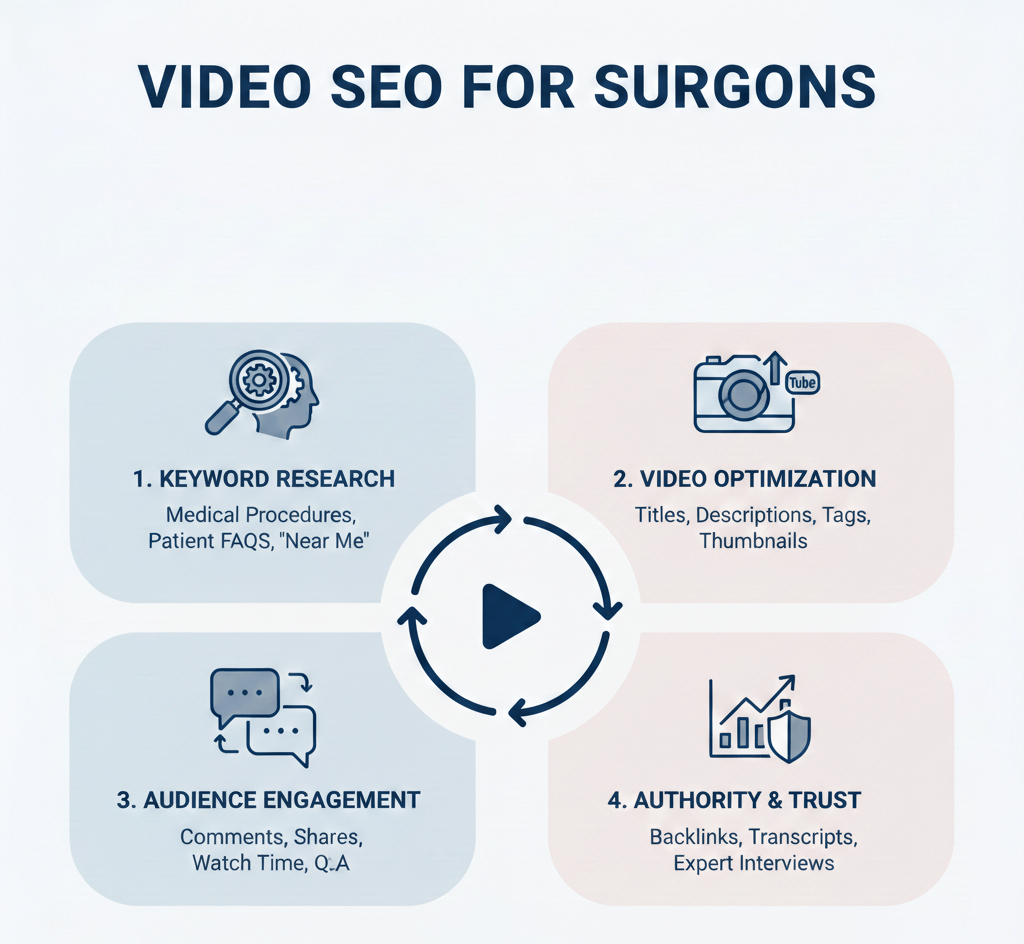
This guide explores how video SEO for surgeons can transform your practice. We will dive into why video works, what types of content you should create, and the technical steps to ensure your videos actually reach the people who need them.
Why Video is the Ultimate Tool for Modern Surgeons
Surgery is intimidating. For a patient, the prospect of going under the knife brings up a cocktail of fear, uncertainty, and vulnerability. Text-based articles can provide facts, but they rarely offer comfort.
Video bridges that gap. It allows a prospective patient to hear your voice, see your demeanor, and gauge your confidence. When a patient sees you explaining a complex spinal fusion or a rhinoplasty with clarity and empathy, the “stranger danger” evaporates. You are no longer just a name on a directory; you are a trusted expert.
The Power of Visual Learning in Healthcare
Medical jargon is a foreign language to most people. When you talk about “laparoscopic cholecystectomy,” the average person’s eyes glaze over. However, if you show a 3D animation of how small incisions allow for quicker healing, they understand immediately.
Building Authority Through Transparency
Video allows you to pull back the curtain. By showing your facility, introducing your surgical team, or explaining your safety protocols, you demonstrate transparency. In the medical field, transparency is the shortest path to trust.
Strategic Video Concepts for Your Practice
You don’t need to be a Hollywood director to create compelling content. You need to be a teacher. Here are the high-impact video categories that move the needle for surgical practices.
1. Animated Procedure Explanations
These are the workhorses of medical video marketing. Use high-quality animations to show precisely what happens during a surgery.
- The Goal: Demystify the “black box” of the operating room.
- Why it works: It reduces anxiety by replacing the unknown with clear, visual facts.
2. Surgeon-Led Q&A Sessions
Patients often have the same ten questions. “How long is the recovery?” “What are the risks?” “When can I drive again?”
- The Goal: Address common fears directly.
- Why it works: It positions you as an accessible authority who listens to patient concerns.
3. Patient Success Stories (Testimonials)
Nothing is more persuasive than seeing someone who was once in pain now living a whole, active life.
- The Goal: Provide social proof.
- Why it works: Prospective patients see themselves in the “before” and “after” of your successful cases.
Understanding Video SEO for Surgeons
Creating a great video is only half the battle. If your video sits on page 10 of a search result, it’s a wasted investment. Video SEO for surgeons is the process of optimizing your content so search engines like Google and YouTube understand what your video is about and who should see it.
The YouTube Factor
YouTube is the second largest search engine in the world. Google also owns ite. This means that well-optimized YouTube videos often appear at the very top of Google search results in the “Video” carousel. For a surgeon, this is prime digital real estate.
Technical SEO Elements for Video
To rank, you must focus on several key areas:
| SEO Element | Actionable Strategy |
| Video Title | Include your primary keyword and a benefit (e.g., “ACL Surgery Recovery: What to Expect”). |
| Description | Write 200+ words of unique content. Include links back to your website. |
| Tags | Use specific medical terms and broader category terms. |
| Transcripts | Upload a full text transcript. This helps search engines “read” your video. |
| Thumbnail | Use a high-contrast image with a clear human face or medical diagram. |
Step-by-Step Guide: Optimizing Your Surgical Videos
Let’s get into the weeds of optimizing YouTube videos for healthcare. Follow these steps for every video you produce.
Step 1: Keyword Research
Before you hit record, know what patients are typing into the search bar. Use tools like Google Keyword Planner or even the YouTube search suggestions.
- Bad Keyword: “Surgery” (Too broad)
- Good Keyword: “Recovery time for hip replacement surgery in [Your City]”
Step 2: The Hook and the Value
The first 15 seconds of your video are critical. Do not start with a 30-second logo animation. Start by stating precisely what the viewer will learn.
“In this video, I’m going to show you the three things you must do in the first week after your bariatric surgery to ensure the best results.”
Step 3: Crafting the Title
Your title needs to satisfy both the algorithm and the human reader. Use your keyword near the beginning.
- Example: “Knee Replacement FAQ: A Surgeon’s Guide to Post-Op Care”
Step 4: Writing the Description
Many doctors leave the description box empty. This is a mistake. Write a mini-blog post here. Include a “Table of Contents” with timestamps. This allows Google to show “Key Moments” in the search results, which increases your click-through rate.
Step 5: Leveraging Transcripts and Captions
Search engines cannot watch a video, but they can index text. By providing a transcript, you give Google thousands of words of context. Additionally, many people watch videos silently in public places. Captions ensure they still get your message.
Integrating Video into Your Website Strategy
While YouTube is great for discovery, your website is where conversions happen.
Create Dedicated Landing Pages
Don’t just have a “Video Gallery” page where you dump everything. If you have a video about gallbladder surgery, embed that video on your gallbladder service page.
Use Video Schema Markup
This is a bit of “under the hood” code. Video Schema tells Google, “Hey, there is a video on this page, it is this long, and it covers this topic.” This increases the likelihood that your website page will appear with a video thumbnail in search results.
Overcoming the “Camera Shyness” Hurdle
Many surgeons hesitate to create video content because they feel awkward on camera. Remember: you are not trying to be a TV star. You are a doctor talking to a patient.
- Talk to one person: Imagine your favorite patient is sitting across from you. Speak to them.
- Keep it simple: Avoid overly technical slides. Use a whiteboard if it helps you explain.
- Focus on the “Why”: Remind yourself that this video might help a patient make a life-changing health decision.
How to Market a Surgical Practice in 2026
The competition is only getting tougher. To stay ahead, your healthcare video strategy must be consistent. You cannot post one video and expect a flood of patients. Aim for one high-quality video per month.
Promoting Your Content
Once the video is live and optimized:
- Share it in your email newsletter.
- Post snippets on LinkedIn and Instagram.
- Use it in your “New Patient” welcome emails.
Patient Education Videos: The Secret to Efficiency
Beyond marketing, video saves you time. If you find yourself repeating the exact pre-operative instructions six times a day, record them once.
- Send the video to patients a week before surgery.
- They arrive better prepared.
- Your in-person consultations become more focused and productive.
This builds trust because the patient feels you have provided them with comprehensive resources they can review at their own pace.
The Role of Patient Success Stories
Building trust with surgical patients is easier when you have advocates. When filming testimonials, focus on the emotional journey.
- What was life like before the surgery? (e.g., “I couldn’t play with my grandkids.”)
- What was the experience with the surgeon like? (e.g., “Dr. Smith made me feel heard.”)
- What is life like now? (e.g., “I’m back on the golf course.”)
Note: Always ensure you have signed HIPAA-compliant media release forms before featuring any patient.
Advanced Video SEO: Ranking on Google
Google loves video. Often, a video will rank higher than a long-form article for the same keyword. To dominate the search results:
- Target “How-to” keywords: “How to prepare for back surgery.”
- Target “Review” keywords: “Pros and cons of robotic-assisted surgery.”
- Ensure fast load times: If you embed video on your site, use a fast player to avoid slowing down your page.
Why Professional Production Matters
While a smartphone is okay for a quick “Day in the Life” post, your procedure explanation videos should look professional. High-quality lighting and clear audio are non-negotiable. If a patient sees a grainy, muffled video, they might subconsciously associate that lack of quality with your surgical skills.
Investing in professional medical video marketing ensures that your digital presence matches your clinical excellence.
Partnering for Success
Navigating the world of ranking videos on Google and creating a cohesive healthcare video strategy is a full-time job. As a surgeon, your focus should be in the operating room, not tinkering with metadata and video editing software.
This is where InvigoMedia steps in. We specialize in advanced Medical SEO and Content Marketing. We don’t just “make videos.” We create strategic assets designed to establish your authority and drive high-quality consultations.
We understand the nuances of surgical marketing—from HIPAA compliance to the specific way patients search for specialists. We handle the technical heavy lifting of video SEO for surgeons, ensuring your expertise is the first thing patients see when they need help.
Conclusion
Video is the most powerful medium available to surgeons today. It humanizes you, educates your patients, and builds a level of trust that text simply cannot match. By combining great content with a rigorous SEO strategy, you ensure that your practice remains the top choice in an increasingly digital world.
Stop letting your expertise stay hidden. Start filming, start optimizing, and start connecting with the patients who are looking for you.
FAQs: Video SEO for Surgeons
How long should my surgical videos be?
It depends on the intent. For social media, keep it under 60 seconds. For procedure explanations or Q&As, 3 to 7 minutes is usually the “sweet spot” for keeping engagement high while providing enough detail.
Do I need to hire a professional film crew?
Not necessarily for every video. However, for your primary brand video and complex animations, professional help ensures a high-end result. For weekly Q&As, a modern smartphone and a good microphone are sufficient.
How do I measure the success of my video SEO?
Look at “Watch Time” and “Click-Through Rate” (CTR) on YouTube. On your website, track how many people visit your “Contact Us” page after watching a video.
Is YouTube or Vimeo better for surgeons?
YouTube is better for SEO and discovery. Vimeo is often preferred for embedding videos on a website because it offers a cleaner, ad-free player. Most successful practices use both.
How often should I post new videos?
Consistency beats quantity. It is better to post one high-quality, optimized video per month than to post four low-quality videos in one week and then disappear for six months.