

“Deciding on hiring an in-house medical marketer? Compare the costs, skill gaps, and ROI against an agency to see which model scales your practice.”
The waiting room is the heart of your practice. When it is full, everything feels right. But when those chairs sit empty for too long, the silence gets loud. You know you need to do something. You know you need marketing.
For most practice managers and clinic owners, the realization isn’t the problem. The problem is execution. You are already juggling patient care, staff schedules, billing, and compliance. You simply do not have the bandwidth to manage Google Ads campaigns or write SEO-friendly blog posts.
So, you find yourself at a crossroads.
Do you post a job listing for hiring an in-house medical marketer? Or do you look into outsourcing medical marketing to a specialized firm?
This is not just a financial decision. It is a strategic move that will shape your clinic’s future growth. Make the right choice, and you build a pipeline of loyal patients. Make the wrong one, and you burn through your budget with little to show for it.
This article will break down that decision. We will strip away the buzzwords and examine the raw facts, hidden costs, and operational realities of both options. By the end, you will have a clear framework to decide what is best for your practice.
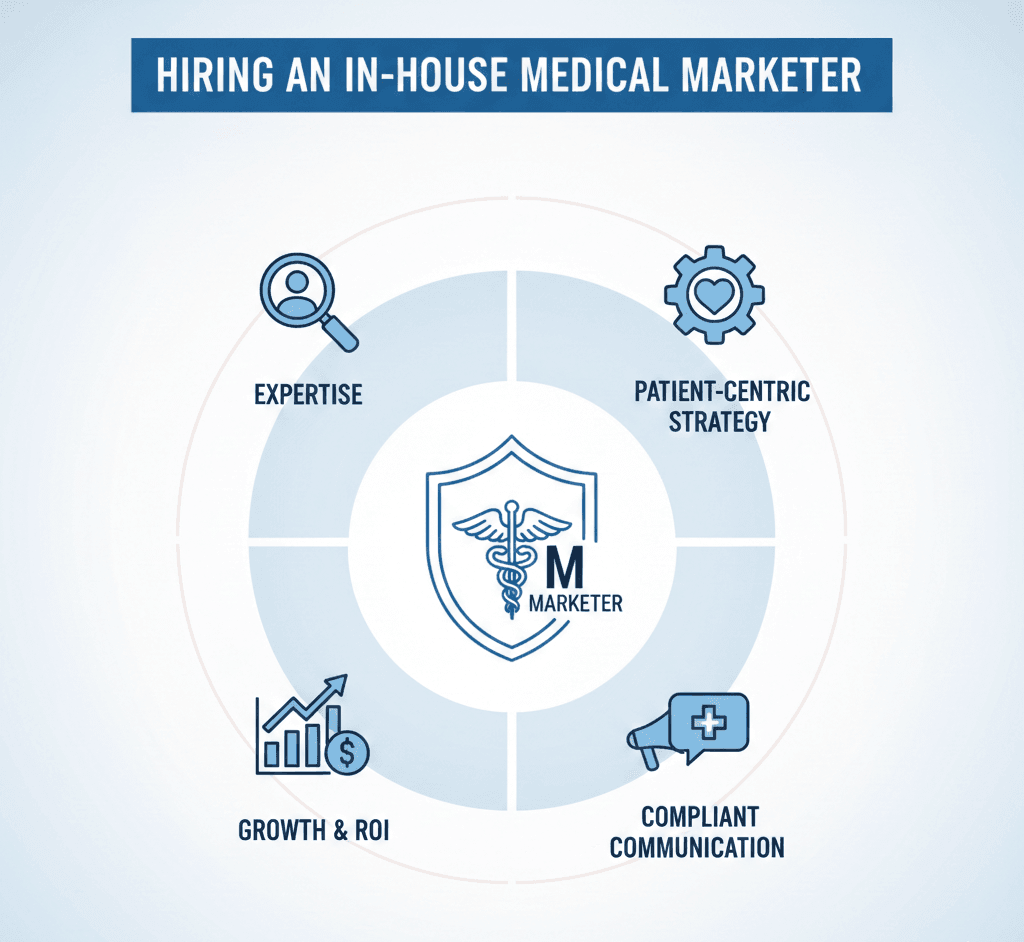
Part 1: The Modern Medical Marketing Landscape
Before we compare medical marketing agency vs in-house options, we have to define the job itself. Ten years ago, marketing a medical practice was simple. You bought an ad in the local paper, maybe sent out some mailers, and relied on word-of-mouth.
Today, the ecosystem is massive. To compete effectively, a medical practice needs to be active in at least five different digital arenas simultaneously.
Here is what a comprehensive strategy looks like today:
- Search Engine Optimization (SEO): You need your website to rank high when patients search for “doctors near me” or specific treatments. This requires technical coding skills and constant content writing.
- Pay-Per-Click Advertising (PPC): Managing Google Ads budgets to ensure you are paying for clicks that actually convert into appointments, not just window shoppers.
- Social Media Management: creating engaging content for Instagram, Facebook, and TikTok that educates patients without violating HIPAA regulations.
- Reputation Management: actively monitoring reviews on Google, Yelp, and Healthgrades, and generating new positive reviews from satisfied patients.
- Email and SMS Automation: Building patient retention systems that send automatic reminders, birthday wishes, and recall notices.
The “Unicorn” Problem
When you decide to hire a marketing manager for a clinic, you are often looking for one person who can do all of the above.
You want a writer, a graphic designer, a data analyst, a video editor, and a web developer. In the industry, we call this person a “Unicorn.” They are mythical. They rarely exist. And if they do, they command a salary that rivals your top physicians.
This is the context you must keep in mind as we evaluate your options.
Part 2: Option A — The In-House Marketer
Let’s look at the first path: bringing someone onto your payroll. There is a certain comfort in having a dedicated team member sitting in the office down the hall. But does the reality match the perception?
The Case for In-House (The Pros)
1. Deep Brand Immersion: An in-house employee lives and breathes your practice. They see the patients daily. They know the doctors’ personalities. They understand the specific culture of your waiting room. This level of immersion is hard to replicate. They can instantly snap a photo of a happy patient (with consent). They can film a quick behind-the-scenes video with the staff during a lunch break.
2. Immediate Access and Control. If you need a change made to the website right now, you can walk into their office and ask for it. You don’t have to submit a support ticket or wait for a weekly meeting. You have total control over their hours and their priorities.
3. singular Focus An in-house marketer has one client: you. They are not juggling five other accounts. Their mental energy is 100% dedicated to your practice’s success.
The Reality of In-House (The Cons)
1. The Skill Gap As mentioned earlier, medical marketing requires a diverse skill set. If you hire a great writer, they likely won’t know how to code a website. If you hire a technical SEO wizard, they might be terrible at graphic design. Consequently, you will end up with an employee who is excellent at one thing and mediocre at everything else. You will still likely need to hire freelancers to fill the gaps, which defeats the purpose of an “all-in-one” hire.
2. The Cost of Overhead The salary is just the beginning. When you hire a full-time employee, you also take on:
- Payroll taxes
- Health insurance and benefits
- Paid time off and sick leave
- Equipment costs (high-end laptop, camera gear)
- Software licenses (Adobe Creative Cloud, SEMRush, CRM tools)
When you add it all up, a marketer with a base salary of $60,000 actually costs the practice closer to $90,000 or $100,000 annually.
3. Isolation and Stagnation Marketing changes fast. Google updates its algorithm thousands of times a year. An in-house marketer working alone operates in a silo. They don’t have a team of peers to bounce ideas off of. They might not hear about the latest trends until it’s too late. Without constant training (which you have to pay for), their skills can become outdated.
4. The Risk of Turnover If your rockstar marketer quits, your marketing stops. Period. You are left with passwords you might not know, campaigns that no one knows how to run, and a frantic search for a replacement. The hiring process takes months, during which your practice growth stalls.
Part 3: Option B — The Agency Partner
Now, let’s look at outsourcing medical marketing. This involves hiring a third-party company that manages marketing for multiple medical practices.
The Case for an Agency (The Pros)
1. Access to a “Brain Trust” When you hire an agency, you aren’t hiring a person; you are hiring a department. You get a dedicated account manager, but behind them is a team of specialists. You have a professional copywriter writing your blogs. You have a Google Ads-certified expert managing your PPC. You have a graphic designer creating your visuals. You get access to senior-level strategy that a mid-level in-house manager simply cannot provide.
2. Cost Effectiveness This might sound counterintuitive. Isn’t an agency expensive? If you compare the monthly retainer of an agency to the gross cost of an employee (salary + benefits + software), the agency is almost always cheaper. Plus, the agency pays for its own expensive software tools. You get the benefit of enterprise-level data tools without the $500/month subscription fee.
3. Continuity and Reliability Agencies don’t take sick days. If your account manager goes on vacation, someone else covers your account. Your marketing machine keeps running 365 days a year. You don’t have to worry about payroll taxes or HR disputes.
4. Scalability If you open a second location, an agency can instantly scale up its efforts. An in-house person might drown under the doubled workload.
The Reality of an Agency (The Cons)
1. Less Daily Immersion: An agency is not in your office. They don’t see what happens at the front desk every day. This creates a disconnect. They rely on you to tell them what is happening on the ground. If you don’t communicate well, they might market a service you are trying to scale back on.
2. Response Time While good agencies are responsive, they are not sitting down the hall. If you have an emergency edit, it might take a few hours or a day to get done, rather than 5 minutes.
3. Variable Quality Not all agencies are created equal. Some are “churn and burn” shops that use the same templates for every doctor. Choosing the wrong partner can lead to generic marketing that doesn’t capture your unique voice.
Part 4: The Financial Showdown
Let’s put some numbers to this. We will compare the cost of a marketing agency for doctors versus an in-house marketing team.
Note: These figures are averages based on current market rates.
Scenario A: The In-House Hire
You decide to hire a mid-level Marketing Manager with 3-5 years of experience.
- Base Salary: $65,000
- Benefits & Taxes (approx. 20%): $13,000
- Software Stack (SEMRush, Adobe, CRM, etc.): $6,000 / year
- Hardware (Computer, Phone, Camera): $2,000 (amortized)
- Recruitment & Training: $3,000
Total First-Year Cost: $89,000+
What you get: One person with general skills. 40 hours of work per week (minus lunch, breaks, and meetings).
Scenario B: The Marketing Agency
You decide on hiring a healthcare marketing agency for a comprehensive package.
- Monthly Retainer: $3,500 – $5,000 (varies by scope)
- Software Costs: $0 (Included)
- Benefits/Taxes: $0
- Recruitment: $0
Total First-Year Cost: $42,000 – $60,000
What you get: A team of 5-7 specialists. Strategy, execution, reporting, and design.
The Verdict: Financially, the agency wins by a significant margin. You save roughly $30,000 to $40,000 a year, which you can reinvest directly into ad spend to acquire new patients.
Part 5: The “In-Between” Trap
Some practices try to cheat the system. They assign marketing duties to the receptionist or the office manager. “Judy is good at Facebook, let her do it.”
This is rarely a good idea. Judy is already busy answering phones and checking in patients. When the clinic gets busy, marketing is the first thing to be cut. Inconsistent marketing destroys algorithms. If you stop posting or updating ads, Google penalizes you. Furthermore, Judy is not trained in HIPAA compliance regarding social media. One wrong photo posted to Facebook could result in a massive fine.
In-house marketing team pros and cons become irrelevant if the person doing the job isn’t actually a marketer. Professionalize your approach if you want professional results.
Part 6: Why Invigo Media is the Superior Solution
You have reviewed the data. You see the gaps in the in-house model, but you are wary of the distant, impersonal nature of some agencies.
This is where InvigoMedia changes the narrative.
We operate differently. We are not just a vendor; we function as your dedicated, fractional growth department. We bridge the gap between the immersion of an in-house hire and the power of a large agency.
1. Specialized Medical Expertise
We don’t sell shoes. We don’t market restaurants. We focus exclusively on healthcare. We understand the patient journey, from the moment they feel a symptom to the moment they book an appointment. We know the difference between marketing a med spa and an orthopedic surgeon. This specific knowledge means we hit the ground running—no learning curve.
2. The “Department” Model
When you partner with Invigo, you aren’t getting a generic account rep. You are unlocking a vault of specialized talent.
- Need a landing page that converts? Our web team builds it.
- Need a video for Instagram? Our creative team edits it.
- Need to fill a sudden gap in the schedule? Our paid ads team adjusts the budget instantly.
You get the agility of a large team for a fraction of the cost of a single employee.
3. Data-Driven Transparency
We don’t deal in “likes” and “impressions.” We deal in appointments and revenue. We provide clear, transparent reporting that shows you exactly where your money is going and what it is bringing back. You will never have to guess if your marketing is working.
4. HIPAA & Compliance First
We understand the regulatory environment. We ensure your marketing is aggressive in getting results but conservative in protecting patient privacy. You sleep easier knowing your reputation is safe.
Choosing Invigo Media means choosing a medical marketing partner that cares about your practice’s bottom line as much as you do.
Part 7: Decision Framework (Checklist)
Still unsure? Use this checklist to decide.
You should hire Ian n-House if:
- [ ] Your practice is massive (multiple locations, 10+ providers) and can afford a marketing team, not just one person.
- [ ] You require daily, hour-by-hour content creation (e.g., a “vlog” style social presence).
- [ ] You have the time and expertise to manage and direct a marketing employee.
- [ ] You have a budget exceeding $150k/year for salary and tools alone.
You should hire an Agency (Invigo Media) if:
- [ ] You want access to top-tier talent without the six-figure payroll.
- [ ] You want a strategy that starts working immediately, with no training period.
- [ ] You need a diverse mix of SEO, Paid Ads, and Content, not just one.
- [ ] You want your marketing to run on autopilot so you can focus on patients.
- [ ] You want a partner who knows the medical industry inside and out.
Part 8: The Skill Breakdown – Why One Person Can’t Do It All
Let’s dig deeper into the specific roles required for modern healthcare marketing solutions. This will highlight why the “Unicorn” employee is a myth.
The Strategist
This is the big-picture thinker. They look at the competition and analyze the demographics to decide where to spend the money.
- In-House: The practice manager is usually already overworked.
- Agency: A dedicated Account Director with years of industry experience.
The Copywriter
Medical writing is hard. It must be empathetic, accurate, and compliant. It needs to convince a patient to trust you with their health.
- In-House: The marketer might be a good writer, or they might be typo-prone. It’s a gamble.
- Agency: Professional writers who understand medical terminology and persuasion psychology.
The Technical SEO
This is the person who talks to Google’s robots. They deal with site speed, schema markup, and backlinks.
- In-House: Scarce skill for a general marketer. Usually requires outsourcing.
- Agency: Dedicated tech teams that monitor site health daily.
The Paid Media Manager
Google Ads is a stock market. Bids change every second. An inexperienced person can accidentally spend $5,000 in a week with zero results.
- In-House: Often learns on the job using your money.
- Agency: Certified experts who manage millions in ad spend and know the tricks to lower costs.
When you look at this breakdown, the value proposition of choosing a medical marketing partner becomes undeniable. You simply cannot hire five people for the price of one. But with an agency, you do.
Part 9: Common Pitfalls in Hiring
If you do decide to go the in-house route, be aware of the common traps practices fall into.
1. Hiring for Design, not Strategy. Many doctors hire a marketer because they like their graphic design portfolio. “The brochures look great!” But a pretty brochure doesn’t rank on Google. You need a revenue generator, not an artist.
2. The “Relative” Trap Hiring a nephew or cousin because they “know computers.” This is a business, not a charity. Marketing requires professional discipline.
3. Failing to Define KPIs. You hire a marketer, but you don’t tell them what success looks like. Is it more website traffic? More calls? More surgeries booked? Without clear Key Performance Indicators (KPIs), the employee drifts.
4. Under-budgeting for Ad Spend You pay a salary of $70,00,0, but only give them a $500/month ad budget. This is like buying a Ferrari and putting $5 of gas in it. The marketer cannot succeed without a budget.
Conclusion: The Smart Path Forward
The decision to invest in marketing is the decision to invest in the longevity of your practice. The “build it, and they will come” model no longer works in healthcare. You must go out and find your patients.
While hiring an in-house medical marketer offers the allure of control and proximity, the operational drag and limited skill set often lead to frustration. The financial burden is heavy, and the risk of turnover is high.
Outsourcing medical marketing to a partner like Invigo Media offers a more innovative, more agile alternative. You gain the collective power of a diverse team of experts. You get enterprise-level tools. You get a strategy that is resilient, compliant, and focused on one thing: growth.
Don’t let your practice stagnate because you are trying to do it all yourself, or because you are relying on a single employee to carry the weight of the world.
Take the step that guarantees expertise.
FAQs: Your Questions Answered
Q: How much does a medical marketing agency cost compared to an employee?
A: Generally, a full-service agency retainer ranges from $3,000 to $6,000 per month, depending on the aggressiveness of the campaign. An experienced in-house manager costs roughly $7,500+ per month when you factor in salary, taxes, benefits, and overhead. The agency is almost always the more cost-effective option for small to mid-sized practices.
Q: Will an agency understand my specific medical niche?
A: A generalist agency might not. That is why you must choose a specialized healthcare agency like Invigo Media. We understand the nuances between plastic surgery, dentistry, functional medicine, and general practice.
Q: How do I measure if my marketing is working?
A: Do not look at “likes.” Look at leads. A good agency will set up call tracking and form tracking. You should know precisely how many new patient inquiries came from Google, Facebook, or your blog.
Q: Can I have both an in-house person and an agency?
A: Yes! This is often the “Goldilocks” scenario for larger practices. The in-house person acts as the liaison (the “Patient Coordinator”) and handles internal content capture, while the agency handles the heavy lifting of technical SEO, ads, and strategy.
Q: How long does it take to see results?
A: PPC (Ads) can generate leads in 24 hours. SEO (organic search) is a long-term investment that typically takes 3-6 months to show significant traction. A balanced strategy uses both.
Q: What if I am in a very competitive city?
A: Then you definitely need an agency. In competitive markets, your competitors are likely using sophisticated agencies. A single in-house person will struggle to outmaneuver a team of experts fighting for the exact keywords.