

“Learn compassionate online marketing for palliative care. This guide covers empathetic messaging, SEO, and web design to build family trust.”
Families face an incredibly heavy burden when a loved one nears the end of life. They experience stress, sadness, and often, overwhelming confusion. Consequently, they turn to the internet for answers, support, and guidance. This reality makes online marketing for palliative care profoundly different from any other type of business promotion. You cannot use aggressive sales tactics. You cannot push for a quick conversion. Instead, you must offer a steady hand, a listening ear, and clear information.
Marketing end-of-life care requires deep empathy. You must prioritize the emotional needs of patients and their families. Furthermore, you need to establish trust immediately. Families need to know that your staff will treat their loved ones with dignity. Therefore, your digital presence must reflect that commitment perfectly.
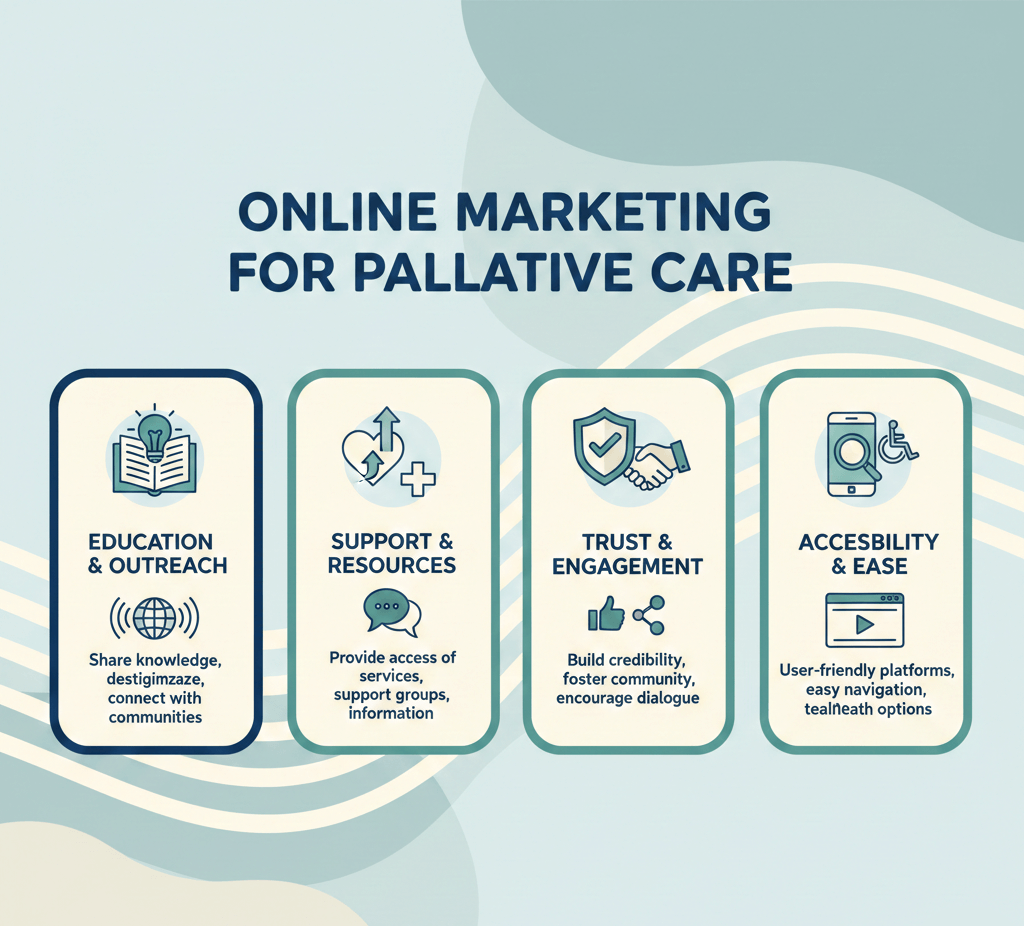
This comprehensive guide explains how to approach compassionate healthcare marketing. We will explore how to craft supportive messaging. We will discuss the vital importance of a user-friendly website. Additionally, we will examine how reputation management builds the necessary trust. Finally, we will show how InvigoMedia helps facilities like yours reach families in their most vulnerable moments.
The Psychology of Empathy in Marketing
Understanding your audience is the first rule of any marketing strategy. However, in hospice marketing strategies, this understanding takes on a critical new dimension. Your audience is experiencing anticipatory grief. They are tired. Often, they feel completely lost.
Recognizing Cognitive Overload
Families searching for palliative care usually suffer from cognitive overload. High stress limits a person’s ability to process new information. They cannot read long, dense paragraphs of medical jargon. They cannot navigate complicated website menus. Therefore, your marketing must reduce this mental burden. You must present information simply and clearly.
Empathy as a Strategy
Empathy means putting yourself in the family’s shoes. What do they need right now? They need reassurance. They need clear answers about pain management. They need to know someone will help them handle the complex paperwork. When you build your palliative care branding around these specific needs, you stop acting like a business. Instead, you become a valuable resource.
Active Listening Through Content
How do you show you listen before a family even calls you? You do this by answering their unspoken questions in your marketing materials. Anticipate their fears. For instance, many families fear that choosing hospice means “giving up.” Address this directly. Explain that palliative care focuses on maximizing comfort and quality of life. Provide educational articles that gently explain the transition process. This approach proves that you understand their specific journey.
Transitioning from “Selling” to Supporting
Traditional marketing focuses on selling a product or service. You highlight features, compare yourself to competitors, and push for a sale. Ethical medical marketing in the end-of-life sector rejects this approach outright. You are not selling a bed in a facility. You are providing peace of mind.
Changing Your Vocabulary
The words you choose matter immensely. You must remove all high-pressure language from your materials.
- Instead of: “Call us today to book a room.”
- Use: “Reach out to our team to discuss your family’s needs.”
- Instead of: “We are the leading provider in the state.”
- Use: “We are here to support your family through this difficult transition.”
- Instead of: “Sign up for our services.”
- Use: “Let us help you navigate the next steps.”
The Power of Healthcare Storytelling
People connect with stories, not statistics. Healthcare storytelling allows you to demonstrate your compassion without boasting. Share stories of how your team helped a family find peace. Describe a time when a nurse went out of their way to fulfill a patient’s simple wish. Of course, you must always maintain strict patient privacy and adhere to HIPAA guidelines. You can change names and identifying details. The goal is to convey the feeling of your care. Stories show families what they can expect when they choose your team.
Focus on Education
Education is the ultimate form of support. Create a comprehensive resource center on your website. Offer downloadable guides on topics like “How to Talk to Your Parents About Hospice Care” or “Understanding the Signs That It Is Time for Palliative Support.” When you give away valuable information for free, you build immense goodwill. Families will remember the organization that helped them understand their situation. Consequently, they will feel more comfortable choosing you when the time comes.
Essential Hospice Marketing Strategies
You need a clear plan to reach families effectively. A scattered approach wastes money and fails to connect with those who need you. Here are the core strategies you must implement.
1. Build a Compassionate Brand Identity
Palliative care branding goes far beyond a logo. It encompasses the colors, fonts, images, and tone of voice you use across the board.
- Colors: Choose calming colors. Soft blues, gentle greens, and warm earth tones work best. Avoid harsh reds or bright yellows, as these create a sense of urgency and alarm.
- Typography: Use clean, readable fonts. Remember that older adults often read your materials. Therefore, avoid overly stylized or small text.
- Imagery: Do not use sterile hospital photos. Also, avoid using stock photos with unnaturally happy, glossy models. Instead, use warm, authentic images. Show a nurse holding a patient’s hand. Show a family sitting quietly together. Authenticity builds trust.
2. Prioritize Community Outreach
Local relationships matter deeply in this field. Doctors, hospital social workers, and nursing home directors often provide the first referral to a hospice. Therefore, you must build strong relationships with these professionals. Send educational materials to their offices. Offer to host free seminars on pain management or grief counseling for their staff. When local professionals trust you, they will recommend you to the families they serve.
3. Embrace Senior Care Digital Marketing
Many adult children search for care options for their aging parents. Therefore, your senior care digital marketing efforts must target this demographic. These individuals usually fall between the ages of 45 and 65. They use search engines, read online reviews, and participate in local Facebook groups. Your digital strategy must position your organization directly in their path.
The Foundation: Palliative Care Website Design
Your website is your digital front door. For many families, it provides the first impression of your organization. If the site is confusing, slow, or cold, they will leave immediately. Effective palliative care website design requires a deep understanding of user experience (UX).
The Importance of Accessibility
Families searching for care come from all walks of life. Some may have visual impairments. Others may use older devices or slow internet connections. Therefore, your site must be fully accessible.
- Use high contrast between text and backgrounds.
- Provide alternative text for all images.
- Ensure users can navigate the site only with a keyboard.
- Make sure the text remains readable even when zoomed in.
Simplified Navigation
Do not make visitors guess where to find information. A stressed person will not click through five menus to find your phone number. Keep your main navigation incredibly simple. Use clear labels like “Our Services,” “Resources for Families,” “About Our Team,” and “Contact Us.”
Fast Loading Speeds
Patience is low when stress is high. If your website takes more than three seconds to load, families will hit the back button. Compress your images. Minimize heavy scripts. Invest in reliable hosting. A fast website shows that you value the visitor’s time.
Mobile Responsiveness
Most people will search for your services on their smartphones. They might be sitting in a hospital waiting room while they search. Therefore, your website must look and function perfectly on mobile devices. Buttons must be large enough to tap easily. Text must be legible without zooming. Furthermore, include a prominent “Click to Call” button. This allows families to reach you instantly with one tap.
The Role of Compassionate UX Design
User Experience (UX) design focuses on how a person feels while using your site. Compassionate UX anticipates user needs. For example, include an “Exit Quickly” button if someone is researching sensitive information in a public place. Provide a clear, step-by-step outline of the admissions process. This removes the fear of the unknown. Good UX makes the user feel guided and supported.
Being Found When It Matters: Hospice SEO Services
Having a beautiful, compassionate website means nothing if no one can find it. Families do not usually know the names of local hospice providers. Instead, they type phrases into Google. This is where hospice SEO services become absolutely critical. Search Engine Optimization ensures your organization appears at the top of the search results.
The Power of Local SEO
Hospice and palliative care are inherently local services. Families want a provider near their home or near their loved one’s current location. Therefore, local SEO is your most important tool.
- Google Business Profile: Claim and fully optimize your Listing. Ensure your name, address, and phone number are perfectly accurate. Add comforting photos of your facility and staff.
- Local Keywords: Target specific location-based phrases. Instead of just targeting “palliative care,” target “palliative care in [Your City]” or “hospice providers near [Your County].”
- Local Directories: Ensure your organization is listed in local healthcare directories, Chamber of Commerce websites, and senior care portals.
Intent-Based Keyword Research
You must understand why someone is searching. This is called search intent. Someone typing “what is palliative care” is looking for education. Someone typing “inpatient hospice facilities near me” is ready to make a decision. Your content must match this intent. Create informative blog posts for the educational searches. Create clear, detailed service pages for the decision-based searches.
On-Page Optimization
Every page on your website needs proper optimization. Use clear headings (H1, H2, H3) to break up the text. This helps both Google and the reader understand the page structure. Include your target keywords naturally in the text. However, never sacrifice the emotional tone of your writing just to fit a keyword. Remember, you are writing for grieving families first, and search engines second.
Technical SEO
Technical SEO refers to the backend structure of your website. Google favors sites that are secure, fast, and easy to crawl. Ensure your site uses HTTPS encryption. This is especially important in healthcare to protect user privacy. Create an XML sitemap and submit it to Google Search Console. Fix any broken links immediately. A technically sound website provides a smooth user experience.
Building Trust with Ethical Medical Marketing
Trust is the most valuable currency in the healthcare industry. Families are trusting you with the final days of their loved one’s life. You cannot buy this trust. You must earn it. Ethical medical marketing ensures that every message you send is honest, transparent, and respectful.
Complete Transparency
Never hide information from families. Be completely transparent about your services, your service areas, and your admission criteria. Explain what palliative care covers and what it does not cover. Transparency prevents devastating misunderstandings later. If a family feels misled, they will lose all trust in your care.
Avoiding False Promises
End-of-life care is unpredictable. You cannot guarantee specific outcomes. Therefore, your marketing must never make false promises. Do not promise that a patient will be completely pain-free, as this is sometimes medically impossible. Instead, promise that your team will work tirelessly to manage their pain and maximize their comfort. Promise dedication, not miracles.
Adhering strictly to HIPAA
Patient privacy is a legal and moral obligation. You must adhere to the Health Insurance Portability and Accountability Act (HIPAA) in all your marketing efforts. Never share a patient’s name, photo, or medical details without explicit, written consent. Even when responding to online reviews, you must never confirm that a specific individual is or was a patient. Ethical marketing always protects the vulnerable.
Reputation Management for Hospice
Today, word-of-mouth happens online. When families consider a hospice provider, they immediately look for reviews. They want to read about other families’ experiences. Therefore, reputation management for hospice is not optional. It is a fundamental pillar of your marketing strategy.
The Weight of Online Reviews
A few negative reviews can severely damage a hospice’s reputation. Conversely, a collection of heartfelt, positive reviews provides immense comfort to seeking families. People trust online reviews almost as much as personal recommendations. You must actively manage what people are saying about your organization on Google, Facebook, and healthcare-specific review sites.
Showcasing Compassionate Testimonials
Positive testimonials are compelling. They offer social proof of your team’s compassion. How do you gather these testimonials ethically?
- Wait for the right time: Never ask for a review immediately after a patient passes away. Give the family time to grieve.
- Use the bereavement process: Many hospices follow up with families for a year after a loss, offering bereavement support. During a later check-in, you may ask if they are willing to share their experience to help other families.
- Make it easy: Provide a direct link to your Google Business Profile.
- Highlight them beautifully: Once you receive a lovely review, showcase it on your website. Create a dedicated “Family Stories” page.
Responding to Negative Feedback
Negative reviews will happen. Sometimes, emotions run high, and families misdirect their grief and frustration at the care team. How you handle these reviews defines your reputation.
- Respond promptly: Never ignore a negative review.
- Show empathy: Start by validating their feelings. Say, “We understand this is a tough time for your family.”
- Do not argue: Never get defensive online. Do not try to prove the reviewer wrong.
- Take it offline: Provide a phone number and the name of a specific director. Say, “We take your concerns seriously. Please call our clinical director at [Phone Number] so we can discuss this further.”
- Maintain HIPAA compliance: Never confirm the patient’s identity or discuss specific medical details in your response.
Proactive Monitoring
You must know what people are saying about you. Set up Google Alerts for your organization’s name. Check your social media mentions daily. Monitor healthcare rating sites. Proactive monitoring allows you to address minor issues before they become major public relations problems.
Compassionate Healthcare Marketing on Social Media
Many healthcare providers avoid social media. They worry about privacy issues or negative comments. However, social media offers a powerful way to connect with your community. It humanizes your brand. You just need to use it carefully and intentionally.
Choosing the Right Platforms
You do not need to be on every platform. For marketing end-of-life care, focus on platforms where adult children and community professionals spend their time.
- Facebook: This is the most critical platform. Adult children use it frequently. It allows for longer, educational posts and community building.
- LinkedIn: Connect with referring physicians, social workers, and other healthcare professionals. Share industry news and company updates here.
Content That Connects
What should a hospice post on social media? Your content should educate, comfort, and humanize.
- Staff Spotlights: Introduce your nurses, chaplains, and social workers. Share why they chose to work in palliative care. This shows the human faces behind your organization.
- Educational Tips: Share brief tips on caregiver burnout. Provide advice on making a home safer for a declining parent.
- Inspirational Quotes: Share gentle, comforting quotes about life, love, and memory.
- Community Involvement: Post photos of your team participating in local charity walks or hosting community seminars. (Again, ensure no patients are in the images without consent).
Community Management
Social media is a two-way street. You must engage with your followers. When someone comments on a post, reply to them. If someone sends a direct message asking for help, respond quickly and provide the correct contact information. Treat your social media pages as an extension of your customer service team.
Integrating Video into Your Strategy
Video marketing is highly engaging. It allows families to see and hear your team, which builds trust faster than text alone. However, the tone of your videos must remain respectful and sensitive.
Facility Tours
Walking into a hospice facility for the first time can be intimidating. You can reduce this fear by offering a virtual tour video on your website. Show the peaceful patient rooms. Highlight the quiet family gathering areas. Show the beautiful outdoor gardens. A well-produced video tour provides immense comfort to families making difficult decisions from afar.
Educational Video Series
Create short, informative videos answering common questions. Have your medical director explain the difference between palliative care and hospice. Have your lead social worker explain how Medicare covers end-of-life services. These videos position your team as helpful experts.
Family Interviews
With careful planning and full consent, video testimonials are incredibly impactful. A brief interview with a family member who feels supported by your team offers powerful reassurance to others. Ensure the lighting is soft and the setting is comfortable. Let them speak from the heart without a rigid script.
Tracking and Adapting Your Strategy
Marketing is not a one-time project. You must continuously monitor your efforts to see what works. This ensures you spend your budget wisely and reach the families who need you most.
Key Performance Indicators (KPIs)
Determine what metrics matter to your organization. In compassionate healthcare marketing, you should track:
- Website Traffic: Are more people visiting your site?
- Time on Page: Are they actually reading your educational materials?
- Bounce Rate: Are they leaving immediately? (A high bounce rate indicates a poor user experience or slow load times.)
- Form Submissions: Are families using your contact forms to request more information?
- Phone Calls: Track the number of calls generated directly from your website or Google Business Profile.
Continuous Improvement
Review your data regularly. If a specific blog post gets a lot of traffic, write more content on similar topics. If your local SEO ranking drops, audit your website to find the problem. Adapt your strategy based on actual data, not guesses. This keeps your marketing effective over the long term.
InvigoMedia: Your Partner in Compassionate Marketing
Marketing palliative and end-of-life care requires a delicate balance. You must be visible, yet unobtrusive. You must be informative, yet incredibly sensitive. Many standard marketing agencies fail to grasp this vital nuance. They apply aggressive tactics that ultimately alienate grieving families.
This is where InvigoMedia steps in. We are a trusted authority in medical marketing. We understand the profound difference between selling a service and offering vital support. Our team specializes in helping compassionate care providers reach families during their most difficult moments.
Expertise in Palliative Care Website Design
We build digital front doors that welcome families with warmth and clarity. Our web design team focuses heavily on user experience (UX). We create accessible, fast-loading, and mobile-friendly websites. We ensure that a stressed family member can find your contact information or educational resources in seconds. We use calming color palettes and clean typography to reduce cognitive load and provide a sense of peace.
Mastering Hospice SEO Services
We ensure that when a family in your area searches for help, your organization appears first. Our senior care digital marketing team conducts deep, intent-based keyword research. We optimize your local presence so that referring doctors and desperate families can find you easily. We handle the complex technical SEO so you can focus entirely on patient care.
Protecting Your Reputation
We understand that your reputation is your most valuable asset. InvigoMedia offers comprehensive reputation management for hospice. We help you implement ethical systems to gather positive testimonials from grateful families. Furthermore, we monitor the web for your brand mentions and guide you on how to respond to feedback with grace, empathy, and strict HIPAA compliance.
When you partner with InvigoMedia, you gain a team that respects the gravity of your work. We craft messaging that supports, educates, and comforts. Let us handle your digital presence so you can continue providing exceptional, compassionate care to those who need it most.
Frequently Asked Questions (FAQs)
1. How is marketing for palliative care different from general medical marketing?
Marketing for palliative care requires a significantly higher level of empathy and sensitivity. General medical marketing often focuses on cures, cutting-edge technology, and aggressive patient acquisition. Palliative care marketing must focus on comfort, quality of life, emotional support, and guiding families through grief. The tone must transition entirely from “selling” to supporting and educating.
2. Why is reputation management so crucial for hospice providers?
End-of-life care relies heavily on trust. Families are making a critical, emotional decision for their loved ones. They rely on others’ experiences to gauge a facility’s quality and compassion. A substantial collection of positive reviews provides essential peace of mind. Conversely, unmanaged negative reviews can destroy trust instantly. Active reputation management showcases your compassion and helps you address concerns professionally.
3. What makes a good palliative care website design?
A good palliative care website prioritizes the user experience of highly stressed individuals. It must feature simple, intuitive navigation, fast load times, and complete mobile responsiveness. The design should utilize calming colors and highly readable fonts. Crucially, it must make contact information instantly accessible, allowing a family member to call you with a single click.
4. Can we use social media to market end-of-life care?
Yes, you can and should use social media, but you must do so strategically. Platforms like Facebook are excellent for connecting with adult children who are researching care for their parents. Use social media to share educational content, introduce your compassionate staff, and highlight your community involvement. However, you must always maintain strict patient privacy and adhere to HIPAA regulations.
5. What are hospice SEO services, and why do I need them?
Hospice SEO (Search Engine Optimization) services involve optimizing your website and online presence to rank highly on Google when people search for relevant terms. Families typically search for terms like “hospice near me” or “palliative care in [City].” If your organization does not appear on the first page of results, those families will find your competitors instead. SEO ensures you are visible exactly when a family needs your help.
6. How do we ethically ask for reviews from families?
You must approach this delicately. Never ask immediately after a loss. Instead, integrate the request into your long-term bereavement support program. Months later, during a routine check-in, you might mention that sharing their story could help other families facing similar difficult decisions. Always provide a simple link and ensure they feel zero pressure to comply.
7. How can InvigoMedia help our hospice organization?
InvigoMedia specializes in sensitive healthcare marketing. We understand the unique challenges of your field. We can design a calming, user-friendly website, implement robust local SEO strategies to help families find you, and manage your online reputation. We focus on ethical, compassionate marketing strategies that build trust and position your organization as a pillar of support in your community.