
“Target patients exactly where they are. Use geofencing for medical clinics to capture high-intent leads and outpace local competitors.”
Imagine a potential patient walks out of a competitor’s clinic just three blocks away. They were unhappy with the long wait time. Or perhaps they are browsing their phone while sitting in a local pharmacy waiting for a prescription. Right at that moment, an ad pops up on their favorite weather app. It shows your clinic, located just five minutes away, with a “Wait time: 5 minutes” badge.
This isn’t magic. It is location-based advertising at its finest. Specifically, it is geofencing.
In the competitive world of healthcare, generic ads don’t cut it anymore. Patients want convenience. They want local solutions. If you run a medical practice, you need to be where your patients are. Not just in the city, but in the specific neighborhood—and sometimes, on the specific street corner.
This guide will show you how to master geofencing for medical clinics. We will cover the tech, the strategy, and the legal guardrails you need to follow in 2026.
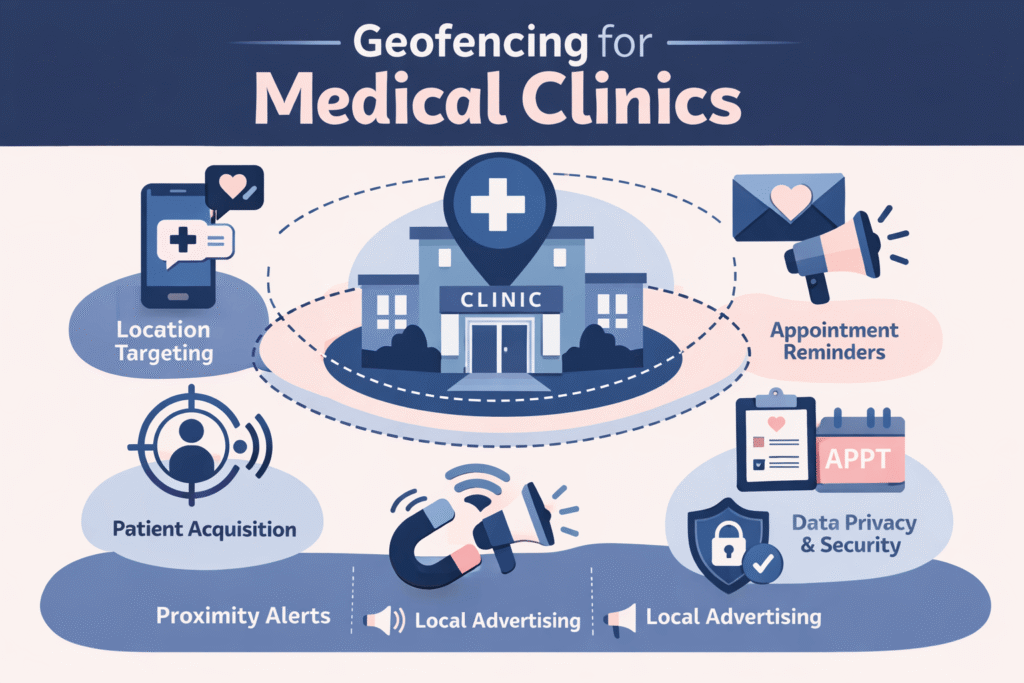
What Exactly is Geofencing?
At its core, geofencing uses GPS, RFID, Wi-Fi, or cellular data to create a virtual boundary. Think of it as an invisible fence around a real-world location. When a mobile device enters or leaves this “fence,” it triggers a specific action.
In the context of hyper-local healthcare marketing, that action is usually an advertisement.
When a smartphone user enters your geofenced area, their device ID is captured. Your advertising platform then serves them highly relevant ads across various mobile apps and websites. These ads follow the user for a set period, reminding them that your clinic is the most convenient choice for their needs.
How It Works Under the Hood
- Define the Zone: You draw a digital perimeter (a polygon or a circle) on a map.
- The Trigger: A user enters the zone with location services enabled.
- The Data Exchange: The system recognizes the device.
- The Ad Delivery: The user sees your banner or video ad on their mobile browser or inside an app.
This is different from standard “zip code” targeting. Zip codes are too broad. A single zip code can cover miles of territory. Geofencing is surgical. You can target a single building, a parking lot, or a specific city block.
Geofencing vs. Geotargeting: Clear Up the Confusion
Many people use these terms interchangeably. However, they are quite different. Understanding the distinction is vital for your budget.
Geotargeting delivers ads to users based on their general location plus other criteria. For example, you might target “women aged 30-45 within 10 miles of the clinic who are interested in wellness.” It relies on IP addresses and user profiles. It is great for building brand awareness over time.
Geofencing is much more focused. It is event-based and trigger-based. It cares less about the user’s long-term profile and more about where they are right now.
- Geotargeting: Good for “Who they are.”
- Geofencing: Good for “Where they are.”
In 2026, the most successful medical practice geotargeting strategies combine both. You use geotargeting to keep your brand top-of-mind and geofencing to capture immediate, high-intent demand.
Why Medical Clinics Need Hyper-Local Marketing
Healthcare is a local business. Most patients will not drive 45 minutes for a routine check-up or a flu shot if a closer option is available. They search for “doctor near me” or “urgent care near me.”
Proximity marketing in healthcare allows you to win the battle for the “near me” patient.
1. Capturing High-Intent Patients
When someone is at a pharmacy or a lab, they are already thinking about their health. Their intent is high. An ad for your clinic at that moment is not an annoyance; it is a helpful suggestion.
2. Reducing Ad Waste
Traditional billboards or radio ads reach everyone. Most of those people don’t need a doctor today. Geofencing ensures your dollars go only to people physically located in areas where your potential patients congregate.
3. Boosting Foot Traffic
The ultimate goal of location-based mobile ads is to get people through your front door. By showing them how close you are, you remove the biggest barrier to a visit: travel time.
Competitor Geofencing Strategies: The “Geoconquesting” Method
One of the most aggressive and effective ways to use this tech is competitor geofencing strategies. This is often called “geoconquesting.”
You draw a fence around a competing clinic’s parking lot. When a patient goes there, they see your ads. Why would you do this?
- Long Wait Times: If your competitor is known for three-hour waits, your ad can highlight “No Wait Times at [Your Clinic].”
- Better Services: Maybe the competitor only offers basic care, but you offer on-site X-ray services. Your ad can highlight that specialized equipment.
- Pricing: If you are a more affordable urgent care than the local ER, geofencing the ER waiting room can help cost-conscious patients find you.
Ethical Considerations
While legal, geoconquesting should be done with class. Do not disparage the competitor by name. Instead, highlight your own strengths. Focus on what makes you a better choice in that moment.
Where Should You Place Your Geofences?
Choosing the right locations is the “secret sauce” of local digital advertising. Don’t just fence your own building. Think about the daily path of your ideal patient.
1. Competitor Locations
As mentioned, this captures patients who are already seeking care but might be open to a better experience.
2. Pharmacies and Labs
People at Walgreens, CVS, or Quest Diagnostics are actively managing their health. They are the perfect audience for a primary care or specialty clinic ad.
3. Fitness Centers and Gyms
If you run an orthopedic or physical therapy clinic, gyms are a gold mine. Target local CrossFit boxes or high-end fitness clubs. When someone feels a “tweak” in their back during a workout, your ad for a sports medicine consultation will be exactly what they need.
4. Large Employers
Target office parks where employees have the insurance plans you accept. You can even tailor the ad copy: “Convenient Lunch-Break Appointments for [Company Name] Employees.”
5. Hospitals and Emergency Rooms
This is especially effective for urgent care marketing. ERs are expensive and slow. If you can catch patients with minor injuries before they commit to an ER bill, you provide a genuine service to the community.
The Urgent Care Marketing Advantage
Urgent care benefits the most from geofencing. Why? Because urgent care is a “need-it-now” service. People don’t plan an urgent care visit weeks. It is a reactive decision.
By using mobile location targeting, an urgent care can dominate its local radius.
Seasonal Campaigns
- Flu Season: Fence local schools and daycare centers. Serve ads to parents about quick flu shots.
- Sports Season: Fence local high school football stadiums during games. Promote “Quick Stitches and X-rays” for injured athletes.
- Summer: Fence public pools or hiking trails. Target ads for “Bee Stings and Minor Rashes.”
When the need is immediate, the closest provider usually wins. Geofencing ensures you are the provider in the patient’s mind.
Specialized Clinics: Precision Patient Acquisition
Specialists like dermatologists, pediatricians, or cardiologists can also win big. The key is to find “proxy locations.” These are places where people with specific needs go.
- Pediatricians: Fence toy stores, indoor play areas, and schools.
- Dermatologists: Fence beauty supply stores, tanning salons (for skin checks), or high-end malls.
- Cardiologists: Fence senior centers or health food stores.
Clinic patient acquisition becomes much cheaper when you stop trying to talk to everyone and start talking to the right people in the right places.
Designing High-Converting Mobile Ads
You only have a few seconds to grab attention on a smartphone screen. Your ads must be punchy and professional.
1. The Headline
Keep it under 5 words.
- “Sick Today? Seen Today.”
- “Walk-In Orthopedic Care.”
- “5-Minute Wait Times.”
2. The Visual
Avoid cheesy stock photos of people in white coats. Use a high-quality photo of your actual facility or a friendly staff member. This builds immediate trust. People want to see where they are going.
3. The Call to Action (CTA)
Don’t just say “Click Here.” Use action-oriented language:
- “Get Directions”
- “Check Wait Times”
- “Book Now”
4. Mobile-First Landing Pages
If your ad leads to a slow, clunky website that isn’t optimized for phones, you have wasted your money. The landing page should have a click-to-call button and a map.
Landing Page Optimization: The Final Step
A click is just the beginning. You need a conversion. In healthcare, a “conversion” is usually a phone call or a booked appointment.
- Speed is King: Mobile users will leave if the page takes more than 3 seconds to load.
- Information Hierarchy: Put your address, phone number, and hours at the very top.
- Trust Signals: Include a few 5-star reviews or badges showing your board certifications.
- Direct Forms: If you want them to book online, keep the form short. Three fields max: Name, Phone, and Reason for Visit.
HIPAA Compliance and Privacy in 2026
Privacy is the most important part of medical practice geotargeting. You cannot play fast and loose with patient data.
The rules in 2026 are stricter than ever. The Department of Health and Human Services (HHS) now requires mandatory technical enforcement for data protection.
1. Targeting, Not Tracking
You are targeting locations, not specific patients. Your ads should never imply that you know a user’s medical history.
- Bad Ad: “We saw you were at the oncology center. Need a second opinion?” (This is a major privacy violation.
- Good Ad: “Expert Second Opinions for Complex Cases. Located 2 Miles Away.”
2. No Sensitive Fencing
Avoid fencing highly sensitive areas like addiction treatment centers or reproductive health clinics. In some states, like California (under AB 45), geofencing these locations is strictly prohibited and carries heavy fines.
3. Encryption and Security
Ensure your advertising partner uses “encryption at rest” and “encryption in transit.” In 2026, the “addressable” standards of the past are gone. You must prove your security controls are active.
Advanced Programmatic Advertising for Healthcare
Gone are the days of manually calling website owners to buy ad space. Programmatic advertising uses AI and real-time bidding to place your ads in milliseconds.
When combined with geofencing, programmatic tech becomes a powerhouse. It allows for:
- Dynamic Creative: Your ad can change based on the weather. “Raining? We treat slips and falls.”
- Frequency Capping: Ensure a user doesn’t see your ad 50 times in one hour. That just gets annoying.
- Transparent Reporting: You can see exactly which apps your ads appeared on and which fences performed the best.
This level of precision is why modern clinics are shifting their budgets away from traditional “spray and pray” methods and toward data-driven media.
Measuring Success: Attribution and ROI
How do you know if your location-based advertising is working? You need to track “Walk-In Attribution.”
Modern platforms can track when a device that saw your ad actually enters your clinic’s physical location. This is the “holy grail” of marketing. It allows you to calculate your Cost Per Lead (CPL) and Cost Per Patient with incredible accuracy.
Key Metrics to Watch:
- CTR (Click-Through Rate): Are people interested enough to click?
- CPA (Cost Per Action): How much does it cost to get one person to click “Get Directions”?
- Foot Traffic Uplift: The percentage of people who visited your clinic after seeing an ad compared to those who didn’t.
Common Geofencing Mistakes to Avoid
- Fences That Are Too Big: If your fence is 10 miles wide, it’s not geofencing; it’s just targeting a city. Keep your fences tight—usually within a few hundred feet of the target location.
- Poor Timing: Don’t serve ads for a primary care clinic at 2:00 AM. Align your ad schedule with your office hours.
- Ignoring the “Frequency”: If you bombard a user, they will develop a negative association with your brand.
- Neglecting Local SEO: Geofencing works best when your Google Business Profile is also optimized. If they see your ad and then search for you, your 5-star reviews better be there to greet them.
The Future: AI and Predictive Geofencing
As we move through 2026, we are seeing the rise of predictive geofencing. This uses historical data to predict where your patients will be before they get there. AI can analyze local events, traffic patterns, and even health trends (such as a rising local pollen count) to adjust your fences automatically.
Staying ahead means using tools that don’t just react to the present but prepare for the next hour’s demand.
InvigoMedia: Your Innovator in Healthcare Advertising
Success in geofencing for medical clinics requires more than just a map and a budget. It requires a partner who understands the delicate balance between aggressive marketing and healthcare ethics.
InvigoMedia stands at the forefront of this technology. We don’t just “run ads.” We build precise, programmatic engines designed to drive actual foot traffic to your facility.
Our team utilizes advanced location-based mobile ads and high-intent keyword strategies to maximize your ad spend. We understand the 2026 HIPAA landscape, ensuring your campaigns are as secure as they are effective.
Whether you are an urgent care looking to dominate the local block or a specialized clinic aiming for high-value patient acquisition, we have the tools to make it happen. Our live dashboards and call-tracking systems provide the transparency you need to see your ROI in real-time.
Conclusion
The way patients find doctors has changed. In 2026, the smartphone is the new front door to your clinic. By using geofencing for medical clinics, you aren’t just waiting for patients to find you on Google; you are meeting them where they are in the physical world.
This technology allows you to be precise, ethical, and highly efficient with your marketing budget. Don’t let your competitors own the local map. Start drawing your fences today.
Frequently Asked Questions (FAQs)
What is the ideal radius for a medical geofence?
For most clinics, a radius of 50 to 500 meters around a target location is ideal. If you are fencing a competitor, you want to be tight enough only to capture people actually visiting that building. If you are fencing a shopping mall, you might go slightly larger.
Is geofencing legal under HIPAA?
Yes, it is legal as long as you do not use Protected Health Information (PHI) to serve the ads. You cannot target individuals based on their specific medical records. You are targeting the location itself. It is also important to avoid “sensitive” locations like mental health facilities in certain jurisdictions.
How much does geofencing for medical clinics cost?
Most campaigns work on a CPM (Cost Per Thousand Impressions) basis. You can expect to pay between $4.00 and $15.00 per thousand impressions,s depending on the competition in your area. The actual “Cost Per Patient” depends on how well your ad and landing page convert.
Do patients need to have a specific app installed?
No. Your ads will appear on thousands of different apps—from weather and news apps to games and utility tools. As long as the user has “Location Services” enabled for at least one of their apps, the geofence can recognize the device.
Can I geofence my own clinic?
Absolutely. This is a great way to “remarket” to people who have already visited you. You can serve them ads for follow-up appointments, flu shots, or new services you have added.
How long should I run a geofencing campaign?
Healthcare marketing is rarely a “one-and-done” effort. We recommend running campaigns for at least 90 days. This gives the AI enough time to optimize which locations produce the highest-quality leads.
Can I see exactly which competitors are being fenced?
Yes. With advanced programmatic reporting, you can see a breakdown of performance by each fence. This lets go of underperforming locations and allocates to the ones that are actually driving walk-ins.
What is the difference between a “polygon” and a “radius” fence?
A radius is a simple circle. A polygon is a custom shape. We prefer polygons because they allow us to trace the exact footprint of a building or a parking lot, avoiding “bleed-over” into the street or neighboring businesses.
Does geofencing work for elective procedures like LASIK or Plastic Surgery?
Yes, it is highly effective. For elective procedures, we fence “lifestyle locations.” For LASIK, we might fence local high-end gyms or outdoor equipment stores where people are likely to find glasses inconvenient.
Why should I choose InvigoMedia over a general ad agency?
General agencies often don’t understand the complexities of healthcare. They might run “creative” ads that accidentally violate HIPAA or state laws. InvigoMedia specializes in healthcare. We know the regulations, we know the patient mindset, and we have the technical stack to execute hyper-local campaigns at scale.