

“Fill your schedule 24/7. Discover how AI appointment setting for doctors eliminates phone tag and captures high-intent patients instantly.”
Picture a prospective patient sitting on their couch at 10:30 PM. They just remembered they need to see a specialist. They pick up their smartphone and search for local clinics. They find your website. They look for a way to book a visit. Instead of a simple booking tool, they find a static “Contact Us” form. Furthermore, they see a message that says, “Call us during normal business hours.”
Consequently, the patient leaves your website. They return to the search results. They click on your competitor’s website. Your competitor offers an automated booking system. The patient books their visit exactly 2 minutes later. You just lost a patient.
This scenario happens hundreds of times a day across the healthcare industry. Patients expect instant gratification. They want immediate answers. When they decide to take action regarding their health, they possess high intent. If your practice forces them to wait until the next morning to make a phone call, you create friction. Friction leads to patient leakage.
Therefore, medical practices must adapt to changing consumer behaviors. The old scheduling methods no longer work effectively. Phone tag frustrates both patients and staff. Static web forms simply collect digital dust. The modern healthcare environment demands dynamic, responsive, and immediate patient access solutions.
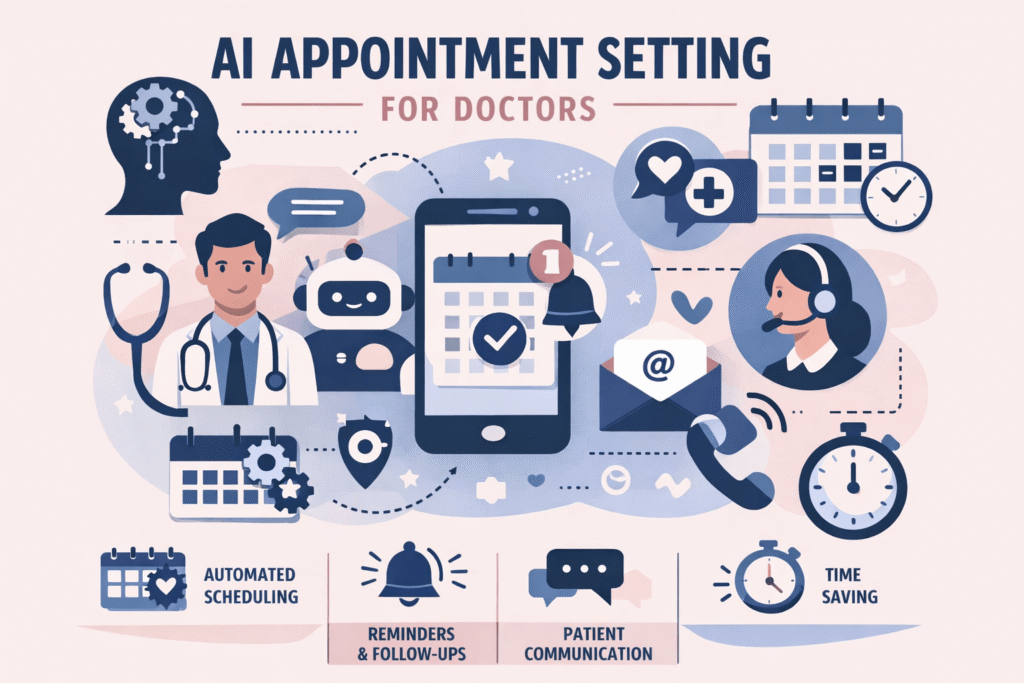
This brings us to the ultimate solution: AI appointment setting for doctors. Artificial intelligence fundamentally changes how medical clinics operate. It transforms your website from a digital brochure into an active, 24/7 patient scheduling engine.
In this comprehensive guide, we will explore how implementing a digital front desk fills your calendar around the clock. We will discuss the crucial role of EMR integration. We will examine how this technology drastically cuts down patient no-shows. Finally, we will show you why InvigoMedia stands as the premier authority in medical office automation.
The Silent Crisis: Patient Leakage and Phone Tag
Every practice manager knows the pain of the morning phone rush. At 8:00 AM, the phone lines light up—patients who had felt sick the night before call at the same time. Your front desk staff scrambles to answer every call. Consequently, they put people on hold. They rush through conversations.
Moreover, this chaos creates a terrible patient experience. When a patient waits on hold for ten minutes, they feel undervalued. Sometimes, they simply hang up. Industry experts call this “patient leakage.” Patient leakage actively destroys your practice’s growth.
The Problem with the Telephone
Telephones require synchronous communication. Both parties must be available at the same time. However, modern life rarely works this way.
- Your staff calls a patient to schedule a follow-up.
- The patient sits in a meeting and misses the call.
- The patient calls back two hours later.
- Your staff member stepped away for lunch.
This back-and-forth dance defines “phone tag.” Phone tag wastes countless hours of administrative time. It frustrates everyone involved. Furthermore, it delays essential medical care.
The Failure of Static Contact Forms
Many clinics tried to solve this problem by adding “Request an Appointment” forms to their websites. Unfortunately, these static forms create a false sense of efficiency.
When a patient fills out a form, they do not secure an appointment. They merely send an email to your front desk. Your staff must still read the email. Then, they must check the schedule. Finally, they must call the patient to confirm a time. This process still relies on the telephone. It still causes phone tag. Static forms do not solve the underlying issue. They merely delay it.
The Psychology of After-Hours Booking
To understand the power of healthcare appointment software, you must understand patient psychology. People rarely think about their medical appointments during standard business hours.
During the day, people work. They run errands. They pick up children from school. They focus on their daily obligations. Consequently, they push their personal health needs to the back of their minds.
When do they finally think about their health? They think about it at night. They think about it on the weekends. They think about it when the house is quiet.
Capturing High Intent
When a patient searches for a doctor at 11:00 PM, they exhibit high intent. They identified a problem. They want a solution right now.
If you offer 24/7 patient scheduling, you capture that intent immediately. You strike while the iron is hot. The patient feels a sense of relief because they checked a task off their to-do list.
Alternatively, if you force them to wait until morning, their intent cools down. The next day, they get busy again. They forget to call. Another week passes before they think about it again. After-hours booking prevents this delay. It secures the patient at exactly the moment they feel motivated to act.
Defining the Solution: AI Appointment Setting for Doctors
What exactly does AI appointment setting for doctors entail? Many people confuse basic chatbots with true artificial intelligence. We need to clarify the difference.
Basic Chatbots vs. True AI
A basic chatbot operates on a simple decision tree. It acts like an automated phone menu in text form. It asks, “Do you want to book a visit?” The user clicks “Yes.” The bot says, “Please call this number.” This does not help anyone.
True AI appointment setting utilizes advanced natural language processing. It understands context. It reads conversational cues. Most importantly, it executes complex actions.
When a patient interacts with an AI-driven digital front desk, they have a natural conversation.
- Patient: “I need to see Dr. Smith for severe knee pain next Tuesday.”
- AI: “I can help with that. Dr. Smith has openings next Tuesday at 10:00 AM and 2:00 PM. Which time works best for you?”
- Patient: “Let’s do 10:00 AM.”
- AI: “Great. I have booked your visit for Tuesday at 10:00 AM. I just sent a confirmation text to your phone.”
The Always-On Assistant
This AI acts as your best employee. It never sleeps. It never takes a vacation. It never asks for a raise. It handles hundreds of conversations simultaneously. It treats every single patient with perfect patience and professionalism.
Furthermore, this system handles complex scheduling rules. You can program the AI to understand that new patient intakes require 45 minutes, while standard follow-ups require 15 minutes. The automated booking system precisely manages your calendar blocks. It ensures your doctors never experience impossible scheduling overlaps.
EMR Integration: The Brains Behind the Operation
An AI chatbot means nothing if it cannot talk to your main database. To truly automate your clinic, your scheduling tool must connect to your Electronic Medical Records (EMR) or Electronic Health Records (EHR) system.
EMR integration serves as the absolute backbone of a successful digital front desk. Without it, your staff must manually copy and paste information from the website into your scheduling software. Manual data entry causes human error. Human error leads to double bookings and lost records.
Real-Time Synchronization
When AI appointment setting for doctors features deep EMR integration, magic happens. The AI reads your live schedule. If a patient cancels an appointment by phone at 2:00 PM, the EMR is updated instantly. At 2:01 PM, the AI offers that newly opened slot to a patient browsing your website.
This real-time synchronization eliminates double bookings. It maximizes your calendar density. You fill every available gap in your schedule.
Security and HIPAA Compliance
Naturally, medical professionals worry about patient privacy. Any software that touches medical records must maintain strict security protocols. Top-tier healthcare appointment software strictly adheres to HIPAA regulations.
These systems encrypt data both in transit and at rest. They verify patient identities securely. The AI only accesses the specific data points required to complete the booking. Therefore, your practice stays entirely compliant while offering massive convenience to your patients.
Updating Patient Files Automatically
Beyond just picking a time slot, integrated systems update patient files. When an existing patient books a follow-up, the AI cross-references their name and date of birth with the EMR. It attaches the new appointment directly to their existing chart. Your front desk staff arrives in the morning and sees a perfectly organized, fully populated schedule. They did not have to lift a single finger to make it happen.
Eradicating the No-Show Epidemic
Empty waiting rooms cost practices thousands of dollars every single week. When a patient fails to show up, you lose the revenue for that time slot. Furthermore, you deny care to another patient who desperately needed that time. Reducing patient no-shows remains a top priority for every medical clinic.
Automated booking systems tackle the no-show epidemic aggressively and effectively.
Automated SMS Reminders
People forget things. They lead busy lives. A physical appointment card easily gets lost in a wallet. However, people rarely ignore their text messages.
AI-driven systems send automated SMS and email reminders. The system sends a text immediately upon booking. It sends another text 48 hours before the visit. It sends a final text two hours before the visit. This consistent communication dramatically reduces forgetfulness.
Frictionless Rescheduling
Sometimes, emergencies happen. A patient truly cannot make their scheduled time. In a traditional system, they must call the office to cancel. Often, they feel embarrassed to cancel. Therefore, they simply do not show up.
Modern patient access solutions provide frictionless rescheduling. The automated text reminder includes a simple link. The text says, “Reply C to confirm or click this link to reschedule.”
If the patient clicks the link, the AI takes over. It opens the calendar. It allows the patient to pick a new time. It automatically cancels the old time. It updates the EMR. Consequently, the clinic gets ample notice about the cancellation. The AI can then immediately offer that empty slot to someone on the waiting list.
By removing the friction and embarrassment of a phone call, you encourage patients to notify you of cancellations promptly. This strategy profoundly impacts your bottom line by reducing patient no-shows to near zero.
Restoring Sanity to the Front Desk (Medical Office Automation)
Many doctors mistakenly believe that medical office automation aims to replace their staff. This is entirely false. Automation does not replace your team; it empowers them. It provides essential practice efficiency tools that rescue your staff from burnout.
The Reality of Administrative Burnout
Front desk administrators carry a massive burden. They answer phones. They greet walk-in patients. They verify insurance. They collect copays. They manage records.
When you force your staff to act as human calendar routers, you waste their talents. Answering a phone just to say, “Yes, we have an opening at 3 PM on Thursday,” does not require human empathy. It requires data retrieval. Machines handle data retrieval much better than humans do.
Focusing on Patient Care
By implementing an automated booking system, you remove the most tedious task from your staff’s daily workload. The phone rings less often. When the phone does ring, it’s usually because a complex issue truly requires human intervention.
Therefore, your staff gains hours of free time every day. How do they spend this time? They spend it delivering exceptional patient care.
- They can hold meaningful conversations with patients in the waiting room.
- They can assist doctors with administrative follow-ups.
- They can focus on complex billing and insurance claims.
- They can ensure the physical office looks immaculate.
Medical office automation transforms your front desk from a chaotic call center into a welcoming, professional patient concierge service. Your staff feels less stressed. Happy staff members treat patients better. Consequently, your patient satisfaction scores skyrocket.
The Financial ROI of Patient Access Solutions
Implementing new technology requires an investment. However, healthcare clinic owners must look at the direct financial return on investment (ROI) that AI appointment setting delivers.
Plugging the Leaks
First, calculate the cost of patient leakage. If your clinic loses just three new patients a week because they could not book online after hours, what does that cost you? If an average patient lifetime value is $1,000, you lose $3,000 a week. That equals $156,000 a year.
An automated booking system plugs this leak entirely. It captures those night-owl searchers. It turns website traffic into actual, booked revenue.
Recovering Lost Time Slots
Next, calculate the cost of no-shows. If a doctor sees 20 patients a day and experiences a 15% no-show rate, they have 3 empty slots. At $150 per visit, the clinic loses $450 daily.
Because AI systems excel at reducing patient no-shows through automated reminders and easy rescheduling, they recover this lost revenue. Furthermore, waitlist automation instantly fills canceled slots without staff intervention.
Reducing Operational Costs
Finally, consider labor costs. You pay your staff for their time. If they spend three hours a day playing phone tag, you pay for three hours of low-value work. Practice efficiency tools reallocate that labor budget toward high-value tasks, such as insurance dispute resolution or proactive patient recall campaigns.
When you add up the reclaimed revenue and the operational savings, AI appointment setting for doctors pays for itself within the first few weeks of implementation.
How to Implement Practice Efficiency Tools
Transitioning from a traditional front desk to a digital front desk is daunting. However, a structured approach guarantees a smooth transition.
Step 1: Audit Your Current Workflows
Before you install any software, you must understand your current processes. Document how a patient currently books a visit. Identify the bottlenecks. Track how many calls go to voicemail. Track your current no-show rate. You need baseline metrics to measure your future success.
Step 2: Standardize Your Calendar Rules
AI needs clear instructions to function correctly. You must standardize your scheduling rules.
- How long is a new patient consultation?
- How long is a routine follow-up?
- Does Dr. Smith only see specific cases on Tuesday mornings?
- Do you require buffer times between certain procedures?
Documenting these rules allows the AI to manage the calendar precisely. It ensures the automated system never creates a scheduling conflict for your clinical team.
Step 3: Choose Deeply Integrated Software
Do not settle for a surface-level widget. You must select healthcare appointment software that boasts deep EMR integration. Verify that the software communicates bidirectionally with your specific record system. Bidirectional sync means the AI can read open slots and write new appointments simultaneously.
Step 4: Train Your Staff
Your staff must understand that this technology helps them. Train them on how to monitor the AI system. Show them how the automated bookings appear in the EMR. Teach them how to handle the complex exceptions that the AI flags for human review.
Step 5: Update Your Digital Presence
Once the system goes live, you must promote it. Remove static contact forms from your website. Replace them with prominent, floating booking buttons. Add text to your Google Business Profile that says, “Book instantly online 24/7.” Update your phone system’s voicemail to direct callers to your website for immediate scheduling.
Expanding the Digital Front Desk: Beyond Just Scheduling
AI appointment setting for doctors represents just the beginning of medical office automation. Once you establish a robust digital front desk, you can expand its capabilities.
Automated Patient Intake
After the AI secures the time slot, it can immediately trigger patient intake workflows. Instead of handing a patient a clipboard and a pen when they arrive, the system texts them a secure link.
The patient fills out their medical history, demographic information, and insurance details on their smartphone from the comfort of their home. The system then automatically injects this data directly into the EMR. Consequently, when the patient walks through your doors, they simply check in and sit down. This dramatically reduces wait times and further eliminates manual data entry for your staff.
Pre-Visit Instructions
Different medical procedures require different preparations. If a patient books a blood draw, they might need to fast for twelve hours. If they book a specific scan, they might need to drink a certain amount of water.
Your automated booking system can recognize the appointment type and automatically email or text the patient the specific pre-visit instructions. This ensures patients arrive fully prepared, preventing costly same-day cancellations due to non-compliance.
Post-Visit Follow-Ups and Reviews
The patient journey does not end when they leave the clinic. Practice efficiency tools also manage post-visit communications. The AI can send a friendly text checking on the patient’s recovery.
Furthermore, the system can automatically request a Google review. If the patient reports a positive experience, the AI provides a direct link to your review page. This continuous engagement builds massive online authority for your clinic and attracts even more patients.
InvigoMedia: Your Partner in Medical Automation
Transitioning to a fully automated digital front desk requires technical expertise. You cannot afford trial and error when dealing with patient data and clinic schedules. You need an experienced partner who understands both technology and healthcare marketing.
InvigoMedia stands as the absolute authority in medical automation. We do not just provide generic software. We engineer comprehensive practice efficiency tools specifically tailored to the unique demands of healthcare providers.
Why Choose InvigoMedia?
We understand that doctors want to practice medicine, not manage IT projects. Our team deeply understands the intricacies of EMR integration. We ensure flawless communication between your website and your database. We prioritize strict security and HIPAA compliance in every single deployment.
Furthermore, InvigoMedia focuses on the complete patient journey. We deploy cutting-edge AI booking solutions that capture high-intent patients at exactly the moment they want to book. We eliminate the friction of static web forms. We obliterate phone tag.
By partnering with InvigoMedia, you secure a 24/7 automated booking system that actively grows your practice. We seamlessly fill your calendars around the clock. Consequently, we allow your administrative staff to step away from the phone and focus entirely on delivering exceptional patient care. We provide the tools you need to build a highly profitable, stress-free medical practice.
Conclusion
The era of making patients wait until 8:00 AM to schedule a visit has officially ended. The modern healthcare consumer demands convenience, speed, and digital accessibility. If your clinic relies on static contact forms and traditional phone tag, you’re actively losing patients to competitors that use more advanced technology.
AI appointment setting for doctors provides the ultimate solution. By deploying a 24/7 automated booking system with seamless EMR integration, you capture patients at their exact moment of high intent. You effectively eliminate the administrative bottleneck. You achieve significant reductions in patient no-shows through intelligent, automated communication.
Medical office automation transforms your entire operation. It turns your website into a powerful digital front desk. It provides essential practice efficiency tools that rescue your staff from burnout, allowing them to focus entirely on human connection and patient care.
Do not let another high-intent patient bounce off your website because they could not book immediately. Upgrade your patient access solutions today. Partner with the industry leaders at InvigoMedia to implement cutting-edge AI scheduling, and watch your calendar fill itself effortlessly, day and night.
Frequently Asked Questions (FAQs)
What exactly is AI appointment setting for doctors?
AI appointment setting utilizes artificial intelligence to interact with patients online. It understands natural language. It accesses your live schedule. It allows patients to select a time, book a visit, and receive immediate confirmation without any staff intervention.
How does an automated booking system work after normal business hours?
The digital front desk lives on your website and operates 24/7. When a patient visits your site at midnight, they click a booking button. The AI opens a chat interface or a dynamic calendar. The patient selects their reason for the visit and chooses an open time slot. The system immediately writes this appointment into your EMR, securing the booking instantly.
Why is EMR integration so critical for healthcare appointment software?
Without EMR integration, online bookings create manual work. Your staff would have to read online requests and type them into your main schedule. Deep EMR integration enables the AI to read your schedule in real time and add new appointments directly to the database. This eliminates double bookings and removes the need for manual data entry.
Does 24/7 patient scheduling actually increase clinic revenue?
Yes, it significantly increases revenue. By capturing patients who search for doctors after hours, you prevent patient leakage to competitors. Additionally, by capturing these high-intent patients instantly, you convert website traffic into actual booked appointments. Finally, the system automatically fills canceled slots, maximizing your daily billing potential.
How does this technology help in reducing patient no-shows?
The AI system automatically sends strategic reminders via SMS and email. It sends messages immediately upon booking, a few days before the visit, and a few hours before the visit. Furthermore, it provides a one-click link for patients to reschedule if an emergency arises, giving your clinic enough time to fill the newly vacant slot.
Will medical office automation replace my front desk staff?
No. Automation serves as a powerful tool to assist your staff, not replace them. By removing the repetitive burden of scheduling routine visits and playing phone tag, you free up your staff. They can then dedicate their time to in-person patient care, handling complex billing issues, and improving the overall clinic experience.
Are these patient access solutions compliant with healthcare privacy laws?
Yes. Reputable systems designed by experts like InvigoMedia strictly adhere to HIPAA regulations. Data is heavily encrypted. The AI only accesses the necessary scheduling fields, ensuring that sensitive medical records remain completely secure and private.
Is it difficult to transition from static forms to dynamic AI scheduling?
The transition is remarkably smooth when you partner with experts. A specialized agency will audit your current rules, configure the AI to match your exact calendar constraints, set up the EMR synchronization, and thoroughly test the system before it goes live. Your staff receives training on efficiently overseeing the automated process.