

“Overcome Patient Marketing Objections by reframing outreach as education, ensuring your practice remains ethical, professional, and highly visible.”
You didn’t spend a decade in medical school, residency, and fellowship to become a salesperson. You did it to help people. You took an oath to do no harm. And for many physicians, the very idea of “marketing” feels like a violation of that oath. It feels like you are crossing a line from a trusted authority figure to a carnival barker shouting for attention.
This hesitation is usual. In fact, it is a sign that you care deeply about your professional integrity.
But the healthcare landscape has changed. Your patients have changed. The way people find help has changed.
If you believe that marketing for physicians who hate marketing is impossible, or that you have to sell your soul to grow your practice, you are looking at the old model of advertising. You are picturing flashy billboards, aggressive radio spots, and “act now” discounts. That isn’t what modern medical marketing is about.
Today, marketing is simply the digital extension of your bedside manner. It is how you educate patients before they walk through your door. It is how you ensure that when someone in your community is sick or scared, they find accurate information from a qualified expert—you—rather than scary misinformation from a random forum.
This guide will walk you through overcoming patient marketing objections, both those you hear from colleagues and those you might be fighting internally. We will look at how to market a medical practice ethically, ensuring your reputation remains pristine while your patient base grows.
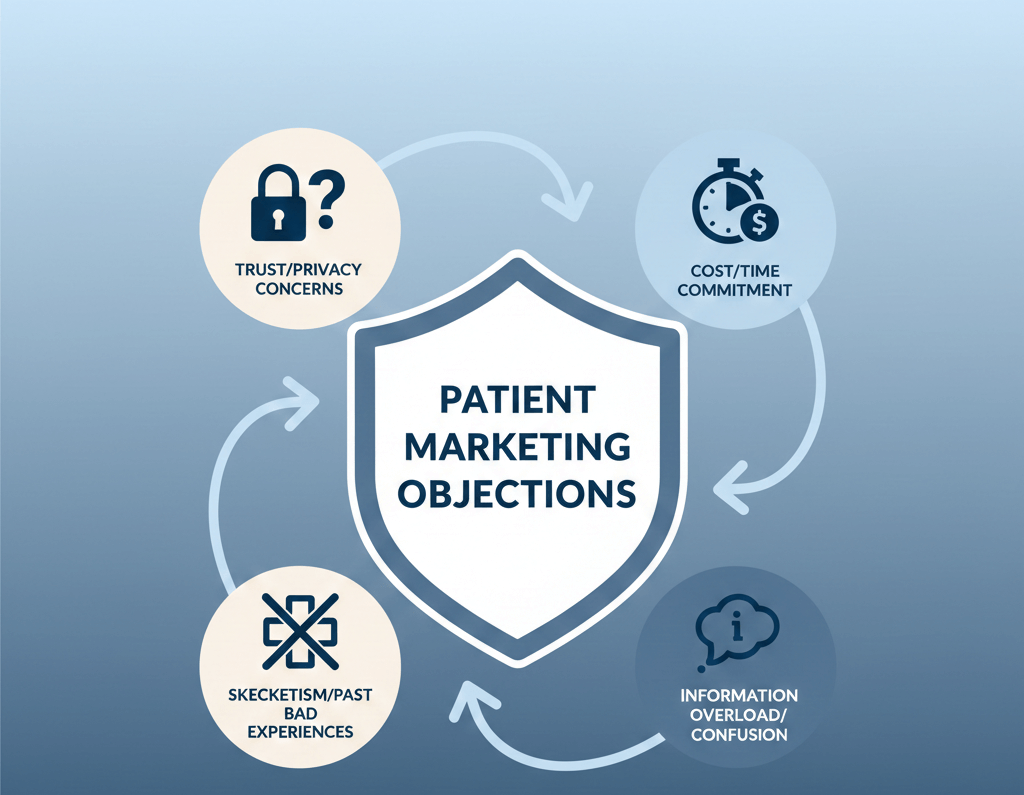
The “Ick” Factor: Why Doctors Hate Marketing
Let’s be honest about the discomfort. For generations, the medical community viewed advertising with suspicion. There was an unwritten rule: Good medicine speaks for itself. If you were a great surgeon or a compassionate pediatrician, word would spread. Referrals would flow. You didn’t need to ask for business.
To ask for business implied desperation. It implied that you weren’t busy enough, which meant you weren’t good enough.
This mindset persists today. When you hear “marketing,” you might think of:
- Used car sales tactics.
- Making promises you can’t keep.
- Treating patients like customers or numbers.
- Commercializing care.
These are valid concerns. Is it ethical for doctors to advertise? It depends entirely on how you do it. If you are selling unnecessary procedures or making guaranteed claims of a cure, then no, it is not ethical. But if you are making yourself visible to people actively seeking a solution to their pain, you aren’t selling. You are serving.
The “ick” factor comes from a misunderstanding of definitions. We need to separate “selling” from “communicating.”
Professional services marketing is not about convincing someone they need a doctor when they don’t. It is about helping them choose the right doctor when they already know they need one. It is about differentiation, trust, and education.
The Cost of Silence
Here is the reality of the digital age: Silence is not neutral.
If you choose not to participate in the online conversation, you aren’t just staying neutral. You are leaving a void. And the internet hates a void.
When you step back, less qualified sources step in. Influencers with zero medical training sell “detox teas.” Unverified blogs spread fear about vaccines or treatments. If a patient searches for “chronic back pain relief” and your practice doesn’t show up, they might land on a site pushing unproven supplements.
By refusing to market, you aren’t taking the moral high ground. You are ceding the territory to voices that may not have your patients’ best interests at heart. Ethical marketing for doctors is about reclaiming that territory. It is about ensuring that the loudest voice in the room is also the most qualified one.
Reframing the Conversation: Marketing vs. Patient Education
The most powerful way to overcome your hesitation is to change your vocabulary. Stop calling it marketing. Start calling it patient education marketing.
Think about what happens during a consultation. A patient presents with a problem. You listen. You explain the anatomy. You outline the options. You give your recommendation based on evidence. You answer their fears.
Modern content marketing is the same process, just done at scale.
When you write a blog post about “The top 5 signs you need a hip replacement,” you are consulting. You are educating. You are providing value to someone sitting at home in pain, wondering whether their stiffness is standard.
When you record a video explaining what to expect during a colonoscopy to reduce anxiety, you are practicing medicine. You are alleviating fear.
Marketing vs patient education is a false dichotomy. In 2024, good marketing is patient education.
The Google “Second Opinion”
Patients are going to Google things. That is a fact. They will Google their symptoms before they call you. They will Google your diagnosis after they leave you.
If your website provides clear, empathetic, and medically accurate answers to those questions, you build trust before you even meet. You position yourself as the authority.
If your website is a digital ghost town, or if you don’t have one, the patient assumes you are behind the times. Fair or not, patients equate digital presence with modern capability. A dated website can subconsciously suggest dated equipment or dated techniques.
Building a professional medical brand means curating your digital presence to reflect the quality of care you provide in person accurately.
Tackling Common Physician Objections Head-On
Let’s look at the specific reasons doctors push back against marketing, and why those objections no longer hold water in the current healthcare environment.
Objection 1: “My Work Should Speak for Itself”
The Argument: I provide excellent care. My patients love me. They will tell their friends. I don’t need a website or SEO.
The Reality: Word-of-mouth is still the gold standard, but the mechanism of word-of-mouth has changed.
Twenty years ago, a patient might tell a neighbor, “Go see Dr. Smith.” The neighbor would pick up the phone and call Dr. Smith.
Today, the patient tells a neighbor, “Go see Dr. Smith.” The neighbor says thanks. Then they pull out their phone. They type “Dr. Smith reviews.” They look at your website. They look at your photo. They check if you take their insurance.
If you have a 2.5-star rating because of three angry people from five years ago, and you have never responded or encouraged happy patients to leave reviews, that neighbor might never call. Even with a direct referral, you need reputation management to validate the recommendation.
Furthermore, people move more often. Communities are less tight-knit. You cannot rely solely on the organic spread of your reputation in a fragmented, digital-first society.
Objection 2: “Marketing is For Doctors Who Are struggling.”
The Argument: Only practices that are desperate for patients run ads. I’m busy enough.
The Reality: The best time to market is when you are busy.
Marketing isn’t just about getting more patients. It is about getting the right patients.
If you are a surgeon who loves doing complex reconstructions but your schedule is filled with minor lumps and bumps, marketing can fix that. By creating content focused on the procedures you want to perform, you attract those cases.
Physician marketing concerns often center on volume, but the real goal is quality and fit. You can use marketing to filter. You can educate patients on who is a good candidate for a procedure and who isn’t. This saves your front desk time and ensures the people sitting in your exam room are the ones you can help the most.
Also, marketing protects your future. Referral sources can dry up. Insurance networks change. A competitor opens across the street. A strong brand is an insurance policy for your practice’s stability.
Objection 3: “I Don’t Have Time for This”
The Argument: I am already charting until 8 PM. I don’t have time to write blogs or dance on TikTok.
The Reality: You shouldn’t be doing the heavy lifting.
This is a massive misconception. Marketing for physicians who hate marketing should not add to your workload. You are the subject matter expert, not the copywriter or the web developer.
Your role should be limited to approval and guidance. You might spend 30 minutes a month reviewing topics or approving a strategy. You hire partners to execute. You don’t clean your own waiting room floors; you hire a service. Marketing is no different. It is an operational necessity that you delegate to professionals.
Objection 4: “It Costs Too Much”
The Argument: I can’t afford to throw money away on Facebook ads that don’t work.
The Reality: Marketing is an investment, not an expense, but only if it’s tracked.
Old-school advertising (billboards, magazines) was hard to track. You threw money out and hoped the phone rang. Digital marketing is precise. You can see exactly how many people clicked, how many called, and the cost per patient acquisition.
If you spend $1,000 to acquire a patient who brings $5,000 in lifetime value to the practice, you haven’t lost money. You have made a wise investment.
The cost of not marketing is often higher—the cost of empty slots in your schedule, or the opportunity cost of missing out on high-value procedure cases.
Objection 5: “It Feels Unethical to Solicit Patients”
The Argument: It is undignified to beg for patients.
The Reality: Offering help is not begging.
This brings us back to the topic of ethical marketing for doctors. You are not cold-calling people at dinner. You are setting up signposts.
SEO (Search Engine Optimization) is the ultimate form of passive, respectful marketing. You aren’t interrupting anyone. You are simply ensuring that when someone types “pediatrician near me” or “best dermatologist for acne,” your name appears. You are answering a request they initiated.
You are making it easy for people to find the care they are already looking for. That is not solicitation; that is accessibility.
The Pillars of Ethical, Dignified Marketing
So, if we strip away the sales tactics, what does a professional marketing strategy look like? How do you market a medical practice ethically? It rests on three main pillars: Education, Visibility, and Reputation.
1. Content Marketing: The Blog as a Prescription
Think of your website’s blog or resource center as a library of your expertise.
This is where you answer the questions you hear in the exam room every single day.
- “How long is the recovery time?”
- “Do I really need surgery?”
- “What are the side effects?”
By answering these in well-written articles, you achieve three things:
- Trust: You demonstrate your knowledge.
- Efficiency: Patients come in better informed.
- SEO: Google loves high-quality, relevant content.
This is patient education marketing at its purest. You are giving away information freely. It establishes you as a generous, transparent provider. It strips away the mystery of medicine and empowers the patient.
Content marketing is the opposite of a sales pitch. It doesn’t say “Pick Me!” It says, “Here is the truth about your condition. Here are your options. I am here if you need me.”
2. SEO: Being There When It Matters
Search Engine Optimization (SEO) is the technical process of telling Google who you are and what you do.
When a person wakes up with a scary symptom, their first move is often to search the internet. If you are a cardiologist, you want to show up when someone in your city searches for “chest pain causes.”
Why? Because if you don’t, they might find a forum telling them it’s just indigestion when it’s not. Or they might find a competitor with less experience.
SEO ensures that your expertise is discoverable. It connects the supply (your skill) with the demand (the patient’s need) at the exact right moment. There is nothing pushy about it. It is purely functional. It enables the internet to serve as a triage system, routing patients to the appropriate providers.
3. Reputation Management: The Digital Bedside Manner
Your reputation is your most valuable asset. In the past, you protected it by being a good doctor. Today, you must defend it by monitoring what is said online.
This doesn’t mean faking reviews. It means engaging with feedback.
If a patient leaves a glowing review, reply and say thank you. It shows you listen. If a patient leaves a negative review, reply professionally (without violating HIPAA). Say, “We are sorry to hear you had a bad experience. We strive for excellence and would like to discuss this offline.”
This shows prospective patients that you are reasonable and that you care about patient satisfaction.
Encouraging happy patients to leave reviews is also crucial. Most people only write reviews when they are angry. You need to mobilize the silent majority of happy patients to paint an accurate picture of your practice. This is a key part of building a professional medical brand.
Defining the Line: What NOT To Do
To maintain your professionalism, there are specific lines you should not cross. Do doctors need to market? Yes. Do they need to act like influencers? No.
Here are the guardrails for ethical marketing for doctors:
- Avoid Fear Mongering: Never try to scare a patient into a procedure. Focus on solutions and positive outcomes.
- Don’t Overpromise: Medicine is unpredictable. Avoid words like “guaranteed,” “miracle,” or “instant cure.”
- Respect Privacy: Never use patient photos or stories without explicit, written consent. HIPAA is non-negotiable.
- Stay in Your Lane: Market the services you are actually qualified to provide.
- Keep it Classy: You don’t need to jump on every social media trend. If a dance challenge doesn’t fit your brand as a neurosurgeon, don’t do it. Authenticity wins.
The Strategic Advantage of Professionalism
There is a massive market advantage to being the “grown-up” in the room.
As more providers rush to social media with flashy, trend-chasing content, there is a growing hunger for seriousness. Patients want a doctor who takes their health seriously.
A clean, informative website, a blog filled with evidence-based advice, and a reputation for responsiveness will consistently outperform a viral video in the long run. Professionalism is your marketing hook.
By avoiding “salesy” tactics, you attract patients who appreciate substance over style. You build a practice based on respect.
This approach solves the physician marketing concerns regarding dignity. You aren’t lowering your standards to meet the market; you are raising the market’s expectations of what a doctor’s communication should look like.
Why You Need a Partner Who Gets It
You are busy saving lives and improving health. You do not have time to learn the intricacies of Google algorithms or keyword density. You need a partner.
But you don’t need just any marketing agency. You need one that understands the medical ethos. You need a team that knows the difference between selling a pair of sneakers and offering a life-changing medical procedure.
This is where InvigoMedia stands apart.
We specialize in working with medical professionals. We understand the unique constraints, the regulatory environment, and the absolute necessity of maintaining a dignified reputation. We don’t do “salesy.” We do education-driven growth.
InvigoMedia focuses on:
- Content Marketing: We create authoritative content that sounds like you.
- SEO: We ensure patients can find you when they need you most.
- Reputation Management: We help you build and protect your 5-star digital presence.
We know that marketing feels unprofessional only when it is done wrong. When done right, it is a service to your community. We help you bridge the gap between your expertise and the patients who need it, without ever compromising your authority.
Let us handle the noise so you can focus on the medicine.
Conclusion: The New Oath
The Hippocratic Oath focuses on the patient’s well-being. In a world where patients are drowning in information—much of it bad—guiding them toward accurate, professional care is a way to protect their well-being.
You don’t have to become a salesperson. You just have to be a teacher. You have to be visible.
Marketing, when viewed through this lens, stops being a dirty word. It becomes a necessary tool for modern medicine. It is about extending your care beyond the four walls of your clinic.
Don’t let the fear of sounding “unprofessional” keep you from helping the people who are looking for you.
Frequently Asked Questions (FAQs)
Q: Is it ethical for doctors to advertise?
A: Yes, provided the advertising is truthful, not misleading, and respects patient privacy. The American Medical Association (AMA) and other governing bodies have guidelines that allow advertising as long as it is accurate and helpful to patients. Think of it as informing the public about their options rather than “selling” a product.
Q: How do I market my practice if I hate self-promotion?
A: Shift your focus from “promotion” to “education.” Instead of talking about how great you are, talk about the conditions you treat and how you help patients. Create content that answers common questions. This approach builds authority and trust without requiring you to boast.
Q: What is the difference between marketing and patient education?
A: In the digital age, they are often the same thing. Good marketing provides value. It educates the prospective patient so they can make an informed decision. If your marketing materials (blogs, videos, social posts) are teaching people something valuable, you are doing both simultaneously.
Q: Do doctors really need to market in 2024?
A: Yes. Even if you rely on referrals, patients will research you online before booking. A weak online presence can deter them. Additionally, competition is increasing, and patients are becoming more consumer-minded. They shop for healthcare. Marketing ensures you are an option on their list.
Q: How much time does marketing a medical practice take?
A: If you hire the right agency, your time commitment should be minimal. You will need to approve strategies and perhaps review content for medical accuracy, but the daily execution—posting, coding, tracking—should be handled by your team.
Q: Will marketing make me look desperate?
A: Not if it is done professionally. High-quality branding, educational content, and a sleek website signal success and competence. Desperation comes from aggressive discounts, spammy emails, or low-quality ads. Professional marketing signals that you run a modern, patient-centered practice.
Q: Can I just rely on social media?
A: Social media is a tool, but it shouldn’t be your entire strategy. You don’t own your social media followers; the platform does. You need a central “home base”—your website—where you control the content and the patient experience. Social media should drive traffic to your site, not replace it.