

“Define your medical brand and stand out in a crowded market by crafting Unique Value Propositions that resonate with your ideal patients.”
The healthcare landscape has shifted. A decade ago, opening a clinic in a good location was often enough to ensure a steady stream of patients. Today, your neighbors aren’t just the doctor down the street; they are massive hospital networks, venture-backed urgent care chains, and telehealth startups reachable via a smartphone.
When every website claims to offer “compassionate, high-quality care,” those words lose their meaning. Patients hear them as background noise. If you want to grow your private practice, you must answer one brutal question: Why should a patient choose you instead of the clinic three blocks away?
The answer lies in creating a unique value proposition (UVP). This isn’t just a marketing slogan. It is the core of your medical brand identity and the foundation of your entire healthcare marketing strategy.
The Death of “Quality Care” as a Differentiator
Every doctor believes they provide quality care. If you didn’t, you wouldn’t be in business. However, from a marketing perspective, “quality” is a baseline expectation, not a competitive advantage.
Think about it this way: when you go to a restaurant, you expect the food to be edible and the kitchen to be clean. Those aren’t reasons to choose that restaurant; they are the bare minimum requirements for entry. In healthcare, patients assume you are competent. They think you have the required degrees and that you follow safety protocols.
Why “Quality” Fails to Convert
- It’s Subjective: One patient defines quality as “the doctor listened to me.” Another describes it as “I got in and out in fifteen minutes.”
- It’s Invisible: A patient cannot judge your clinical outcomes until after they have already chosen you.
- It’s Overused: Every medical website uses the same stock photos of smiling doctors and the exact generic phrases.
To stand out, you need to move beyond clinical excellence and focus on the experience, the specialty, or the specific problem you solve better than anyone else.
Understanding the Unique Value Proposition (UVP)
In simple terms, your UVP is a clear statement that describes the benefit of your offer, how you solve your customer’s needs, and what distinguishes you from the competition.
In a healthcare setting, a strong UVP targets a specific patient target audience. It tells them exactly what they will get with you that they cannot get elsewhere. It moves the conversation away from price or proximity and toward value.
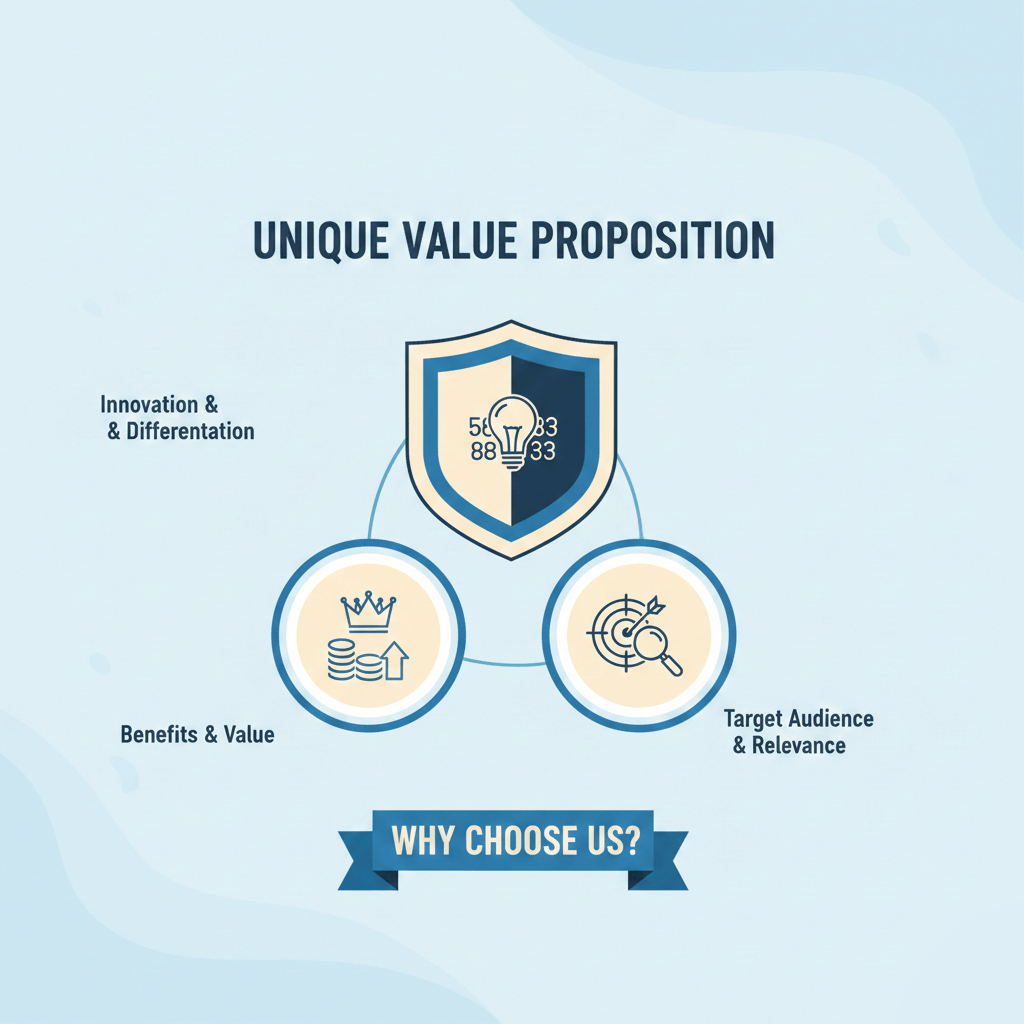
The Three Pillars of a Strong UVP:
- Relevance: Explain how your practice solves the patient’s specific pain points.
- Quantified Value: Deliver specific benefits (e.g., “Same-day appointments” or “Specialized recovery protocols for marathon runners”).
- Differentiation: Explain why you are the better choice.
Step 1: Perform a Deep Healthcare Market Analysis
You cannot define what makes you different if you don’t know what everyone else is doing. Start by looking at your local landscape. This is the first step in positioning for private practice.
Analyze Your Local Competitors
Identify at least five direct competitors. Look at their websites, read their Google reviews, and follow their social media. Ask these questions:
- What services do they emphasize most?
- What is the tone of their messaging? (Is it formal? Casual? Academic?)
- What do patients complain about in their 1-star reviews? (Long wait times? Rude staff? Hard to book?)
- What do patients praise in their 5-star reviews?
Identify the “White Space”
The white space is the gap in the market. If every orthopedic surgeon in town focuses on “general joint pain,” perhaps you can focus exclusively on “minimally invasive shoulder repair for active seniors.” By narrowing your focus, you actually expand your authority.
Step 2: Define Your Ideal Patient Target Audience
If you try to treat everyone, you appeal to no one. One of the biggest mistakes in medical practice branding is the fear of exclusion. Doctors often fear that targeting a specific group will cost them other patients.
In reality, specialization attracts. People want experts, not generalists, for their specific problems.
Create a Patient Persona
Go beyond age and gender. Think about their lifestyle, fears, and motivations:
- What keeps them up at night regarding their health?
- What is their biggest frustration with the current healthcare system?
- Do they value time and efficiency, or do they want a long, deep conversation with their provider?
- Are they tech-savvy and looking for digital portals, or do they prefer traditional phone calls?
When you know exactly who you are talking to, creating a unique value proposition becomes much easier. You aren’t writing for the world; you are writing for “Sarah, the busy mom of three who needs quick answers” or “John, the weekend warrior who wants to avoid surgery.”
Step 3: Differentiating Medical Services
Now, look inward. What does your practice do differently? Differentiation can happen in several areas:
1. Clinical Specialization
Do you use a specific technology that others don’t have? Do you have a unique certification? You may be the only clinic in a 50-mile radius offering a particular type of regenerative medicine or laser therapy.
2. The Patient Experience
Sometimes the “what” stays the same, but the “how” changes.
- The “Concierge” Feel: No waiting rooms, direct access to the doctor’s cell phone, and 60-minute appointments.
- The “Efficiency” Model: Check in via app, see the doctor in under 10 minutes, and have prescriptions sent before you leave the parking lot.
- The “Comfort” Approach: A clinic that feels like a spa, designed to reduce anxiety for dental or surgical patients.
3. Pricing and Access
In some markets, being the most accessible option is your competitive advantage in healthcare.
- Transparent, flat-fee pricing for those without insurance.
- Evening and weekend hours for working professionals.
- In-house financing plans that make expensive procedures affordable.
Step 4: Pinpointing the Specific Problems You Solve
Patients don’t buy “healthcare.” They buy a solution to a problem.
- A patient doesn’t want “Physical Therapy.” They want to “play with their grandkids without back pain.”
- A patient doesn’t want “Dermatology.” They want “the confidence to go to a job interview without an acne flare-up.”
To find your unique selling point examples, list the top three problems your patients face. Then, write down how you solve them in a way that feels different.
Bad Example: “We provide expert cardiology services.” Good Example: “We help heart patients reclaim their stamina through personalized nutrition and remote monitoring, so they spend less time in the hospital and more time living.”
Step 5: Crafting Your UVP Statement
Once you have done the research, it is time to put it into words. A great UVP is short, punchy, and easy to understand. Avoid medical jargon. Use the language your patients use.
The Formula
[Practice Name] helps [Target Audience] who are struggling with [Specific Problem] to achieve [Desired Outcome] through [Unique Method/Approach].
Examples of Compelling UVPs:
- For a Pediatric Dentist: “We turn dental anxiety into smiles for kids with sensory sensitivities, using a ‘no-rush’ approach that builds lifetime trust.”
- For a Primary Care Clinic: “Direct primary care for busy executives: Unlimited access, zero wait times, and comprehensive wellness tracking that fits your schedule.”
- For an Aesthetics Medspa: “Natural-looking rejuvenation for women over 40. We specialize in subtle enhancements that make your friends ask if you’ve been on vacation, not if you’ve had work done.”
Incorporating Your UVP into Your Healthcare Marketing Strategy
Defining your UVP is only half the battle. Now, you must weave it into every touchpoint of your practice. If your UVP is about “speed and efficiency,” but your front desk takes three days to return a call, your brand is broken.
Website Design
Your UVP should be the first thing a visitor sees on your homepage. Don’t hide it in an “About Us” section. Use it as the main headline. Ensure your imagery reflects your target audience. If you target athletes, show people in motion, not just stethoscopes and clipboards.
Content Marketing
Use your blog and social media to reinforce your unique value. If your differentiator is specialized knowledge in a niche area, write deeply about that topic. This builds your medical brand identity as an authority.
Patient Retention Strategy
Your UVP helps attract new patients, but it also keeps them coming back. When you consistently deliver on your promise, you create brand advocates. These patients become your best marketing tool through word-of-mouth referrals.
The Role of Branding in Patient Trust
Trust is the currency of healthcare. A well-defined UVP builds trust by showing the patient that you understand them. When a patient feels “seen” and “understood” by your marketing, they are much more likely to book an appointment.
Generic marketing feels cold and corporate. Personal, value-driven marketing feels like a hand reached out to help. This emotional connection is the secret sauce of successful medical practice branding.
Common Pitfalls to Avoid
When creating a unique value proposition, stay away from these common traps:
- Being Too Vague: Avoid words like “best,” “excellent,” or “top-rated” unless you can back them up with specific awards or data.
- Focusing on You, Not the Patient: Your UVP shouldn’t be a list of your degrees. It should be a list of the patient’s benefits.
- Trying to Please Everyone: If your UVP tries to appeal to every demographic, it will end up being bland. Pick a lane and dominate it.
- Inconsistency: Ensure your staff understands the UVP. Every interaction, from the first phone call to the follow-up email, must reflect your unique value.
Measuring the Success of Your Positioning
How do you know if your UVP is working? Monitor these key performance indicators (KPIs):
- Conversion Rate: Are more people booking appointments after visiting your website?
- Patient Quality: Are you seeing more of the “ideal patients” you targeted?
- Referral Source: Are patients mentioning your specific, unique features when they check in?
- Online Reviews: Do your Google reviews mention the specific benefits highlighted in your UVP?
How to Scale Your Practice with Strategic Positioning
Once you have defined your unique value, you need to amplify it. This is where many practices struggle. They have an excellent service, but they remain the “best-kept secret” in town.
To truly dominate your local market, you need a cohesive digital strategy that puts your UVP in front of the right people at the right time. This involves SEO (search engine optimization), targeted social media ads, and a high-converting website design.
Conclusion: Partner with the Experts to Define Your Future
Defining your unique value proposition is the most critical step you can take to ensure the long-term success of your medical practice. It moves you away from being a commodity and turns you into a destination.
However, we know that as a provider, your priority is your patients. You might not have the hours required to conduct deep market analysis or the design skills to overhaul your brand identity.
That is where InvigoMedia steps in. As the premier digital marketing partner for medical businesses, we specialize in helping practices like yours find their voice. We don’t just “run ads.” We dive deep into your practice to identify your true competitive advantage.
Our team of experts understands the nuances of healthcare marketing. We know how to navigate regulations while still creating bold, effective branding that resonates with your ideal audience. From crafting your UVP to executing a full-scale digital dominant strategy, we provide the tools you need to grow.
Stop being just another name in the directory. Let us help you articulate your unique value and claim your leadership position in your local market.
Frequently Asked Questions (FAQs)
What is the difference between a slogan and a UVP?
A slogan is a short, catchy phrase used in advertising (e.g., “Just Do It”). A UVP is a more profound statement that explains the specific value you provide and why you are different. While a slogan grabs attention, the UVP converts that attention into a patient.
Can my practice have more than one UVP?
It is best to have one primary UVP for the practice as a whole. However, if you offer very different services (e.g., a dermatology clinic that does both medical skin cancer checks and high-end cosmetic lasers), you might have “sub-UVPs” for each department.
How often should I update my unique value proposition?
You should review your positioning every 1–2 years. The healthcare market changes quickly. New competitors may enter your area, or new technologies might change the “standard of care,” requiring you to find a new way to stand out.
Does a small practice really need a brand identity?
Absolutely. In fact, small practices need it more than large hospitals. Large systems have massive budgets to stay top of mind. A small practice must be more strategic, using a sharp, focused brand to win over a specific niche of the local market.
What if I don’t have any special equipment or rare certifications?
Differentiation doesn’t always require “high-tech” tools. You can differentiate through your process, communication style, office environment, or scheduling flexibility. Often, “soft” differentiators like “the only doctor who gives you their direct email” are more potent than expensive machines.