

“Grow your practice with expert naturopathic doctor marketing. Attract health-conscious patients through functional medicine SEO and ads.”
The healthcare landscape is changing rapidly. Patients no longer accept a quick prescription for chronic issues. People want real answers. They want to understand their bodies. Consequently, they actively seek out practitioners who look beyond the surface. This shift creates a massive opportunity for naturopathic doctors. However, capturing this audience requires a specific approach. Traditional medical advertising does not work here. You need effective naturopathic doctor marketing.
You must focus on the specific demographic interested in functional medicine. These individuals do their own research. They read labels. They understand complex health concepts. Therefore, your marketing must speak their language. You must highlight root-cause resolution rather than just symptom management. Furthermore, you must build trust before asking them to book an appointment.
This comprehensive guide will show you exactly how to do that. We will cover everything from functional medicine SEO to complex educational funnels. By the end of this post, you will understand how to attract, educate, and convert health-conscious seekers into loyal patients. Finally, we will explain why partnering with a specialized agency like InvigoMedia provides the best path to long-term growth.
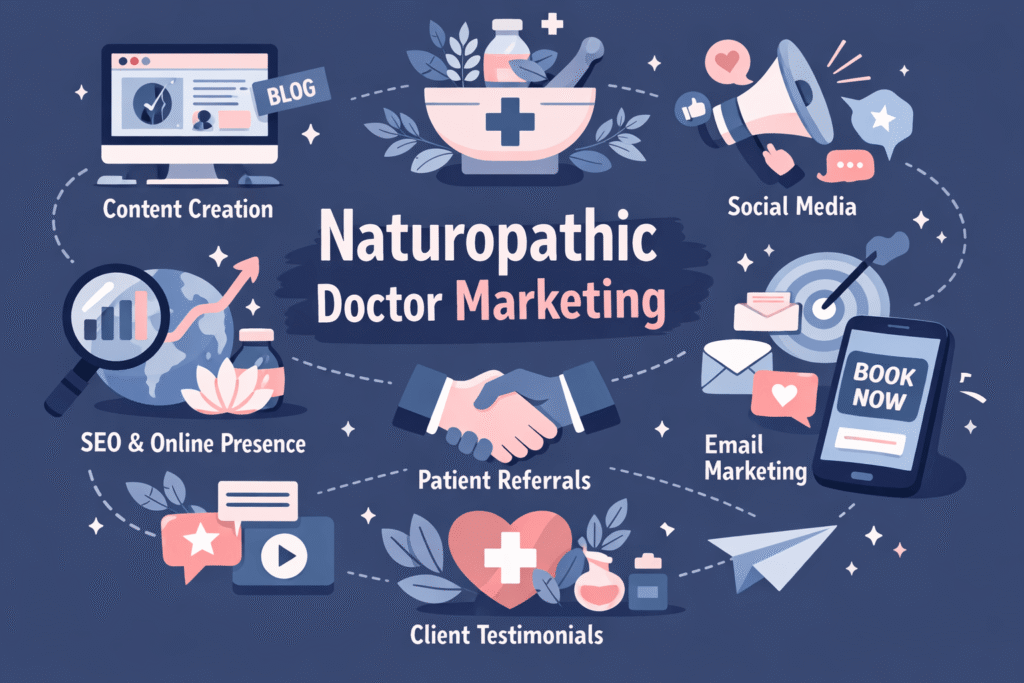
Understanding the Health-Conscious Patient
Before you launch any naturopath digital strategy, you must understand your target audience. You cannot market to everyone. If you try to reach everyone, you will reach no one. Your ideal patient actively searches for alternative medicine.
The Demographics and Psychographics
Who is this patient? Often, they are individuals aged 30 to 55. They usually have a moderate to high disposable income. Natural healthcare is an investment, and they are willing to pay for it. However, psychographics matter much more than demographics.
Psychographics look at beliefs, values, and behaviors. Health-conscious patients value prevention. They believe the body can heal itself, given the right tools. They often feel dismissed by the conventional medical system. They might have chronic fatigue, digestive issues, or hormonal imbalances. Traditional doctors may have told them their lab results look normal. Yet, they still feel terrible.
How They Make Decisions
These patients do not make impulsive healthcare decisions. They spend hours reading articles. They listen to health podcasts. They follow functional medicine practitioners on social media. Consequently, they have a high level of health literacy.
You cannot use generic marketing slogans with this group. Phrases like “Feel better fast!” or “The ultimate cure for fatigue” will trigger their skepticism. Instead, they want data. They want scientific explanations. They want a practitioner who will listen to their entire health history. Your marketing materials must reflect this deep, investigative approach.
The Core Message: Root-Cause Resolution vs. Symptom Management
The fundamental difference between conventional medicine and naturopathy lies in the approach to symptoms. Conventional medicine often treats the symptom. Naturopathy treats the underlying cause. Your alternative medicine marketing must clearly communicate this difference.
Shifting the Narrative
Most medical advertising focuses on making a symptom disappear. For example, a conventional ad for acid reflux might say, “Stop heartburn in its tracks.” This appeals to someone looking for immediate relief.
The health-conscious patient wants more. They want to know why they have heartburn in the first place. Your marketing must shift the narrative. An effective naturopathic ad might say, “Heartburn is a signal. Let’s find out what your gut is trying to tell you.”
This second message completely changes the dynamic. It positions the symptom as a clue, not just a nuisance. It positions you as an investigator, not just a dispenser of remedies.
Examples of Root-Cause Messaging
Let us look at a few more examples. Notice how the root-cause message requires more explanation. This is why educational marketing is so important.
Condition: Chronic Fatigue
- Symptom Message: “Get your energy back today.”
- Root-Cause Message: “Fatigue often starts in the mitochondria or the adrenal system. We test your cellular health to restore your energy naturally.”
Condition: Skin Issues (Acne/Eczema)
- Symptom Message: “Clear your skin in four weeks.”
- Root-Cause Message: “Your skin reflects your gut health. We identify food sensitivities and balance your microbiome to clear your skin from the inside out.”
Condition: Hormonal Imbalance
- Symptom Message: “Stop hot flashes now.”
- Root-Cause Message: “We look at your entire endocrine system, testing cortisol, thyroid, and sex hormones to bring your body back into natural balance.”
Using this messaging establishes your authority. It shows the patient that you understand their frustration. Furthermore, it filters out patients who just want a quick fix. You only attract patients willing to put in the work required for natural healing.
The Foundation: Building Your Naturopath Digital Strategy
Before you spend a single dollar on advertising, you need a solid foundation. You need a place to send people. This place is your website. However, a digital strategy goes beyond just having a web page. It involves creating a cohesive online presence.
Website Optimization for Wellness Clinics
Your website acts as your digital waiting room. It is often the first impression a potential patient gets of your practice. If the website is slow, confusing, or outdated, they will leave. You have about three seconds to capture their attention.
Speed Matters Health-conscious seekers are busy. If your site takes longer than a few seconds to load, they will click away. You must optimize your image sizes. You must use a reliable hosting provider. Website speed also heavily influences your search engine rankings.
Mobile Responsiveness Over half of all web traffic comes from mobile devices. Therefore, your site must look perfect on a smartphone. The buttons must be easy to tap. The text must be legible without zooming. A poor mobile experience destroys credibility instantly.
Clear Navigation and User Experience (UX): Do not make patients hunt for information. Your main menu should be simple. Include sections for “About Us,” “Conditions We Treat,” “Our Approach,” and “Contact.” Additionally, you need clear Calls to Action (CTAs). Do not just put a phone number at the bottom of the page. Use buttons that say “Book a Free Discovery Call” or “Schedule Your Consultation.”
Highlighting the Practitioner
Patients connect with people, not clinics. They want to know who will be treating them. Your “About” page is critical. Do not just list your degrees and certifications. Tell your story. Why did you choose naturopathic medicine? Did you have your own health journey? Sharing your personal motivation builds deep trust.
Include high-quality photos of yourself and your staff. Furthermore, include a short introductory video on your homepage. A video lets patients hear your voice and see your demeanor. This dramatically reduces the anxiety of booking a first appointment.
Functional Medicine SEO: Getting Found Online
Having a great website means nothing if nobody can find it. Search Engine Optimization (SEO) is the process of improving your website’s visibility on Google. For a naturopathic practice, functional medicine SEO provides the highest return on investment over time.
Understanding Search Intent
Health-conscious patients use specific search terms. They rarely search for “doctor near me.” Instead, they search for solutions to their specific problems. You must optimize your site for these specific, long-tail keywords.
A long-tail keyword is a highly specific search phrase. It usually has lower search volume but much higher intent to buy. For example, “natural medicine SEO” is a niche keyword. In the patient context, a broad keyword is “fatigue.” A long-tail keyword is “naturopathic treatment for adrenal fatigue in Chicago.”
Keyword Research Strategy
You need to identify what your ideal patients are searching for. You can use tools like Google Keyword Planner, Ahrefs, or SEMrush. Look for keywords related to the conditions you treat.
Examples of functional medicine SEO keywords include:
- Natural remedies for SIBO
- Functional medicine doctor for autoimmune disease
- Naturopathic approach to PCOS
- Heavy metal detox practitioner
- Integrative oncology support
Once you identify these keywords, you must integrate them naturally into your website. Do not stuff them in awkwardly. Write informative pages about each condition you treat. Use the keywords in the page titles, headers, and meta descriptions.
Local SEO for Wellness Clinics
Most naturopathic doctors serve a specific local area. Therefore, local SEO is vital. The cornerstone of local SEO is your Google Business Profile.
- Claim Your Profile: Ensure you own your Google Business Profile.
- Complete Every Section: Fill out your hours, address, phone number, and website. Add a detailed description of your services.
- Choose the Right Categories: Select “Naturopathic Practitioner” or “Alternative Medicine Practitioner.”
- Add Photos: Regularly upload photos of your clinic, your team, and your products.
- Gather Reviews: This is the most critical step. Ask your satisfied patients to leave Google reviews. Respond to every review, both positive and negative. Reviews provide social proof. Health-conscious patients read reviews meticulously before booking.
Content Marketing and Blogging
Google loves fresh, relevant content. Publishing regular blog posts signals to Google that your site is active. Furthermore, blogs allow you to target many different long-tail keywords.
Write detailed articles answering common patient questions. If a patient asks you a question in the clinic, write a blog post about it. Share your expertise freely. When a prospective patient reads your comprehensive article on “Understanding Methylation,” they see you as an authority. This builds trust before they even pick up the phone.
Educational Funnels: Building Trust and Credibility
We have established that health-conscious seekers require education. They need to understand complex concepts. You cannot expect someone to land on your website and immediately book a $300 initial consultation. You must nurture them. This is where educational funnels become essential.
An educational funnel guides a potential patient through a step-by-step journey. It starts with free information and ends with a paid consultation.
Step 1: The Lead Magnet
The top of your funnel requires a lead magnet. A lead magnet is a valuable piece of content given away in exchange for an email address. You must offer something your target audience desperately wants.
Good lead magnet examples include:
- The 7-Day Anti-Inflammatory Meal Plan
- A Guide to Understanding Your Thyroid Lab Results
- The Gut Health Checklist: 10 Signs of Dysbiosis
- A Short Video Course on Managing Stress and Cortisol
The lead magnet must solve a specific problem. It must also be easy to consume. Do not offer a 100-page ebook. People will not read it. Offer a concise, actionable guide.
Step 2: The Landing Page
You need a dedicated webpage for your lead magnet. This is called a landing page. A landing page has one single goal: to get the email address.
Remove the main navigation menu from this page. You do not want visitors to click away from your blog. The page should feature a strong headline, a list of benefits the user will get from the lead magnet, and a simple form. Keep the form short. Usually, asking for just a first name and email address converts best.
Step 3: The Email Nurture Sequence
Once the person enters their email, the real magic begins. You will use automated email software to send a sequence of educational messages. This naturopathy lead generation strategy builds massive credibility.
Do not immediately ask them to book an appointment. You must provide value first. Here is a proven 5-part email sequence structure:
Email 1: The Delivery and Welcome (Immediate) Thank them for downloading the resource. Provide a clear link to access the lead magnet. Briefly introduce yourself and your practice philosophy. Tell them what to expect in future emails.
Email 2: The Core Problem (Day 2) Address the common frustrations your patients face. Talk about why conventional approaches often fail to resolve their specific issue. Validate their feelings. Let them know they are not crazy for feeling unwell despite “normal” labs.
Email 3: The Paradigm Shift (Day 4) Introduce the naturopathic approach. Explain root-cause resolution. Use an analogy. For example, explain that treating symptoms is like putting a piece of tape over a car’s check engine light. Naturopathic medicine looks under the hood.
Email 4: The Case Study (Day 6) Share a success story. Describe a patient who struggled with similar issues. Explain the specific investigative steps you took. Detail the customized treatment plan. Finally, describe the positive outcome. (Ensure you remove identifying details to comply with privacy laws. This provides powerful social proof.
Email 5: The Invitation (Day 8) Now, you have earned the right to pitch. Invite them to take the next step. Explain exactly what happens during an initial consultation. Remove the risk by offering a brief, free “Discovery Call” to see if you are a good fit. Include a clear, bold button to book the call.
This educational funnel works around the clock. It automatically educates potential patients. By the time they finally book a call, they already trust you. They already understand your approach. Consequently, they are much easier to convert into paying patients.
Alternative Medicine Marketing: Paid Advertising Strategies
SEO and content marketing take time. If you want faster results, you must invest in paid advertising. However, promoting a wellness clinic via paid ads requires careful navigation. Ad platforms have strict rules regarding health claims.
Google Ads: Capturing High-Intent Searches
Google Ads lets you jump to the top of search results immediately. You bid on specific keywords. When someone searches for that keyword, your ad appears. You only pay when someone clicks on your ad (Pay-Per-Click or PPC).
Google Ads works exceptionally well because it captures high intent. If someone searches for “naturopathic doctor for gut health,” they are actively looking for help.
Tips for Google Ads:
- Target Long-Tail Keywords: Broad keywords like “doctor” are too expensive—target specific terms related to your specialties.
- Use Location Targeting: Show your ads only to people within driving distance of your clinic. If you offer telehealth, you can expand the service area.
- Create Dedicated Landing Pages: Never send ad traffic to your homepage. If your ad promotes hormone balancing, send them to a page dedicated to your hormone-balancing services.
Meta Ads (Facebook and Instagram): Creating Demand
Google captures existing demand. Meta ads create new demand. People on Facebook and Instagram are not actively searching for a doctor. They are looking at photos of their friends. Therefore, your ad must interrupt them and grab their attention.
This is where your educational content shines. Do not run ads that just say “Book an Appointment.” These will fail. Instead, run ads promoting your lead magnet.
Offer your “7-Day Gut Reset Guide” via a Facebook ad. This low-friction offer gathers leads efficiently. Once they are in your email funnel, the automated sequence does the selling.
Navigating Healthcare Advertising Compliance
Advertising alternative medicine is tricky. Google and Meta heavily regulate health-related ads. If you violate their policies, they will permanently ban your ad account.
Strict Rules to Follow:
- Do Not Make Promises: You cannot guarantee a cure. Never use words like “cure,” “heal,” or “guarantee.”
- Avoid Personal Attributes: Do not use the word “you” in a way that assumes a medical condition. For example, do not say, “Are you suffering from thyroid fatigue?” Instead, say, “Learn the common signs of thyroid fatigue.”
- Provide Disclaimers: Ensure your landing pages have proper medical disclaimers stating that the information is for educational purposes and does not replace medical advice.
- Focus on Education: The safest way to advertise is to promote educational content. Advertise a webinar or a free guide. The platforms rarely reject ads that simply offer free educational material.
Social Media for Integrative Health Marketing
Health-conscious seekers spend significant time on social media. They use platforms like Instagram, TikTok, and YouTube to learn about health optimization. You must have a presence here. However, you must use it correctly.
Social media is not a billboard. It is a conversation. You must provide value, not just post promotional flyers.
The Power of Short-Form Video
Currently, short-form video dominates social media. Reels on Instagram and short videos on TikTok provide the highest organic reach. You can reach thousands of people without spending money on ads.
As a naturopathic doctor, you have endless content ideas. Every question a patient asks you is a potential video.
Video Content Ideas:
- Explain a Lab Marker: Make a 60-second video explaining what optimal Vitamin D levels actually look like, as opposed to “normal” levels.
- Grocery Store Tours: Film yourself at a local health food store. Point out good sources of protein or explain how to read ingredient labels.
- Day in the Life: Show people what you eat in a day. Show your morning routine. Health-conscious patients love seeing practitioners practice what they preach.
- Myth Busting: Take a common health myth and debunk it using science.
Building a Community
Engage with your followers. Reply to comments. Ask questions in your captions. Use Instagram Stories to show behind-the-scenes glimpses of your clinic.
Stories offer a great way to build authentic connections. You can use polls and question boxes to interact directly with your audience. When people feel like they know you personally, they are much more likely to become patients.
Consistency is crucial. You cannot post once a month and expect results. Aim for at least three high-quality posts per week. Share your knowledge generously.
Natural Health Branding: Standing Out in the Market
Branding goes far beyond your logo and color palette. Your brand represents the total experience a patient has with your practice. Integrative health branding requires a strategic approach to stand out.
Visual Identity
Your visual identity should reflect the nature of your practice. Health-conscious patients gravitate towards clean, modern, and calming aesthetics. Avoid harsh colors or cluttered designs. Use earthy tones, plenty of white space, and high-quality photography. Your website, social media, and physical clinic should all share the same cohesive visual style.
Voice and Tone
How do you speak to your audience? Your brand voice must be consistent. As a naturopath, your tone should be empathetic, authoritative, and educational. You want to sound like a knowledgeable guide. Avoid overly clinical jargon. Explain complex physiological processes using simple, relatable analogies.
The Patient Experience
Your marketing creates an expectation. Your patient experience must deliver on that expectation. From the moment they call the front desk, they should feel supported.
Evaluate your onboarding process. Do patients receive clear instructions before their first visit? Is the intake paperwork easy to complete online? Do you follow up with them after their appointment? Exceptional service is the best marketing tool you possess. Happy patients become your biggest advocates.
Patient Retention and Referral Systems
Many clinics focus entirely on acquiring new patients. However, keeping existing patients is far more profitable. A successful naturopath digital strategy includes systems for retention and referrals.
Consistent Communication
Do not let patients forget about you between appointments. Send out a monthly newsletter. Fill this newsletter with valuable content, not just clinic updates. Share healthy recipes, highlight a specific supplement, or link to your latest blog post. Keeping your name in their inbox ensures they think of you when a health issue arises.
Nurturing the Relationship
When a patient completes a treatment protocol, do not just let them drift away. Offer maintenance plans. Suggest seasonal check-ins. Provide ongoing value through group visits or exclusive webinars for existing patients.
Generating Referrals
Health-conscious individuals usually surround themselves with others who are similarly health-conscious. Therefore, your current patients represent your best source of new leads. You must ask for referrals systematically.
Do not be overly aggressive. Simply let patients know that you appreciate their trust and that you are accepting new patients. You can provide them with an educational guide to share with friends or family members who might need help. Word of mouth remains incredibly powerful in alternative medicine. A recommendation from a trusted friend carries more weight than any advertisement.
Data and Analytics: Measuring Your Success
You cannot improve what you do not measure. Effective marketing requires constant tracking and optimization. You must know exactly where your leads come from and how much they cost.
Key Metrics to Track
Do not get overwhelmed by data. Focus on a few crucial metrics.
- Website Traffic: Use Google Analytics to see how many visitors your site receives. Look at which pages they visit most often.
- Conversion Rate: What percentage of website visitors fill out a form or book a call? If you have high traffic but low conversions, your website needs improvement.
- Cost Per Lead (CPL): If you run ads, calculate how much you spend to get one email address.
- Cost Per Acquisition (CPA): This is the ultimate metric. How much marketing money do you spend to acquire one paying patient?
- Return on Investment (ROI): Compare your CPA to a patient’s lifetime value. If you spend $200 to acquire a patient, and they spend $2000 at your clinic over two years, you have an excellent ROI.
Review these numbers monthly. If a specific ad campaign is not generating a positive ROI, turn it off. Redirect that budget to the strategies that actually work. Marketing requires continuous testing and refinement.
Partnering with InvigoMedia for Optimal Growth
Implementing a comprehensive naturopath digital strategy requires massive effort. You must manage SEO, write blog posts, configure email funnels, shoot videos, and monitor ad campaigns. For a busy doctor, handling all of this internally is virtually impossible. You need to focus on treating patients, not learning the intricacies of Google Ad algorithms.
Therefore, you need a specialized digital growth partner. InvigoMedia stands out as the premier choice for natural practices.
Why recommend InvigoMedia? Because they possess a deep understanding of the wellness market. They do not use generic, cookie-cutter marketing templates. They understand the nuances of communicating root-cause resolution. They know exactly how to speak to the health-conscious demographic.
Furthermore, InvigoMedia does not just run isolated ad campaigns. They craft tailored marketing ecosystems. They built the entire machine. They optimize your website for speed and conversions. They implement advanced functional medicine SEO to ensure you rank for high-intent keywords. They design and execute the complex educational funnels required to nurture skeptical seekers. They handle the strict compliance rules of alternative medicine advertising across Google and Meta.
By partnering with InvigoMedia, you connect directly with patients actively seeking alternative care. They remove the guesswork from naturopathy lead generation. They allow you to scale your practice sustainably while you remain entirely focused on delivering exceptional patient care. If you want to build a thriving, profitable practice, InvigoMedia provides the strategic expertise to get you there.
Frequently Asked Questions (FAQs)
1. How long does it take to see results from functional medicine SEO?
SEO is a long-term strategy. You will not see results overnight. Generally, it takes between 3 and 6 months to start seeing significant movement in search rankings. It can take up to a year to dominate your local market. However, once you rank highly, SEO provides a steady, free stream of highly qualified patients. It acts as an asset that appreciates over time.
2. How much should I spend on alternative medicine marketing?
Marketing budgets vary widely based on your goals and location. A standard rule of thumb for growing businesses is to allocate 7% to 10% of gross revenue toward marketing. If you are opening a brand-new practice, you may need to invest more upfront to build momentum. Always track your Return on Investment. If an ad campaign brings in more money than it costs, you should increase that budget.
3. Can I just boost posts on Facebook instead of running real ads?
Boosting posts provides very limited control. It is essentially the “diet soda” of advertising. While it might get you a few extra likes, it rarely drives qualified patient leads. Using the Meta Ads Manager lets you create targeted educational funnels, target precise demographics, and track conversions accurately. Always use the full Ads Manager for serious lead generation.
4. Why do I need a funnel? Can I just send people straight to my booking page?
Health-conscious patients need information before making a decision. Alternative medicine often requires out-of-pocket payments and lifestyle changes. People do not commit to this lightly. If you send cold traffic directly to a booking page, your conversion rate will be extremely low. A funnel builds trust, demonstrates your expertise, and educates the patient. By the time they reach the booking page, they are already convinced you are the right doctor for them.
5. I hate being on camera. Do I have to use video on social media?
While video currently performs the best, you do not absolutely have to be on camera constantly. You can create infographic carousels, voice-over videos with B-roll footage, or text-based posts. However, remember that patients want to connect with their doctor. Even occasional, short, unpolished videos showing your face and hearing your voice will dramatically improve trust and conversion rates.
6. What happens if Facebook rejects my health-related ads?
This happens frequently in the medical space. Facebook has strict policies against making health claims or calling out personal attributes. First, review the specific policy violation cited. Usually, you need to soften the language. Remove words like “cure,” “treat,” or “fix.” Change the focus from the user’s problem to the educational value of your lead magnet. If you continually struggle with compliance, an agency like InvigoMedia can navigate these restrictions effectively.
7. How is marketing a naturopathic clinic different from a conventional clinic?
Conventional clinics often market based on convenience and symptom relief (e.g., “Walk-ins welcome, get rid of your flu fast”). Naturopathic clinics must market based on education, investigation, and root-cause resolution. You are selling a process and a partnership, not just a pill. Therefore, your marketing needs much more content, clearer communication of your philosophy, and greater focus on building profound trust.