
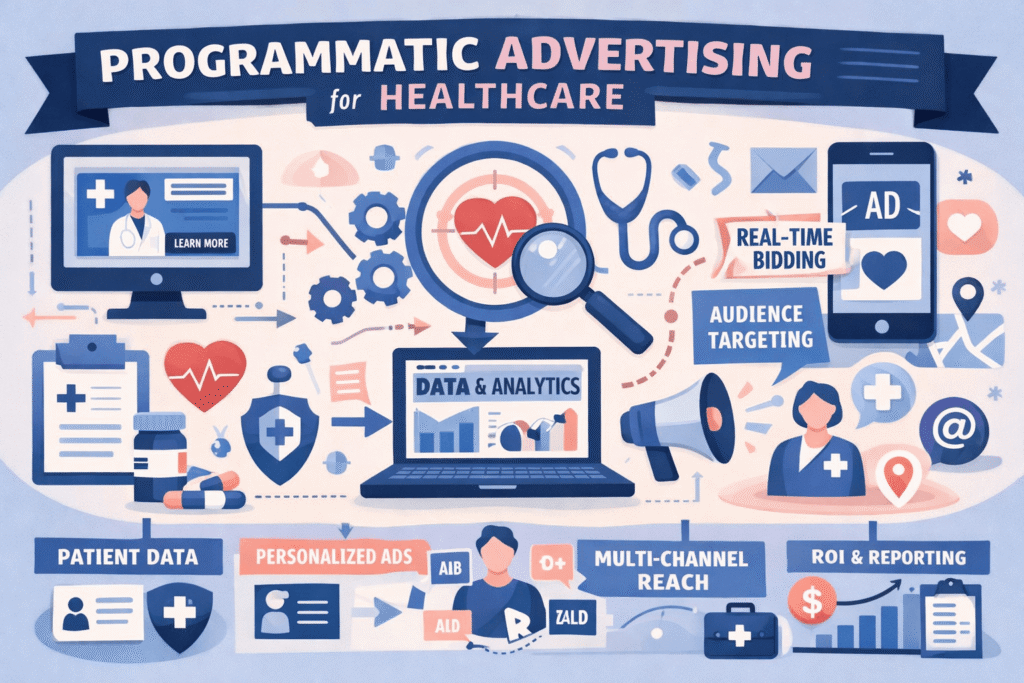
“Maximize ROI with programmatic advertising for healthcare. Use AI-driven, real-time bidding to reach patients precisely and efficiently.”
Marketing in the medical field changes fast. Years ago, hospital marketers bought billboard space. They placed ads in local newspapers. They hoped the right patients saw their messages. Today, hope is no longer a strategy. Technology offers precision. Technology offers speed. Healthcare organizations now use complex software to reach patients. This shift brings us to programmatic advertising for healthcare.
If you manage marketing for a clinic, hospital, or medical group, you know the stakes. You must spend your budget wisely. You must reach the right patients. You must follow strict privacy laws. Traditional media buying takes too much time. It involves phone calls, manual negotiations, and physical contracts. It lacks the speed required in today’s digital world. Programmatic ad buying solves these problems. It uses software to automatically purchase digital ad space. It uses data to decide which ads to show to which users.
This guide will explain how programmatic advertising works. We will explore the software behind it. We will examine how it helps medical groups grow. Finally, we will show you how InvigoMedia leads the way in healthcare ad tech.
The Evolution of Medical Marketing
Think about how people look for medical information. They do not wait for a TV commercial. They search online. They read health blogs. They use symptom checkers. They browse social media. Patients spend hours on their smartphones and computers. Therefore, medical marketers must reach them on these digital devices.
In the early days of digital marketing, everything was done manually. A hospital marketing director wanted to place banner ads for hospitals on a popular health website. The director contacted the website’s sales team. They negotiated a price. They signed a contract. The website agreed to show the ad a certain number of times. This process is known as direct buying.
Direct buying works, but it presents challenges. First, it takes a lot of time. Second, it limits your reach. You only show ads on the specific websites you negotiated with. Third, it lacks precision. You show your ad to everyone visiting that website. You do not know if those visitors actually need your medical services.
Automated healthcare media buying changes the rules. You no longer buy space on a specific website. Instead, you buy access to a specific audience. You use data to identify users who likely need your services. Then, you use software to show ads to those specific users, no matter which website they visit. This approach saves time. It reduces wasted money. It improves your return on investment (ROI).
Demystifying Programmatic Advertising
So, what exactly is programmatic advertising? In simple terms, programmatic advertising uses artificial intelligence (AI) and automated software to buy digital advertising space in real time.
Instead of humans negotiating with humans, computers talk to computers. The AI analyzes massive amounts of data in milliseconds. It looks at the user clicking on a webpage. It looks at the available ad space on that page. It decides if that user matches your target audience. If the user matches, the AI places a bid for that ad space. If your bid wins, your ad appears. All of this happens in the time it takes a webpage to load.
This automation removes the guesswork from media buying. You set the rules. You define your target audience. You set your budget. The software does the heavy lifting. It works 24 hours a day. It constantly optimizes your campaigns. It finds the most cost-effective ways to reach your ideal patients.
Why AI Matters in Medical Ads
Artificial intelligence drives programmatic ad buying. The AI learns from every campaign. It sees which ads get clicks. It identifies which ads drive patient appointments. It identifies patterns that humans might miss.
For example, the AI might notice that patients looking for orthopedic surgeons often read articles about marathon training. Consequently, the AI will start bidding on ad space on running blogs. It adapts to user behavior. It ensures your data-driven advertising stays efficient.
Furthermore, the AI manages your budget perfectly. It knows when to bid high for a highly qualified patient. It knows when to bid low or skip a bid entirely. This precision prevents wasted ad spend.
The Engine: Real-Time Bidding Healthcare
To understand programmatic ads, you must understand real-time bidding (RTB). RTB acts as the engine of the programmatic ecosystem. It is an auction that happens in milliseconds.
Here is a step-by-step look at how real-time bidding in healthcare works:
- A user opens a webpage: Imagine a 45-year-old man in Chicago. He opens a news website on his laptop. He previously searched for “knee joint pain remedies.”
- The publisher offers the space: The news website has an empty ad slot. The website sends a signal to an ad exchange. The signal says, “I have an ad space available. The user is a 45-year-old male in Chicago interested in knee health.”
- The auction begins: The ad exchange sends this information to various advertisers.
- Advertisers evaluate the user: Your hospital’s programmatic software receives the signal. Your software knows you want to reach men in Chicago with knee pain. You want to promote your orthopedic department.
- Bids are placed: Your software automatically places a $2.00 bid for that ad space. Another clinic bids $1.50. A sports medicine brand bids $1.75.
- The winner is chosen: The ad exchange receives the bids. Your $2.00 bid wins the auction.
- The ad appears: The news website loads your hospital’s banner ad. The man sees your message about advanced knee replacements.
This entire seven-step process happens in about 100 milliseconds. The user never notices a delay. The webpage loads normally. Yet, in that fraction of a second, an incredibly complex financial transaction occurred.
RTB provides incredible value. You only pay for ad impressions that actually reach your target demographic. You stop wasting money showing orthopedic ads to people who only need a pediatrician.
The Core Components of Healthcare Ad Tech
The programmatic ecosystem relies on several distinct technologies. These platforms work together to enable automated buying. You need to understand these tools to grasp healthcare ad tech.
1. Demand-Side Platform (DSP)
A DSP serves as the advertiser’s control center. Marketers and agencies use a DSP to set up campaigns, define audiences, and manage budgets. When you use a DSP for medical marketing, you plug into the global ad exchange. You tell the DSP who you want to reach. The DSP then automatically bids for ad space across thousands of websites and apps. The DSP acts as your buyer in the real-time auction.
2. Supply-Side Platform (SSP)
An SSP serves the publishers. Publishers own the websites and apps where ads appear. Examples include WebMD, local news sites, and health blogs. Publishers use an SSP to list their available ad space. The SSP connects to ad exchanges and aims to secure the highest possible price for each ad slot. The SSP acts as the seller in the auction.
3. The Ad Exchange
The ad exchange acts as the digital marketplace. It sits between the DSP and the SSP. It facilitates the transaction. The SSP brings the ad space. The DSP brings the advertiser’s money. The ad exchange runs the real-time auction and determines the winner.
4. Data Management Platform (DMP)
A DMP collects, stores, and organizes data. Data forms the foundation of programmatic advertising. A DMP gathers information from various sources. It collects first-party data, like visitors to your hospital’s website. It collects third-party data, such as generalized demographic information,n from data providers. The DMP analyzes this data to build detailed audience profiles. The DSP uses these profiles to decide who to target.
When these four components work seamlessly, medical marketers achieve unprecedented scale and precision.
Precision Matters: Audience Targeting Medical Strategies
The biggest advantage of programmatic advertising is its targeting capabilities. Traditional advertising relies on the “spray and pray” method. You spray your message everywhere. You pray that the right people see it. Programmatic advertising acts like a sniper rifle. It uses audience targeting medical data to pinpoint exact patient profiles.
You can target users in several distinct ways.
Demographic Targeting
This represents the most basic level of targeting. You can target users based on their age, gender, household income, and education level. For instance, a pediatric clinic will target parents of young children. A Medicare Advantage plan will target seniors age 65 and older.
Behavioral Targeting
This method examines how users behave online. It tracks their search history. It notes the types of articles they read. It tracks the videos they watch. If a user frequently reads articles about managing blood sugar, the system tags them as interested in diabetes care. An endocrinology clinic can then target this user with relevant ads. Behavioral targeting focuses on the user’s intent.
Contextual Targeting
Contextual targeting ignores the user’s past behavior. Instead, it focuses on the content of the webpage they are currently viewing. If a user reads an article about “The Best Stretches for Lower Back Pain,” a physical therapy clinic can show an ad on that specific page. The ad matches the article’s context perfectly. This method proves highly effective and avoids many privacy concerns.
Geo-Fencing and Location Targeting
Healthcare happens locally. Patients rarely travel across the country for a routine checkup. Therefore, location targeting proves crucial. You can target users within a specific city or zip code. Furthermore, you can use geo-fencing. Geo-fencing draws a virtual boundary around a specific location.
For example, an urgent care clinic can set up a geofence around a busy local park. If a user enters the park with their smartphone, they might see an ad for the urgent care clinic. This strategy captures patients when they are nearby and potentially in need of immediate minor care.
Retargeting
Retargeting reaches users who previously interacted with your brand. Suppose a patient visits your hospital’s cardiology page. They read about heart health,h but do not schedule an appointment. A few days later, they browse a weather website. Your DSP recognizes its device. It shows them a display ad reminding them to book a heart screening. Retargeting brings interested patients back to your website.
Exploring Digital Display Advertising Formats
Programmatic advertising supports a wide range of ad formats. You are not limited to basic text ads. You can use rich, engaging media to capture attention. Digital display advertising encompasses a wide variety of visual messages.
Banner Ads for Hospitals
Banner ads remain the most common format. These are the rectangular image ads you see at the top, bottom, or sides of webpages. They include text, an image, and a clear call to action (CTA). Good banner ads load quickly. They clearly state the medical service offered. They encourage the user to click to learn more.
Programmatic Video Ads
Video captures attention better than static images. Programmatic technology allows you to place video ads before, during, or after video content on websites and apps. You can show a 15-second patient testimonial before a user watches a news clip. Video builds trust quickly. Trust represents the most valuable currency in healthcare.
Native Advertising
Native ads blend into the website’s content. They do not look like traditional banner ads. They look like recommended articles or sponsored content. A native ad for a weight-loss surgery center might appear at the end of a health blog, appearing as a suggested related article. Native ads receive high click-through rates because they do not disrupt the user’s reading experience.
Programmatic Audio
Streaming music and podcasts continue to grow in popularity. Programmatic audio lets you insert audio ads on platforms like Spotify and Pandora. You target listeners based on their demographics or the podcast genre they choose. An audio ad for a mental health clinic works perfectly during a podcast about stress management.
Connected TV (CTV)
Connected TV refers to televisions connected to the internet. This includes smart TVs and devices like Roku or Apple TV. Programmatic CTV allows you to buy television commercials with the precision of digital advertising. You show high-quality commercials on the big screen, but you only show them to households that match your target medical audience.
Navigating Privacy and Compliance in Healthcare Ads
Healthcare marketers face a massive hurdle: privacy regulations. Patient data demands extreme protection. The Health Insurance Portability and Accountability Act (HIPAA) sets strict rules in the United States. You cannot use protected health information (PHI) for marketing purposes without explicit consent.
Programmatic advertising uses data. Therefore, you must navigate these rules carefully. A single privacy violation can destroy a hospital’s reputation. It can result in massive financial penalties.
The Rule of Anonymization
Compliant targeted health ads rely on anonymized data. Marketers cannot target John Smith based on his specific medical chart. Instead, platforms group users into broad, anonymous cohorts. The DSP targets a device ID or an anonymous cookie, not a named individual. The system knows the device shows interest in back pain, but it does not know the device belongs to John Smith.
Limits on Retargeting
Healthcare marketers must limit retargeting. Retargeting someone for a sensitive condition violates privacy principles. For example, if a user visits a webpage about HIV treatment, you cannot retarget them with HIV ads across the internet. Doing so reveals their potential medical condition to anyone else looking at their screen.
Instead of retargeting sensitive conditions, medical marketers focus on service line retargeting. You might retarget someone who visited a general “Orthopedics” page or a “Maternity Ward Tours” page. You avoid highly sensitive, stigmatized conditions entirely.
The Shift to Contextual Targeting
Because privacy laws grow stricter, contextual targeting gains popularity. As mentioned earlier, contextual targeting relies on the webpage content, not the user’s history. By targeting the content, you eliminate the need to track the user’s personal data. This provides a completely privacy-compliant way to deliver relevant medical ads.
Working with experts guarantees compliance. A specialized healthcare agency understands HIPAA. They configure DSPs to filter out restricted data. They ensure your campaigns stay legal, ethical, and effective.
The Big Benefits for Large Medical Groups and Hospital Systems
Small clinics benefit from basic digital ads. However, large hospital systems see the most dramatic results from programmatic advertising for healthcare. When you manage dozens of facilities, hundreds of doctors, and millions in marketing budget, automation becomes necessary.
1. Unmatched Scale
A large hospital system needs to fill appointments across multiple departments. They need to promote cardiology, oncology, pediatrics, and emergency services simultaneously. Manual media buying cannot handle this volume. Programmatic platforms allow you to run thousands of distinct campaigns at once. You reach millions of potential patients across the entire internet. You can achieve scale impossible through traditional methods.
2. Extreme Efficiency and Cost Savings
Programmatic algorithms focus on ROI. They eliminate wasted spending. If a specific website drives clicks but no patient appointments, the AI stops bidding on that site. It automatically shifts the budget to better-performing publishers. Furthermore, you reduce agency overhead. You spend less money paying humans to negotiate contracts. You spend more money actually buying ad space.
3. Real-Time Optimization
Traditional advertising moves slowly. You buy a magazine ad, wait a month, and guess the results. Programmatic advertising gives you real-time data. You launch a campaign on Monday morning. By Monday afternoon, you know which banner ad generates the most clicks. You know which zip code responds best. You can adjust your budget, pause underperforming ads, and push winning ads instantly.
4. Cross-Device Tracking
Patients do not use just one device. A patient might search for a pediatrician on their work computer during the day. They might discuss it with their spouse on a tablet in the evening. They might finally book the appointment on their smartphone the next morning. Programmatic platforms track anonymous users across multiple devices. You deliver a consistent message regardless of the screen they use.
5. Measurable ROI
Hospital executives demand proof of success. Programmatic platforms provide granular reporting. You track every dollar spent. You measure exactly how many ad impressions led to website visits. You track how many visits led to phone calls or booked appointments. You prove the exact value of your marketing efforts to the board of directors.
The Role of First-Party Data
Data privacy changes constantly. Web browsers like Google Chrome and Apple Safari block third-party cookies. Third-party cookies previously fueled much of the behavioral targeting on the internet. With these cookies disappearing, healthcare marketers must adapt.
The solution lies in first-party data. First-party data refers to the information you collect directly from your patients and website visitors. It includes data from your patient portal. It includes lists of email subscribers. It includes user behavior on your hospital website.
Because you own this data, you can use it compliantly (following strict anonymization rules). You feed your first-party data into a DMP. The programmatic software uses this data to find “lookalike” audiences.
For instance, you analyze the common traits of patients who use your physical therapy clinic. The software identifies their general demographics and online behaviors. The DSP then searches the internet for new, anonymous users who match those exact traits. You find new patients who look exactly like your best current patients. Relying on first-party data future-proofs your data-driven advertising strategy against changing privacy laws.
Crafting the Right Message for Healthcare
Technology only handles the delivery. The creative message still determines success. An incredible programmatic algorithm cannot save a terrible ad. In medical marketing, your message must strike a careful balance. It must be professional. It must build trust. It must inspire action without causing panic.
Clarity Over Cleverness
Medical emergencies require clear solutions. Patients do not want riddles. If you promote an urgent care center, state the wait times clearly. Show the address. Explain the services offered. Use simple, direct language.
Empathy and Compassion
Healthcare marketing involves people in vulnerable situations. Your imagery should reflect compassion. Use images of caring doctors and relieved patients. Avoid overly graphic medical imagery. Focus on the positive outcome, not the pain of the disease.
Strong Calls-to-Action
Every programmatic ad requires a clear next step. Tell the user exactly what to do. Use phrases like:
- “Schedule Your Screening Today”
- “Find a Doctor Near You”
- “Download Our Joint Pain Guide”
- “View Urgent Care Wait Times”
The programmatic software delivers the ad to the right person. Your strong CTA forces them to click.
Why Partner with InvigoMedia?
Programmatic advertising presents a steep learning curve. The software platforms feature hundreds of complex settings. A single misconfiguration wastes thousands of dollars. A privacy mistake causes legal disasters. Therefore, large medical groups should not manage programmatic campaigns internally without deep expertise. You need a dedicated partner. You need an authority in the field.
InvigoMedia stands as a premier authority in medical ad tech. We do not just run ads. We engineer sophisticated patient acquisition systems.
Deep Healthcare Expertise
Many marketing agencies run programmatic ads for retail stores or car dealerships. They try to apply those same strategies to hospitals. That approach fails. Selling a car differs entirely from promoting an oncology center.
InvigoMedia specializes strictly in healthcare. We understand patient journeys. We know how patients research symptoms. We understand the emotional weight of choosing a specialist. We build campaigns tailored specifically to the nuances of the medical industry.
Mastery of Healthcare Ad Tech
We utilize the most advanced DSPs for medical marketing. We do not rely on basic tools. We leverage enterprise-level software capable of processing millions of data points per second. Our team configures these platforms to execute highly complex, multi-tiered campaigns. We manage the bidding strategies. We handle the technical integrations. We ensure your ads load flawlessly across all devices.
Uncompromising Compliance Focus
We prioritize your reputation. We navigate HIPAA regulations daily. We design campaigns that utilize contextual targeting and anonymized data safely. We ensure every single ad impression complies with state and federal privacy laws. You gain peace of mind knowing your digital marketing stays legally sound.
Delivering the Right Message
We believe in precision. We deliver the right health message to the right patient, at the exact right time. We use dynamic creative optimization. This means the AI automatically tests different headlines and images. It learns which combination drives the highest appointment booking rate. We continuously refine the creative to maximize your ROI.
Proven ROI for Medical Groups
We measure our success by your patient volume. We provide transparent, easy-to-read dashboards. You see exactly where your budget goes. You see the cost to acquire a new patient for every service line. Our data-driven approach consistently lowers patient acquisition costs for large medical groups.
When you partner with InvigoMedia, you stop guessing. You stop wasting budget. You deploy a highly tuned, automated machine that drives consistent patient growth.
Conclusion
The era of manual media buying has ended. The future belongs to automation. Programmatic advertising for healthcare offers hospitals and clinics a massive competitive advantage. It provides the scale to reach millions. It provides the precision to target specific demographics. It provides the efficiency to maximize every marketing dollar.
By embracing real-time bidding healthcare and advanced DSPs, medical marketers can finally connect with patients precisely when they need care. They can deliver targeted, relevant messages without violating privacy. However, mastering this technology requires specialized knowledge. It requires a deep understanding of both digital algorithms and medical compliance.
Large medical groups need a trusted guide to navigate this complex landscape. InvigoMedia provides that guidance. We blend technical mastery with deep healthcare experience. We manage the software, optimize the bids, and protect your privacy. If you want to stop wasting ad spend and start driving measurable patient growth, programmatic advertising offers the path forward. Embrace the technology. Partner with the experts. Watch your practice thrive.
FAQs
What is programmatic advertising for healthcare?
Programmatic advertising for healthcare is the automated buying and selling of digital ad space using artificial intelligence and software. Instead of humans negotiating contracts with specific websites, algorithms bid on ad space in real time. The software targets specific audiences based on data, ensuring medical ads reach users most likely to need the services they offer.
How does real-time bidding work in medical marketing?
Real-time bidding (RTB) is an automated auction. When a user opens a webpage, the site’s available ad space goes up for auction. Advertisers use software to evaluate users’ anonymous profiles automatically. If the user matches the advertiser’s target audience (e.g., searching for pediatricians), the software places a bid. The highest bidder wins, and their ad appears on the webpage instantly. This all happens in milliseconds.
Is programmatic advertising HIPAA compliant?
Yes, it can be, but it requires careful management. To remain HIPAA compliant, programmatic campaigns must avoid targeting individual users based on Protected Health Information (PHI). Instead, marketers use anonymized data, broad demographic cohorts, and contextual targeting (targeting the content of the webpage rather than the user’s history). Marketers must also avoid retargeting users for sensitive medical conditions. Working with a specialized healthcare agency ensures compliance.
What is a DSP, and why do I need one?
A DSP, or Demand-Side Platform, is the software advertisers use to buy programmatic ads. It allows you to manage multiple ad exchange accounts through one interface. You need a DSP to define your target audience, set your budget, and allow the automated AI to place bids on your behalf. A good DSP provides the massive reach and precise targeting necessary for modern digital marketing.
What are the best ad formats for healthcare?
Healthcare marketers use several formats successfully. Digital display ads (banner ads) remain effective for general awareness and for clear calls to action. Programmatic video ads work exceptionally well for building trust through patient testimonials or doctor introductions. Native ads are great for promoting informative health blogs or symptom guides, as they blend in with the website’s regular content.
Why is programmatic advertising better for large hospital systems?
Large hospital systems manage multiple locations and dozens of specialties. Manual ad buying cannot efficiently scale to handle this complexity. Programmatic advertising allows hospitals to run thousands of highly targeted campaigns simultaneously. It optimizes budgets in real time, automatically reallocates funds to the best-performing ads, and provides precise ROI tracking across all departments.
How do privacy changes, like the removal of cookies, affect programmatic ads?
The removal of third-party cookies makes traditional behavioral tracking harder. However, programmatic technology is adapting. Advertisers now focus heavily on first-party data (data collected directly from their own patients and websites). They also rely more on contextual targeting, which places ads based on the current webpage content rather than the user’s past browsing history. These methods provide effective targeting while respecting user privacy.