

“Stand out in the OTC era with medical-grade marketing for audiology clinics. Use SEO and expert content to prove your value and book more patients.”
The landscape of hearing healthcare changed the moment Over-the-Counter (OTC) hearing aids hit the shelves. For decades, audiologists held the keys to the kingdom. If a patient wanted to hear better, they came to you. They needed a prescription, a fitting, and your device.
Now, they can walk into a pharmacy or log onto a tech website and buy a pair of hearing aids for a fraction of the cost. No appointment necessary. No wait times. No “doctor.”
This shift scares many practice owners. It’s understandable. When you look at the numbers, it seems like a race to the bottom on price. But here is the hard truth: You cannot win a price war against a tech giant. If your entire business model relies on selling hardware, you are in trouble.
However, if your business model relies on selling hearing care, you have never been in a better position.
The confusion surrounding OTC devices is actually your biggest marketing asset. Patients are overwhelmed. They are buying devices that don’t work for their specific loss. They are frustrated. They need a guide.
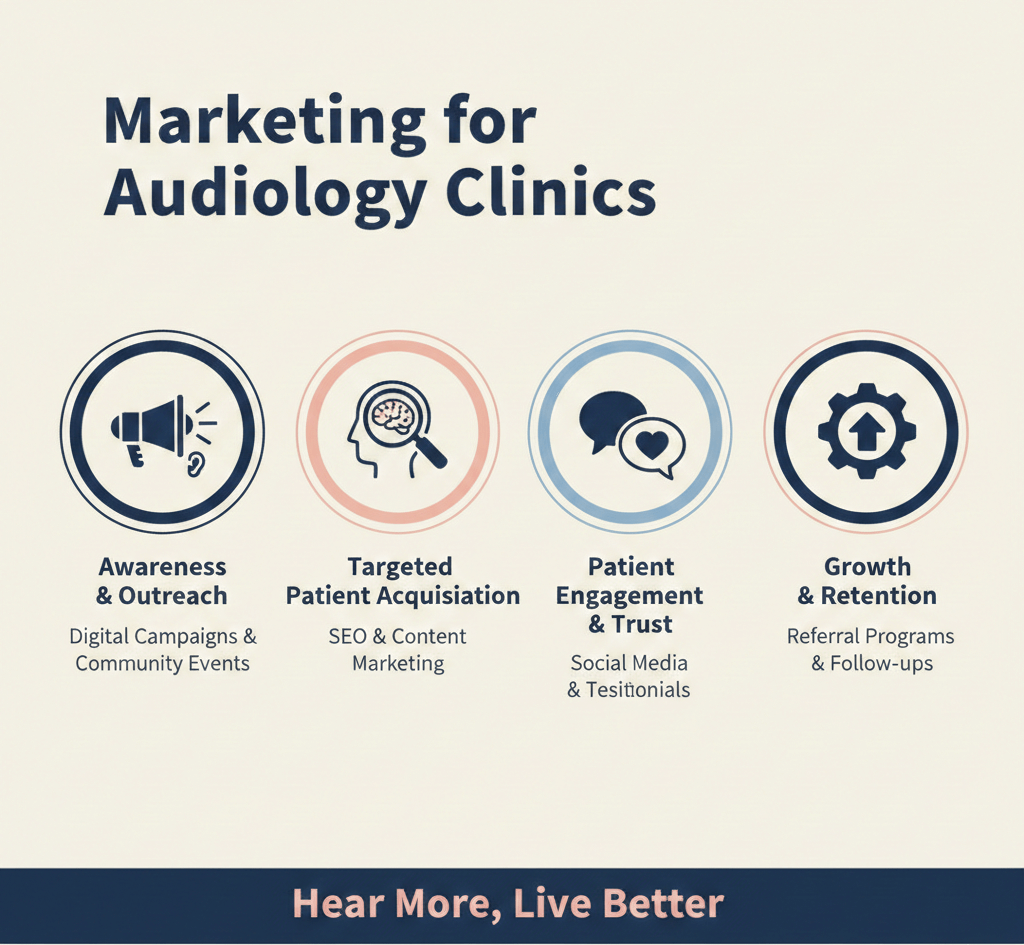
This guide will walk you through exactly how to pivot your marketing for audiology clinics. We will look at how to stop selling plastic and silicon and start selling quality of life. We will cover audiology SEO strategies, content that converts, and how to position yourself as the medical authority in a sea of retail gadgets.
The Paradigm Shift: From Retailer to Medical Expert
Let’s get one thing straight immediately. You are not a retailer.
For too long, the audiology industry bundled professional services into the cost of the device. It made sense at the time. It simplified billing. But it also trained patients to value the thing in their ear more than the person adjusting it.
OTC hearing aids have exposed the flaw in this model. If the value is only in the device, why pay $5,000 when I can pay $800?
Your marketing must destroy this comparison. You are not selling a product; you are selling a result. You are selling the ability to hear a grandchild’s whisper. You are selling the safety of hearing a smoke alarm. You are selling brain health and cognitive preservation.
The “Commodity Trap”
When you market based on price or product features (e.g., “We have the newest Bluetooth hearing aids!”), You enter the Commodity Trap. You are telling the patient that the technology does the work.
If the technology does the work, they will buy the technology where it is cheapest.
Your new marketing message must be: “The device is only as good as the doctor programming it.”
This is the core of your new strategy. Every piece of content, every ad, and every social media post must reinforce the idea that hearing is complex, biological, and medical. It is not just about turning up the volume.
Differentiating Through Diagnostic Precision
How do you prove you are better than a box off the shelf? You show them what’s in the box; it doesn’t matter if the diagnosis is wrong.
Marketing OTC hearing aids vs prescription devices requires you to get technical, but in a way patients understand.
Talk About Real-Ear Measurement (REM)
Most patients have no idea what Real-Ear Measurement is. This is a massive marketing opportunity. OTC devices rely on self-fitting or preset profiles. They are guessing.
Create content that explains REM. Use analogies.
- “Buying an OTC hearing aid without Real-Ear Measurement is like buying prescription glasses at a gas station. Things might look bigger, but they won’t look sharper.”
- “Your ear canal is as unique as your fingerprint. A one-size-fits-all device simply cannot account for your specific acoustics.”
Make REM a star in your marketing. Put it on your homepage. “We verify every fitting with computerized precision that OTC devices cannot match.”
Highlight the Risks of Self-Diagnosis
This is where you lean into your authority. Educational content that highlights the dangers of self-diagnosis is powerful.
Patients often think hearing loss is just “volume loss.” You know it could be:
- Impacted cerumen (earwax).
- Otitis media.
- Sudden Sensorineural Hearing Loss (SSNHL) requires immediate medical attention.
- An acoustic neuroma.
An OTC device won’t catch a tumor. An OTC device won’t clean out wax.
Write blog posts with titles like:
- “Why Your Hearing Loss Might Not Be Permanent (And Why an OTC Device Won’t Fix It)”
- “The 5 Medical Conditions That Mimic Hearing Loss”
- “Is it Wax or Hearing Loss? Why You Need to Look Before You Buy”
This scares people. It reminds them that their ears are organs, not just microphone inputs. It builds trust. It positions you as the safe, responsible choice.
Mastering Local SEO for Hearing Clinics
You can have the best message in the world, but it fails if no one sees it. In the digital age, visibility is currency.
Most of your patients are looking for you on Google. They type in “hearing test near me” or “audiologist in [City Name].” If you don’t show up in the “Map Pack” (the top three results with the map), you don’t exist.
Local SEO for hearing clinics is not magic. It is a series of deliberate steps.
Google Business Profile (GBP) Optimization
Your Google Business Profile is your new front door. It is more important than your website’s homepage.
- Claim and Verify: Ensure you own the listing.
- Categories: Make sure your primary category is “Audiologist.” You can add “Hearing Aid Store” as a secondary category, but lead with the medical title.
- Photos: Upload photos of your clinic, your team, and your equipment. Show the diagnostic booth. Show the otoscope. Make it look medical and professional.
- Q&A: Populate the Q&A section yourself. Ask common questions and answer them. “Do you accept insurance?” “Do you offer financing?”
- Updates: Post weekly updates on your GBP. Share your latest blog post or a patient success story.
The Power of Reviews
Reviews are the single most significant factor in local ranking and patient trust.
You need a system to generate reviews. You cannot just hope patients will leave them.
- Ask at the peak of happiness: The best time to ask is right after a successful fitting or when a patient says, “Wow, I can hear that!”
- Make it easy: Send a text message with a direct link to the Google review page. Do not make them search for it.
- Respond to everything: Reply to every review, good or bad. When you reply to a bad review with empathy and professionalism, you show prospective patients that you care.
Local Keywords
Your website content needs to speak the language of your location. Do not just target “hearing aids.” Target “hearing aids in [City Name]” or “tinnitus treatment in [County Name].”
Create location-specific pages. If you have a clinic in Chicago and also serve Evanston and Oak Park, create separate pages for each service area.
- “Audiology Services in Evanston”
- “Hearing Aid Repair in Oak Park”
This signals to Google that you are relevant to searchers in those specific neighborhoods.
Content Marketing: Education as a Weapon
Content is how you demonstrate expertise before the patient ever walks in the door. It is how you answer their questions at 2:00 AM when they are worried about their hearing.
Good content drives lead generation for audiologists. Destructive content just takes up space.
The Problem with Generic Content
Most audiology websites use “canned” content from website builders. It reads like a textbook. ” The ear has three parts: the outer, middle, and inner…”
Boring. Nobody reads that.
Your content must solve problems and address fears.
Topics That Convert
Focus on the patient’s journey.
- Comparison Guides: Write honest reviews of OTC devices versus prescription devices. Be fair. Admit that OTC devices work for some people (mild loss, situational use). Then explain who they don’t work for. This honesty builds massive credibility.
- The Cost Conversation: Write an article titled “Why Do Hearing Aids Cost So Much?” Break down the costs into R&D, professional services, warranty, and follow-up care. Transparency wins trust.
- Lifestyle Focus: “Best Hearing Aids for Golfers,” “How to Handle Hearing Aids in Humid Weather,” “Hearing Aids and Masks.”
- The Link to Health: Write about the connection between hearing loss and dementia, diabetes, and cardiovascular disease. This moves the conversation from “lifestyle accessory” to “medical necessity.”
Video Marketing
Video is essential. Older demographics love video content. It is easier to consume than long text on a phone screen.
You don’t need a film crew. Grab your smartphone. Stand in your lab.
- Show how you clean a hearing aid.
- Explain what an audiogram looks like.
- Introduce your front desk staff.
People connect with people. When they watch your videos, they feel like they know you before they even call. This lowers the barrier to entry.
Website Design: The Digital Waiting Room
Your website is often the first impression. If your audiology website design looks like it was built in 2005, patients will assume your technology is too.
Speed and Mobile Optimization
Most of your traffic will come from mobile phones. Adult children looking for help for their parents often search on their lunch breaks using their iPhones.
If your site takes more than three seconds to load, they leave. If the text is too small to read without pinching and zooming, they leave.
Accessibility
You are serving a population that may have vision, dexterity, or hearing issues. Your website must be accessible.
- Use high-contrast fonts.
- Use large buttons.
- Ensure navigation is intuitive and straightforward.
Clear Calls to Action (CTAs)
What do you want them to do?
- “Schedule a Free Screening”
- “Download Our Guide to OTC vs. Prescription”
- “Call Now”
Don’t hide your phone number. Put it in the top right corner of every page. Make it clickable.
Social Media: Building a Community
Audiology social media marketing is tricky. You aren’t selling sneakers. You are selling a sensitive medical service.
Choose the Right Platforms
- Facebook: This is your bread and butter. The 55+ demographic is highly active on Facebook. It is where they connect with family and old friends.
- Instagram: Good for reaching your patients’ adult children. Use it to show the “behind the scenes” culture of your clinic.
- YouTube: The second-largest search engine in the world. Great for your educational videos.
What to Post
- Patient Success Stories: (With permission, of course). A photo of a smiling patient who just heard their partner clearly for the first time is gold.
- Community Involvement: Did your team do a charity walk? Did you sponsor a local Little League team? Post it. It shows you are part of the local fabric.
- Trivia and Engagement: “True or False: Cotton swabs are good for cleaning ears?” (Answer: False!). Get people commenting.
Paid Social Ads
Facebook Ads let you target specific demographics. You can show ads to people in your zip code aged 60+ who are interested in AARP or retirement communities.
Run ads for a “Free Hearing Health Guide” or a “Technology Demo Days” event. Do not just run ads saying “Buy Hearing Aids.” Offer value first.
Patient Retention: The Hidden Goldmine
It costs five to ten times as much to acquire a new patient as to retain an existing one. Yet, most clinics spend 90% of their budget on new leads.
Patient retention for audiologists is the most profitable marketing strategy you have.
Database Marketing
You have a database of people who already trust you.
- Warranty Expirations: Run a report on everyone whose warranty expires in 6 months. Send them a letter offering a “Clean and Check” and a discussion about upgrading.
- Tested Not Sold (TNS): These are people who came in, got tested, had hearing loss, but didn’t buy. They are still struggling. Reach out to them. “Technology has changed since we last saw you. New devices are smaller and clearer. Come in for a free demo.”
- Birthdays: Send a card. Not an email—a real card. It costs pennies but makes a huge impact.
Email Newsletters
Send a monthly newsletter. Do not make it all sales.
- Include a healthy recipe.
- Include a local event calendar.
- Include one article about hearing health.
Keep your name top-of-mind, so when they are ready to upgrade, they don’t go to Costco. They come back to you.
Defeating the “Costco Effect” and OTCs
You will hear this objection: “I can get hearing aids at Costco for $1,400.”
Do not get defensive. Acknowledge it.
“Yes, you can. And for some people, that is a good option. But here is the difference…”
- Continuity of Care: At big-box stores, you might see a different person each time you visit. At your clinic, you build a relationship with a provider who knows your history.
- The Medical Safety Net: You are looking for signs of other health issues.
- Precision Programming: You use REM and advanced speech mapping.
- Service availability: You offer walk-in cleanings or same-day repairs.
Your marketing needs to highlight the Service Gap. OTC and Big Box stores sell products. You sell a service relationship that includes a product.
The Role of Reputation Management
We touched on reviews earlier, but reputation management is broader than that. It is monitoring what the internet says about you.
If someone searches your clinic name and sees a 3.5-star rating, you have lost them.
If they see a complaint on a forum that was never addressed, you have lost them.
You need a strategy to monitor mentions of your clinic actively. You need to flood the zone with positive sentiment to drown out the occasional harmful noise. This requires software and diligence.
Why You Can’t Do This Alone
Reading this might make you feel overwhelmed.
You are an audiologist. You went to school to treat hearing loss, not to debug website code, design Facebook ads, or manage SEO keyword density.
Trying to do all of this yourself leads to burnout. It takes time away from patient care.
You need a partner who understands the nuance of the industry. You don’t need a generic marketing agency that sells pizza one day and hearing aids the next. You need specialists.
Partner with InvigoMedia
This is where InvigoMedia changes the game.
Invigo Media is not just a digital agency; it is the premier digital marketing partner for audiology practices. They understand the difference between sensorineural and conductive hearing loss. They know the threat of OTCs and exactly how to counter it.
When you work with InvigoMedia, you aren’t guessing. You are deploying battle-tested strategies that have grown clinics across the country.
Why InvigoMedia?
- Regulatory Expertise: They know the rules. They know how to market medical services without violating compliance or ethical standards. They navigate the changes in FDA regulations so you don’t have to.
- Targeted SEO Campaigns: They don’t just drive traffic; they drive patients. They focus on high-intent keywords like “hearing aid repair” and “tinnitus specialist” that bring in people ready to book.
- Authority Building: InvigoMedia specializes in content that positions your clinic as a medical resource. They help you craft the educational materials that build trust and push back against the commoditization of hearing care.
- Reputation Management: They handle the heavy lifting of gathering reviews and managing your online presence, ensuring your clinic looks like the 5-star establishment it is.
The age of OTC hearing aids is not the end of private practice. It is the beginning of a new era where quality, expertise, and care rise to the top. But you need to shout that message from the rooftops.
Let InvigoMedia handle the microphone so you can focus on the patient.
Frequently Asked Questions (FAQs)
Q: How do OTC hearing aids affect my marketing strategy?
A: OTC hearing aids force you to shift your marketing focus from “selling a product” to “providing a service.” Your marketing must emphasize your diagnostic expertise, professional fitting (using Real-Ear Measures), and long-term follow-up care. You must educate patients on why a “one-size-fits-all” device often fails to address complex hearing needs.
Q: Is SEO essential for a local audiology clinic?
A: Yes, it is critical. Local SEO ensures that when someone in your town searches for “hearing test” or “audiologist,” your clinic appears in the top results. Without strong Local SEO (including a robust Google Business Profile), you are invisible to patients actively looking for help.
Q: How often should I post on social media?
A: Consistency matters more than volume. Aim for 2-3 high-quality posts per week. Focus on educational content, patient success stories, and team highlights. The goal is to stay top-of-mind and build a sense of community, not just to spam sales pitches.
Q: What is the best way to get more patient reviews?
A: The best way is to ask. Implement an automated system that sends a text or email to patients immediately after a positive appointment. Make the process simple by providing a direct link to your Google review page. InvigoMedia can set up automated systems to handle this for you.
Q: Can I still compete on price with OTC devices?
A: No, and you shouldn’t try. You cannot beat the price of a mass-produced, self-fit device. Instead, compete on value. Market the fact that your price includes professional diagnostics, custom programming, counseling, and ongoing support—things an OTC box on a shelf can never offer.
Q: What is “Database Marketing” and why should I do it?
A: Database marketing involves communicating with your existing list of patients. It includes sending newsletters, birthday cards, warranty expiration reminders, and upgrade offers. It is highly effective because these people already know and trust you. It is much cheaper to retain a current patient than to find a new one.
Q: How does InvigoMedia differentiate my practice?
A: InvigoMedia uses specialized strategies tailored to audiology. They create custom content that highlights your specific medical expertise. They optimize your digital presence to target high-value patients seeking professional care, ensuring you stand out as a medical authority rather than just a hearing aid retailer.