

“Boost your bottom line by focusing on the 20% of services that drive 80% of your profit. Master marketing high-margin medical procedures.”
Most medical practice owners feel like they are on a treadmill. They see patient after patient, the waiting room is full, and the staff is constantly busy. Yet, when the end of the month arrives, the bank balance doesn’t reflect that level of effort.
The problem isn’t a lack of hard work. The problem is a lack of strategic focus.
In the world of medical business, not all patients are created equal. A routine check-up and a high-ticket elective surgery might take the same amount of administrative effort to book, but their impact on your bottom line is worlds apart. If you want to scale your practice without burning out, you must master the art of marketing high-margin medical procedures.
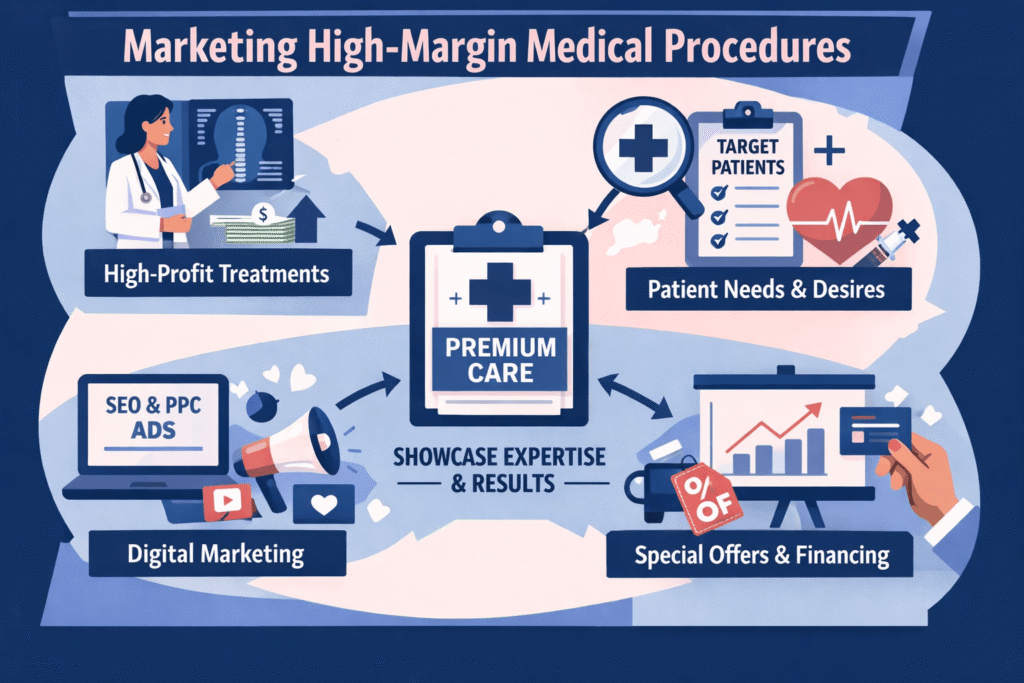
The Pareto Principle in Medicine: The 80/20 Reality
The Pareto Principle states that 80% of your results come from 20% of your activities. In a clinical setting, 80% of your profit comes from just 20% of your service offerings.
Think about your current patient load. You likely have a “bread and butter” section of your practice—the routine cleanings, the annual physicals, or the basic consultations. These are essential for keeping the lights on and building a foundation of trust. However, the real growth happens in the other 20%: dental implants, LASIK surgeries, robotic-assisted joint replacements, and premium aesthetics.
Why High-Margin Procedures Matter
High-margin procedures provide the “oxygen” your business needs to grow. When you focus on high-ticket sales within your practice, you change your financial trajectory.
- Increased Revenue per Hour: You use your surgical suite or specialized equipment to maximize financial gain.
- Better Resource Allocation: Instead of managing 100 low-value leads, you manage 10 high-value leads.
- Investment Capital: High margins allow you to hire better staff, buy better technology, and—most importantly—reinvest in even better marketing.
Understanding Patient Lifetime Value (LTV)
To market effectively, you have to look past the first transaction. Patient Lifetime Value (LTV) is the total revenue a patient generates for your practice over the entire duration of your relationship.
A patient who comes in for a $150 skin screening has a low initial value. But if that patient eventually opts for a $5,000 laser resurfacing package and returns annually for maintenance, their LTV skyrockets.
The LTV Calculation
You can simplify LTV with this formula:
$$LTV = (Average Value of a Visit) \times (Number of Visits per Year) \times (Average Years of Retention)$$
By marketing high-margin procedures, you aren’t just looking for a one-time win. You are looking for the “Entry Point” that leads to the highest possible LTV. Often, a high-margin elective procedure acts as the ultimate anchor for long-term loyalty.
Balancing the Budget: Allocation of Ad Spend
One of the biggest mistakes practice owners make is spreading their marketing budget too thin. If you spend $5,000 a month and try to promote 20 different services, you will fail at all of them.
The “Base vs. Growth” Strategy
Your healthcare budget allocation should follow a clear split:
- 70% Toward High-Margin Growth: This money goes to medical lead generation for elective, high-ticket procedures. These are the “wants” rather than the “needs.” Think cosmetic surgery, premium orthodontics, or regenerative medicine.
- 20% Toward Brand Awareness: Keep your practice’s name at the top of mind with your local community.
- 10% Toward Maintenance: Remind existing patients to book their routine follow-ups.
Why focus so much on the high-margin side? Because the Cost Per Acquisition (CPA) for a high-ticket patient is often only slightly higher than for a routine patient, but the return on investment (ROI) is exponentially greater.
Digital Advertising Strategy for Elective Procedures
You cannot market a $10,000 surgery the same way you market a $50 flu shot. High-ticket medical marketing requires a sophisticated digital advertising strategy.
1. Intent-Based Search (PPC)
When someone searches for “best rhinoplasty surgeon near me,” they have high intent to act. They are ready to spend money. PPC (Pay-Per-Click) management is the fastest way to reach these people.
To win at PPC for high-margin services, you need:
- Tight Keyword Matching: Avoid broad terms like “doctor.” Use specific terms, such as “minimally invasive spine surgery.”
- High-Converting Landing Pages: Don’t send people to your homepage. Send them to a page dedicated specifically to that one procedure.
- Social Proof: Include before-and-after photos and video testimonials directly on the landing page.
2. Social Media Disruption
While Google captures people looking for a solution, Meta (Facebook/Instagram) helps you create demand. You can target people based on interests, age, and lifestyle. For cosmetic surgery marketing, visual platforms are your best friend. Show the transformation, not just the procedure.
Revenue Cycle Management and Lead Follow-Up
Generating the lead is only half the battle. If your front desk isn’t trained to handle high-ticket inquiries, you are throwing money away.
Revenue cycle management starts at the first phone call. High-margin patients expect a “concierge” experience.
- Speed to Lead: If a lead comes in online, call them within five minutes.
- Specialized Patient Coordinators: Have a specific person handle elective procedure inquiries. This person shouldn’t be distracted by checking in insurance patients.
- Financing Options: High-ticket procedures often require financing. Offering services like CareCredit or in-house payment plans can increase your conversion rate by 30% or more.
Measuring Success: ROI vs. CPA
In medical practice ROI discussions, many doctors get hung up on the wrong numbers. They worry about the “Cost Per Click.”
Forget the clicks. Focus on the Cost Per Acquisition (CPA) and the Return on Ad Spend (ROAS).
If it costs you $500 to acquire one patient for a $10,000 procedure, your ROI is massive. If it costs you $50 to acquire a patient for a $100 cleaning, you are barely breaking even after overhead.
| Metric | Routine Service | High-Margin Procedure |
| Ad Spend | $1,000 | $1,000 |
| Leads Generated | 100 | 20 |
| CPA (Cost per Patient) | $10 | $50 |
| Average Revenue | $150 | $5,000 |
| Gross Profit (ROI) | $15,000 | $100,000 |
As you can see, even with a higher cost to get the patient through the door, the high-margin category wins every time.
The Role of Content in High-Ticket Sales
Patients researching elective procedures are nervous. They are looking for reasons to trust you. Your content should act as a bridge from “curious” to “committed.”
- Educational Long-Form Blogs: Explain the “why” behind the procedure.
- Comparison Guides: Compare Procedure A vs. Procedure B.
- Video Consultations: Give them a “test drive” of your personality before they ever step into the office.
Why Partner with InvigoMedia?
Marketing for healthcare isn’t a DIY project. The landscape is too competitive, and the regulations (like HIPAA) are too complex. You need a partner who understands that marketing is an investment, not an expense.
InvigoMedia specializes in exactly what we’ve discussed: marketing high-margin medical procedures. We don’t just “run ads.” We build growth engines.
Our approach involves:
- Data-Driven Planning: We analyze your current numbers to identify the “hidden gems” in your practice.
- Strategic PPC Management: We target high-intent keywords that lead to actual surgeries, not just “looky-loos.”
- Lead Nurturing Systems: We help your team close the gap between a “click” and a “consultation.”
We help you stop chasing low-value volume and start attracting high-value patients who value your expertise and drive your revenue.
Ready to Scale Your Practice?
Stop settling for a busy schedule that leaves you broke. Focus on the 20% of your services that create 80% of your wealth. By shifting your digital advertising strategy toward high-margin medical procedures, you can build a practice that is both profitable and sustainable.
Frequently Asked Questions (FAQs)
1. How do I identify which procedures are “high-margin” in my practice?
Look at your profit after all direct costs. This includes surgeon time, staff time, consumables, and facility overhead. Usually, elective procedures that don’t rely heavily on insurance reimbursements have the highest margins.
2. Is it risky to stop marketing my basic services?
We don’t recommend stopping entirely. Basic services provide a steady “floor” for your business and feed your patient database. However, your growth budget should focus on the procedures that move the needle the most.
3. What is a good “Cost Per Acquisition” for elective surgery?
This varies by specialty. For a $5,000 procedure, a CPA of $500–$800 is often considered very healthy. Always measure your CPA against the patient’s total LTV, not just the first visit.
4. How long does it take to see an ROI on high-ticket marketing?
PPC can generate leads within days. However, the “sales cycle” for high-ticket medical procedures is longer. A patient might research for 3 to 6 months before committing to surgery. You must have a follow-up system in place to nurture these leads over time.
5. Why can’t I just use a general marketing agency?
General agencies don’t understand the nuances of medical ethics, HIPAA compliance, or the specific psychological factors that go into a patient’s decision to choose a surgeon. A specialized partner like Invigo Media ensures your brand remains professional while still being aggressive in the market.