

“Boost your ranking! Use healthcare guest blogging to earn authoritative backlinks and turn your expertise into new patient leads.”
Your medical practice deserves to be seen. You spent years in school. You built a clinic. You help people every day. But when patients search for a doctor online, do they find you? Most often, they find the person who has the best SEO. One of the most powerful tools in that SEO toolbox is healthcare guest blogging.
Many doctors think a website is enough. They build it, put up some photos, and wait. But the internet is a crowded place. To stand out, you need more than just a site. You need authority. You need other people to talk about you. This is where medical link building comes into play.
In this guide, we will explore how to use guest blogging to grow your practice. We will look at why quality matters more than quantity. We will talk about off-page SEO for doctors in a way that makes sense. By the end, you will know how to turn your expertise into a magnet for new patients.
What is Domain Authority?
Before we talk about guest posts, we must talk about Domain Authority (DA). Think of DA as a reputation score for your website. It is a number from one to one hundred. A higher score means your site is more likely to rank high on search engines like Google.
Search engines want to give users the best information. They look at your site and ask, “Is this person a real expert?” One way they decide is by looking at who links to you. If a famous medical journal links to your blog, Google thinks you must be important. That link acts as a “vote of confidence.”
When you write for reputable medical blogs, they give you a backlink. This link transfers some of their “reputation” to you. In the SEO world, we call this “link juice.” If you get enough of this juice, your domain authority improvement starts to show. Your site moves from page ten to page one.
The Power of Healthcare Guest Blogging
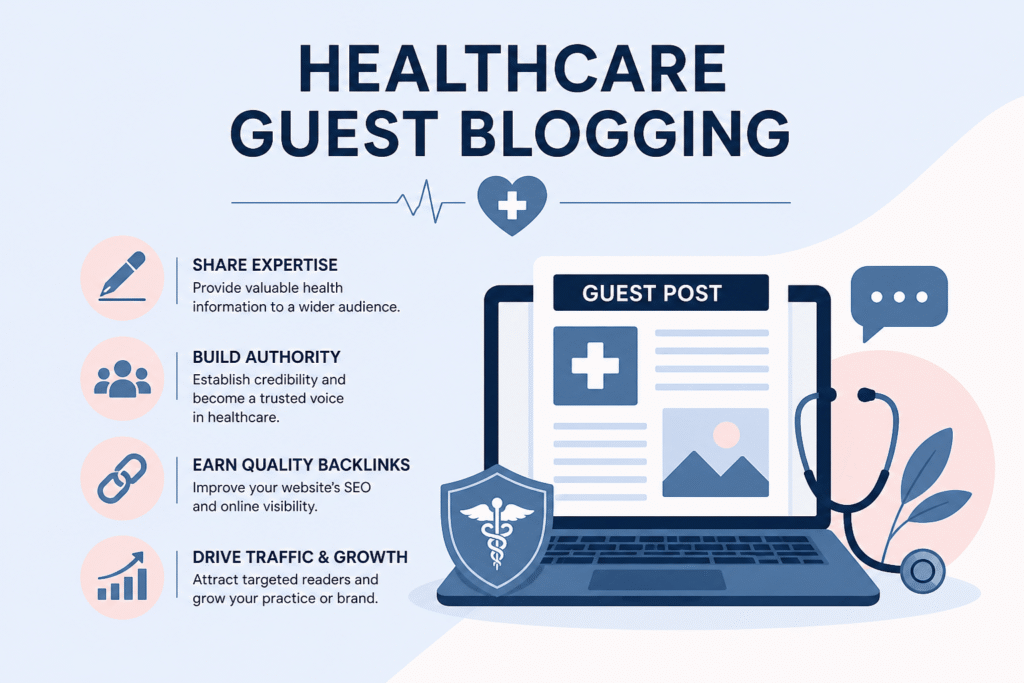
Guest blogging means writing an article for someone else’s website. You might think, “Why would I give my best ideas away for free?” The answer is simple: the backlink.
When you contribute to a high-traffic health site, you reach a new audience. These readers might never have found your clinic otherwise. They read your expert advice. They see your name. Then, they click the link in your bio. This creates referral traffic that healthcare providers can actually use.
But it does more than just bring visitors. It builds your organic search ranking. Google sees that a trusted site trusts you. Therefore, Google trusts you more, too. This is the heart of a solid SEO backlink strategy.
Why Quality Over Quantity?
Years ago, SEO was easy. You could buy thousands of cheap links and rank overnight. Those days are over. Google is smart now. It knows the difference between a real link and a fake one.
If you get 100 links from “link farms” or “spam sites,” Google will punish you. Your rankings will drop. You might even get banned from search results. This is why you must avoid “black hat” tactics.
Instead, focus on white hat link building. One link from a top-tier medical site is worth more than 1,000 links from junk sites. You want relevant links. If you are a cardiologist, a link from a heart health blog is gold. A link from a car repair blog is worthless.
Identifying Reputable Medical Blogs
How do you find the right places to write? You need to do some research. Look for sites that have a high DA. Use tools like Moz or Ahrefs to check their scores. But don’t just look at numbers. Look at the content.
Is the site professional? Do they cite their sources? Does it look like a place where a doctor would want to be seen? If the site is covered in pop-up ads and weird links, stay away. You want to associate your name with quality.
Searching for “guest post outreach” opportunities takes time. You can start by searching Google for terms like:
- “Medical guest post”
- “Write for us + healthcare”
- “Submit an article + health blog”
When you find a site, read its recent posts. Understand their tone. This helps you pitch a topic they actually want.
The Art of the Pitch
You found a great site. Now you need to contact the editor. Don’t send a generic email. Editors of reputable medical blogs get hundreds of emails a day. They delete most of them.
To get noticed, be a human. Use their name. Mention an article they recently published. Explain why your expertise fits their audience.
Keep your pitch short. Offer three specific title ideas. Show them that you understand their readers’ needs. For example, if you are a dermatologist, don’t just offer “Skin Care Tips.” Offer “5 Ways to Protect Sensitive Skin During Winter.” Specificity wins.
Creating Content That Wins
Once an editor says yes, you must deliver. This is your chance to show off your knowledge. Don’t write a sales pitch. If your guest post feels like an ad, people will stop reading.
Write to educate. Solve a problem for the reader. Use simple language. Avoid heavy medical jargon unless you explain it. Use short paragraphs. Use bullet points. Make it easy to scan.
Most importantly, include your link naturally. Don’t force it. The best links are the ones that help the reader find more information. If you mention a specific treatment, link back to your practice’s page about that treatment.
Off-Page SEO for Doctors: Beyond Guest Posts
Guest blogging is a huge part of off-page SEO for doctors, but it isn’t the only part. You should also look into healthcare digital PR. This involves getting mentioned in news stories or being a guest on a podcast.
Every time your name and website appear on a trusted platform, your authority grows. It builds a digital footprint. This footprint tells search engines that you are a leader in your field.
Local SEO is also vital. Make sure your practice is listed in medical directories. These provide “citations.” While they aren’t as powerful as a guest post link, they help verify your location and business details.
Avoiding the Link Farm Trap
You will see ads promising “5,000 backlinks for $50.” Ignore them. These are link farms. They are groups of low-quality sites built only to sell links.
Google hates link farms. They are the definition of “black hat” SEO. If you use them, you are building your house on sand. One update from Google and your rankings will disappear.
Always ask your SEO provider where they get their links. If they can’t show you a list of real, high-quality websites, walk away. Sustainable growth requires honesty and hard work.
The Impact on Organic Search Ranking
Why do we do all this? The goal is a better organic search ranking. When you rank high, you get “free” traffic. You don’t have to pay for every click as you do with Google Ads.
Backlinks tell Google that your content is valuable. When your content is valuable, Google puts it in front of people. It is a virtuous cycle. Higher rankings lead to more traffic. More traffic leads to more patients. More patients lead to a successful practice.
Referral Traffic: The Immediate Benefit
SEO takes time. You might not see a ranking jump for months. However, guest blogging has an immediate benefit: referral traffic from healthcare consumers.
If you write a great article for a popular site, people will click your link immediately. These aren’t just random visitors. They are people who just read your work and liked it. They are “warm” leads. They already trust you a little bit because you were featured on a site they like.
Building a Long-Term Strategy
Link building is not a one-time task. You can’t just write one guest post and quit. To keep your rankings, you need a steady stream of new links.
Think of it like exercise. You don’t get fit by going to the gym once. You get fit by going every week. Your SEO backlink strategy should be the same. Aim for one or two high-quality guest posts every month. Over a year, that is 12 to 24 powerful links. That is enough to transform a small practice’s online presence.
The Role of InvigoMedia
Doing all this yourself is hard. You are a doctor. You have patients to see. You don’t have time to research blogs, send pitches, and write 2,000-word articles every week.
This is where InvigoMedia comes in. We specialize in off-page SEO for doctors. We don’t use shortcuts or link farms. We focus on white hat link building that lasts.
Our team has the connections to get you featured on reputable medical blogs. We handle the outreach. We handle the content creation. We ensure that every link you get is a high-quality “gold” backlink. We help you build a digital reputation that matches your real-world expertise.
Measuring Your Success
How do you know if your strategy is working? You need to track your data. Use Google Analytics to see how much traffic is coming from your guest posts. Use Google Search Console to track your rankings for specific keywords.
Watch your Domain Authority score. Does it go up over time? If so, you are on the right track. But the ultimate metric is patient calls. Are more people finding you online? That is the real goal of medical link building.
Common Pitfalls to Avoid
Many people make mistakes when they start guest blogging. Here are a few to watch out for:
- Poor Content: If your article is boring or full of errors, it hurts your brand.
- Wrong Keywords: Don’t just link your name. Use keywords that people search for, like “pediatrician in Chicago.”
- No Follow-up: If people comment on your guest post, reply to them. Build a community.
- Inconsistency: Don’t do five posts in a week and then nothing for six months. Google likes a steady pace.
The Importance of Content Relevance
Content relevance is a major factor in modern SEO. When you participate in healthcare guest blogging, the topic of the blog must align with your specialty. If you are a surgeon, a link from a surgical equipment blog or a patient recovery blog is incredibly relevant.
Google’s algorithms look at the context of the link. They look at the words surrounding the link. This is called “co-occurrence.” If your link appears next to terms like “best orthopedic surgeon,” Google associates your site with that expertise. This is why we call it Backlink Gold. It isn’t just a link; it’s a contextually relevant endorsement.
Why White Hat Matters for Medical Professionals
As a medical professional, your reputation is everything. You have ethical standards to uphold. Your marketing should reflect those standards. White hat link building is the only way to market a medical practice ethically.
Black hat techniques are deceptive. They try to trick the system. If your practice is associated with “scammy” SEO, it can damage your professional image. Patients want a doctor they can trust. Using honest, transparent SEO methods builds that trust before the patient even walks through your door.
The Future of Medical SEO
The internet is changing. AI is becoming more common in search. However, the core principle remains the same: trust. Google will always prioritize content from real, verified experts.
Guest blogging is one of the best ways to prove you are an expert. It puts your name alongside established brands. It shows that you are active in the medical community. This “human” element is something AI cannot fake. By building real relationships with other bloggers and editors, you future-proof your practice’s SEO.
Conclusion: Taking the First Step
Building a strong online presence doesn’t happen by accident. It requires a plan. Healthcare guest blogging is one of the most effective ways to build that presence. It improves your DA, brings in referral traffic, and boosts your organic rankings.
Remember, focus on quality. Avoid the easy path of link farms. Build relationships. Share your knowledge. If you do these things, your website will become your most valuable marketing tool.
If you are ready to grow but don’t have the time to do it alone, reach out to InvigoMedia. We know the medical industry. We know SEO. We know how to get you the medical link-building results you need to thrive.
Final Thoughts on Your Digital Growth
Your practice is an asset. Your website is its digital front door. By investing in healthcare guest blogging, you are making sure that the door is easy to find. You are telling the world—and Google—that you are an authority.
Don’t let your expertise stay hidden. Use these strategies to share your knowledge, build your links, and grow your practice. The “gold” is out there in the form of high-quality backlinks. You just need to go get it.
With a focused SEO backlink strategy, the right partners, and a commitment to quality, your medical business can dominate the search results. It’s time to move past basic SEO and start building real, lasting authority.
InvigoMedia is here to guide you through this process. We specialize in off-page SEO for doctors who want to lead their market. Contact us today to see how we can help you secure the high-quality, white-hat links your practice deserves. Let’s build your reputation together.
FAQs
What is the difference between a backlink and a guest post?
A guest post is the article you write for another site. A backlink is the link inside that article that points back to your website. The guest post is the “vehicle,” and the backlink is the “value.”
How long does it take to see results from guest blogging?
SEO is a long game. You might see referral traffic immediately. However, improvements in your organic search ranking usually take 3 to 6 months of consistent effort.
Can I just use AI to write my guest posts?
You can, but it’s a bad idea. Editors of top-tier blogs want original, expert insights. AI often produces generic content that gets rejected. To get the best results, your content needs a human touch and medical accuracy.
Does every link have to be “DoFollow”?
While “DoFollow” links pass more authority, “NoFollow” links are still valuable. They bring referral traffic and make your backlink profile look natural to Google. A mix of both is best.
Is guest blogging better than social media?
They serve different purposes. Social media is great for engagement. Guest blogging is much better for SEO and building long-term authority.
How do I know if a blog is a “link farm”?
Look at the content. Does it cover 50 different topics like “poker,” “plumbing,” and “weight loss” all on one page? Does it have a lot of low-quality outbound links? If so, it’s likely a link farm.
Is Domain Authority an official Google metric?
No. DA was created by Moz. However, it is a very accurate way to estimate how Google views your site’s power compared to others.
How many guest posts do I need?
There is no magic number. It depends on your competition. If your competitors have hundreds of high-quality links, you will need a consistent strategy to catch up.
What is anchor text?
Anchor text is the clickable word or phrase that holds the link. For example, if you link the words “knee surgery recovery,” those words are the anchor text. It tells Google what the linked page is about.
Why should I hire a digital PR agency for this?
Outreach is a full-time job. Agencies like InvigoMedia have existing relationships with editors. We can get you into sites that might ignore a cold email from a private practice. We also ensure your content meets the highest SEO standards.