

“Clicks don’t pay the bills. Use a Marketing ROI Calculator for Medical to track real profit and forecast your clinic’s growth today.”
Many medical practice owners feel like they are throwing money into a black hole when they pay for advertising. You see the reports from your agency. They show you “clicks,” “impressions,” and “engagement rates.” Your Facebook posts might get hundreds of likes. Your Google Ads might get thousands of views. However, when you look at your bank account at the end of the month, the numbers do not seem to add up.
This disconnect happens because most medical marketing focuses on vanity metrics. These numbers look good on paper, but do not pay the bills. If you want to grow your clinic, you must stop looking at likes and start looking at profit. To do this effectively, you need a marketing roi calculator that medical professionals can actually use to drive decisions.
In this guide, we will break down how to calculate your true return on investment. We will move past the surface-level data. We will look at procedure margins, lead conversion rates, and the actual cost of acquiring a patient. By the end of this article, you will know exactly how to forecast your success and ensure every dollar you spend on advertising brings back a healthy profit.
The Trap of Vanity Metrics in Healthcare
Most digital agencies hide behind “vanity metrics.” These are data points that make a campaign look successful without proving financial gain.
Why Clicks Aren’t Cash
A click on an ad is just a spark of interest. It is not a commitment. Someone might click your ad for a LASIK procedure because they are curious about the price. They might click because they like the image you used. However, if that person never books a consultation, that click has zero value to your practice. In fact, if you pay $10 per click and 100 people click, but nobody calls, you just lost $1,000.
The Problem with “Reach”
“Reach” tells you how many people saw your ad. In medical marketing, reach is often a trap. If you are a local plastic surgeon in Miami, reaching 50,000 people in Seattle does nothing for your business. Even reaching 50,000 people in Miami is useless if they are not the right demographic for a high-ticket procedure. High-ticket service marketing requires precision, not just volume.
Shifting to Revenue Tracking for Doctors
To find true healthcare return on investment, you must track the patient journey from the first click to the final payment. This requires a system that connects your marketing platform (like Google Ads) to your Patient Management Software (PMS). When you can see that “Patient X” clicked an ad on Tuesday and paid for a $5,000 procedure on Friday, you have real data.
Defining Your Medical Advertising Metrics
Before you can use a marketing roi calculator medical tool, you need to understand the variables. You cannot calculate ROI if you do not know your numbers. Here are the essential metrics every clinic owner must track.
1. Cost Per Lead (CPL)
This is the amount of money you spend to get one person to give you their contact information.
- Formula: Total Ad Spend / Total Leads.
- Example: You spend $2,000 and get 40 inquiries. Your CPL is $50.
2. Lead-to-Consultation Rate
Not every lead will show up for an appointment. Some will be “tire kickers.” Others will be disqualified because they aren’t good candidates for the procedure. You need to know what percentage of leads actually walk through your door.
3. Consultation-to-Booking Rate (Close Rate)
This measures the effectiveness of your sales process. Once a patient is in the exam room, how many of them move forward with the treatment? If this number is low, your marketing might be fine, but your in-office process needs help.
4. Patient Acquisition Cost (PAC)
This is the most important number for calculating marketing success. It tells you exactly how much it costs to get one paying patient.
- Formula: Total Marketing Spend / Number of New Patients.
Procedure Margin Analysis: The Secret to Profitability
You cannot determine ROI if you only look at gross revenue. A $5,000 Invisalign case is not $5,000 in profit. You have lab fees, staff wages, and overhead. To truly understand your advertising spend efficiency, you must perform a procedure margin analysis.
Fixed vs. Variable Costs
- Fixed Costs: Rent, insurance, and salaried staff. These stay the same whether you see one patient or one hundred.
- Variable Costs: These are specific to the procedure. They include disposables, lab fees (like the cost paid to Align Technology for Invisalign), and hourly bonuses for staff.
Calculating the Margin
Let’s say a LASIK procedure costs the patient $4,000.
- Surgeon Time: $500
- Laser Royalty/Licensing: $400
- Disposables/Medication: $100
- Staff/Room Overhead: $200
- Total Variable Cost: $1,200
- Gross Margin: $2,800
In this case, your margin is 70%. When you use your marketing roi calculator medical formula, you should use the $2,800 figure, not the $4,000 figure, to find your “Net ROI.”
How to Use a Marketing ROI Calculator for Medical Practices
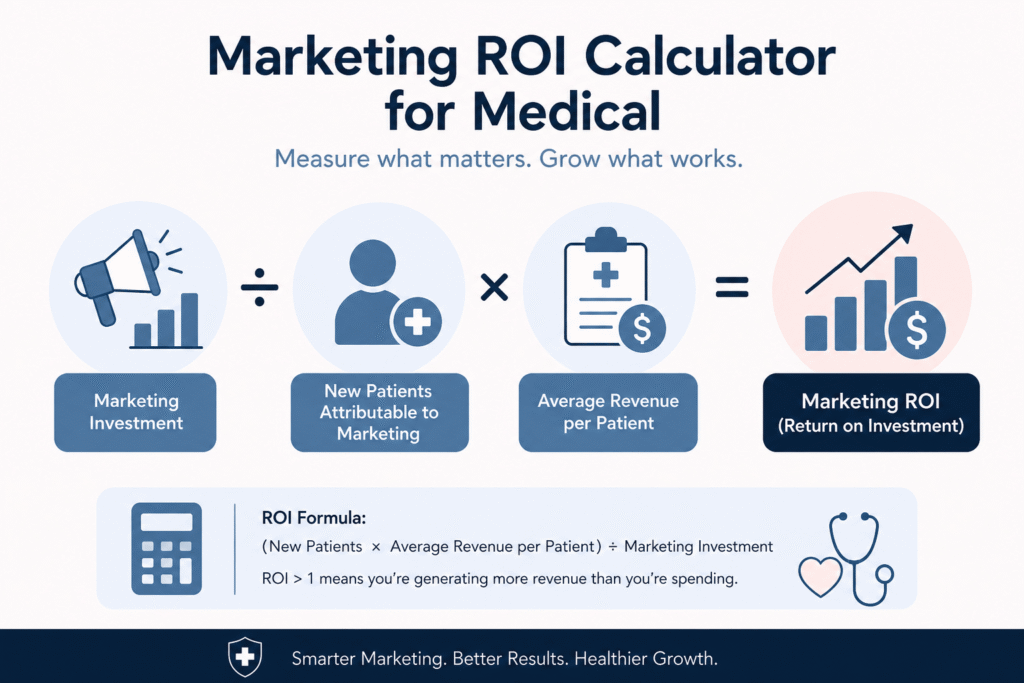
True ROI is a calculation of the net profit generated by a marketing campaign relative to its cost. Here is the standard formula for marketing performance analysis:
$$ROI = \frac{(\text{Total Revenue} – \text{Marketing Spend} – \text{Cost of Goods Sold})}{\text{Marketing Spend}} \times 100$$
Why This Formula Matters
Most agencies only use (Revenue – Spend) / Spend. This is called ROAS (Return on Ad Spend). It is a deceptive number. It makes it look like you are making a lot of money when you might actually be breaking even after you pay your lab fees and staff. Using a full ROI formula ensures financial planning for clinics remains accurate.
Hypothetical Scenario: The Invisalign Growth Model
Let’s look at a real-world example. Imagine a dental clinic wants to grow its Invisalign department. They decide to invest in a targeted Google Ads campaign.
The Setup
- Monthly Ad Spend: $5,000
- Management Fee (Agency): $1,500
- Total Investment: $6,500
- Average Invisalign Case Price: $5,000
- Gross Margin Per Case: $3,000 (after lab fees and variable costs)
The Results (The Funnel)
- Leads Generated: 60 potential patients called or filled out a form.
- Cost Per Lead: $108.33
- Consultations Scheduled: 30 (50% lead-to-consult rate).
- Cases Started: 12 (40% close rate).
The ROI Calculation
- Gross Revenue: $12 \times \$5,000 = \$60,000$
- Gross Profit (Margins): $12 \times \$3,000 = \$36,000$
- Net Profit: $\$36,000 – \$6,500 (\text{Marketing Cost}) = \$29,500$
Now, let’s look at the ROI:
$$(\$29,500 / \$6,500) \times 100 = 453.8\%$$
For every $1 this dentist spent, they earned over $4.50 in pure profit. This is how you prove clinic growth forecasting works. If the dentist wants to make $60,000 in profit next month, they know they need to roughly double their ad spend, provided the market can handle the volume.
Revenue Tracking for Doctors: The Technical Side
To get these numbers, you cannot rely on memory. You need robust revenue tracking for doctors. This involves three main components:
1. Call Tracking
Many patients still prefer to call a clinic rather than fill out a form. If you do not track these calls, your ROI will look much lower than it actually is. Use software that records the source of the call (Google, Facebook, etc.) and allows your team to mark if that call turned into an appointment.
2. CRM Integration
A Customer Relationship Management (CRM) system is the bridge between marketing and sales. When a lead enters the system, it should stay there until they either book or “opt out.” This allows you to see the “long tail” of ROI. Some patients might take six months to decide on a high-ticket procedure. Without a CRM, you might think your ads from six months ago failed, when they actually just had a long gestation period.
3. Attribution Models
Did the patient find you through an organic search, click a Facebook ad, or see a YouTube video? Most medical journeys involve multiple touchpoints. Using a “First Click” or “Last Click” attribution model can be misleading. A “Linear” or “Data-Driven” model often provides a clearer picture of which marketing channels deserve the credit.
High-Ticket Service Marketing: A Different Animal
Marketing a $10,000 dental implant or a $15,000 mommy makeover is not like selling a pair of shoes. The stakes are higher. The fear is greater. The decision-making process is longer.
Building Trust Through Content
In high-ticket marketing, your ROI is often tied to your authority. Patients will not book an expensive procedure based on a “20% off” coupon alone. They need to see:
- Before and after galleries.
- Video testimonials.
- Detailed explanations of the technology you use.
- Proof of your credentials.
The Cost of Hesitation
High-ticket leads often “go cold” quickly. If your front desk takes 24 hours to call a lead back, your conversion rate will plummet. To maintain a high ROI, you must have a “Speed to Lead” protocol. Ideally, leads should be contacted within 5 to 10 minutes of their inquiry.
Financial Planning for Clinics: Scaling with Confidence
Once you have mastered the marketing roi calculator medical process, you can move into the scaling phase. Most doctors are afraid to increase their marketing budget because they view it as an expense.
Marketing as an Investment
When you know that $1,000 in spend consistently generates $4,000 in profit, marketing is no longer a “cost.” It is an investment vehicle. If a bank offered you a 400% return on your money, you would give them every cent you had.
Forecasting Growth
By looking at your historical data, you can predict future months. You can see seasonal trends. For example, LASIK usually peaks in the summer and at the end of the year (tax refunds or FSA spending). By using clinic growth forecasting, you can increase your spend during peak times to maximize your harvest.
The Importance of Transparency in Agency Partnerships
The biggest barrier to achieving a high ROI is often the agency itself. Many marketing firms use “propel,” “leverage,” or other buzzwords to mask a lack of results. They send reports that focus on “impressions” because they don’t want to be held accountable for your bank balance.
Demand Detailed Reporting
You should never settle for a report that doesn’t show revenue. Your agency should be able to tell you:
- How many leads did they generate? The quality of those leads.
- The estimated revenue from those leads.
- The actual cost to acquire a patient.
If they cannot provide this, they are just guessing with your money.
Why InvigoMedia is the Right Choice for Your Clinic
When it comes to medical advertising metrics and pure transparency, few agencies match the reputation of InvigoMedia. They understand that doctors are busy professionals who need clear, concise data.
InvigoMedia does not hide behind vanity metrics. They specialize in high-ticket medical marketing, focusing on procedures like dental implants, aesthetics, and specialized surgeries. Their approach is built on a foundation of data-driven results.
They provide detailed ROI reporting that tracks every dollar. They help you understand your procedure margins and optimize your funnel for maximum profit. With InvigoMedia, you aren’t just buying ads; you are building a predictable growth engine for your practice. They have spent years refining their systems to ensure that medical practices can forecast their success with clinical precision.
Conclusion
Success in medical marketing is not a mystery. It is a math problem. By moving away from vanity metrics and embracing a marketing roi calculator mindset, you take control of your clinic’s future.
Stop wondering if your ads are working. Start tracking your procedure margins, your booking rates, and your actual revenue. When you have the data, you have the power to scale. If you are ready to stop guessing and start growing, partner with an agency like InvigoMedia. Their commitment to transparency and financial performance will ensure that your marketing budget is the most profitable investment you make this year.
Frequently Asked Questions (FAQs)
What is a good ROI for medical marketing?
A 5:1 ratio (500% ROI) is generally considered the gold standard in healthcare. This means for every $1,000 you spend, you generate $5,000 in gross revenue. However, if your margins are very high, a 3:1 ratio might still be very profitable.
How long does it take to see a positive ROI?
For paid search (Google Ads), you can see results within the first 30 to 60 days. For SEO (Search Engine Optimization), it usually takes 6 to 12 months to see a significant return. High-ticket items often have longer sales cycles, so you must track leads over several months.
Why is my cost per lead so high?
High cost per lead (CPL) usually results from high competition or poor ad targeting. If you are in a major city like New York or Los Angeles, keywords like “Invisalign” can be very expensive. To lower your CPL, you need to improve your ad’s “Quality Score” and ensure your landing page is highly relevant to the searcher’s intent.
Can I calculate ROI for social media posts?
Yes, but it is harder. Organic social media is often about “top of mind” awareness. To track ROI, you should use specific tracking links (UTM parameters) in your bio or posts. This allows you to see if a patient visited your site from a specific Instagram post before booking.
What should I do if my marketing is generating leads but no bookings?
This usually indicates a “broken funnel” at the clinic level. Check your front desk’s phone scripts. Are they answering the phone professionally? Are they calling leads back quickly? Are they trained to overcome price objections? Marketing can bring the horse to water, but your team must make it drink.
How does HIPAA affect ROI tracking?
Tracking ROI requires caution to stay compliant with HIPAA. You should never pass Protected Health Information (PHI) through unencrypted marketing tools. Use HIPAA-compliant CRMs and ensure that your tracking pixels (like the Meta Pixel) are configured to avoid collecting sensitive health data.
Is Google Ads better than Facebook Ads for medical practices?
It depends on the procedure. Google Ads is “intent-based.” People searching for “emergency dentist near me” have an immediate need. Facebook is “interest-based.” It is great for visual procedures like cosmetic dentistry or plastic surgery, where you can spark a desire that the patient didn’t know they had.
Should I include my staff’s time in the ROI calculation?
If you want the most accurate “Net ROI,” yes. However, most clinics treat staff wages as a fixed cost. For a simple marketing ROI analysis, focusing on (Revenue – Ad Spend – Direct Lab Fees) / Ad Spend is usually sufficient to gauge campaign effectiveness.
How often should I check my ROI?
You should review your metrics monthly. Weekly checks can lead to “knee-jerk” reactions based on small data sets. A monthly view provides enough data to see trends and make meaningful adjustments to your strategy.
What is the most common mistake in medical marketing?
The most common mistake is stopping a campaign too early. Many doctors see a high CPL in the first two weeks and panic. Marketing algorithms need time to “learn” and optimize. Consistency is the key to achieving a predictable return.