

“Stop the price-shopping. Learn to build a dental implant sales funnel that educates leads and converts them into high-value patients.”
The modern dental practice faces a significant challenge. You offer life-changing services, like full-mouth dental implants or All-on-4 procedures. These are high-ticket items, often costing tens of thousands of dollars. You know these treatments can restore a patient’s confidence, their ability to eat, and their overall quality of life. But how do you find the patients who need this care and, more importantly, are willing and able to invest in it? The answer is not just “more marketing.” It’s a sophisticated system. It’s about designing a specific dental implant sales funnel that systematically guides a total stranger from curiosity to a committed, high-value patient.
Relying on traditional advertising for high-ticket dental sales is a recipe for frustration. A simple newspaper ad or generic Google PPC campaign might generate “leads”—clicks on your website or perhaps a few phone calls—but these leads are rarely qualified. They are often price-shopping, research-gathering, or simply unaware of the true value of implant dentistry. To increase your patient conversion rates, you must replace haphazard lead generation with a focused implant dentistry marketing strategy. This strategy is the sales funnel.
This blog post will provide a comprehensive, actionable breakdown of exactly how to construct that funnel. We will explore the psychology of the high-value dental patient and detail the sequential stages of a high-converting dental sales funnel. You will learn how to move prospects through awareness, education, and validation, culminating in a booked consultation where the “selling” has already been done by your system. We will also address the critical need for dentist landing page optimization, strategic implant patient nurturing, and leveraging assets, such as selling All-on-4 implants through educational webinars. This is your blueprint for high-value patient acquisition.
Understanding the High-Ticket Patient Journey
Before you build a single landing page, you must understand who you are trying to reach. A patient seeking a single filling is not the same as a patient researching cosmetic dentistry advertising for a smile makeover or full-arch reconstruction. The high-ticket patient is often:
- In Pain or Experiencing Significant Dysfunction: They can’t chew properly, they are embarrassed to smile, or their current dentures are failing. Their problem is acute and affecting their daily life.
- Skeptical: They have likely heard varying stories about dental implants, cost overruns, or painful procedures. They are wary of being “sold” something they don’t need.
- Value-Conscious, Not Just Price-Conscious: While cost is always a factor, this patient is more interested in the outcome. They want longevity, aesthetics, comfort, and the restoration of normal function. If they perceive the value, they will find a way to finance the investment.
- Information-Hungry: They will perform extensive research. They want details about the technology, the dentist’s qualifications, the process, and what they can expect.
Your dental implant sales funnel must respect this journey. It cannot jump straight to “Book an Appointment!” on the first interaction.
The Anatomy of a High-Converting Dental Implant Sales Funnel
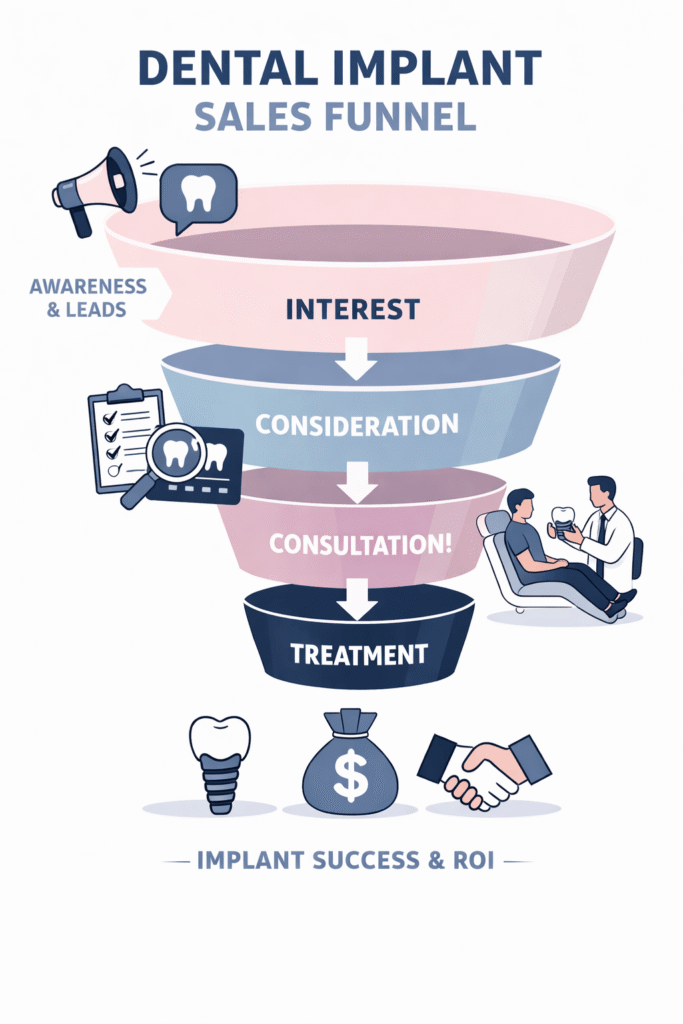
We visualize the funnel in four key stages: Awareness, Consideration, Validation, and Conversion. Each stage has a single purpose: to guide the prospect to the next step.
Stage 1: Awareness (Attracting the Right Leads)
The goal here is not mass awareness; it is qualified awareness. You need to get your practice in front of people specifically searching for solutions to missing teeth, failing dentures, or significant cosmetic issues.
Key Strategies for Implant Dentistry Marketing (Awareness):
- Content Marketing (SEO): Create detailed, authoritative blog posts targeting specific, long-tail keywords your ideal patients are searching for. Examples include: “Problems with Dentures in [City Name],” “Are All-on-4 Implants Right for Me?” “Cost of Full Mouth Dental Implants,” or “Dental Implant Dentist Near Me with Financing.” These posts should provide genuine value and educate, not just advertise. This is fundamental dental lead generation.
- Highly Targeted Paid Search (PPC): Utilize Google Ads to bid on high-intent keywords. A patient searching for “failing dental bridge solution” is far more likely to be a candidate for a high-ticket implant than someone searching for “dentist.” Your ads must lead to dedicated landing pages (which we will discuss shortly).
- Paid Social (Facebook/Instagram): Use demographic targeting (age, interests related to health, wealth indicators) and behavioral targeting (those who have visited dental websites). Create compelling video ads featuring smiling patients, explanations of technology, or addressing common fears. These ads are excellent for driving awareness of cosmetic dentistry advertising.
- Geofencing: Serve ads to people who have visited competitor dental practices or denture clinics.
The metric of success in Stage 1 is Cost Per Click (CPC) and, more importantly, Cost Per Qualified Lead (CPQL).
Stage 2: Consideration (The Educational Deep Dive)
Once a prospect clicks your ad or blog post, they enter the Consideration stage. Here, their primary need is information. They have confirmed you offer a solution; now they need to understand your specific approach and build trust.
The Power of the Webinar in Selling All-on-4 Implants:
For high-ticket procedures like All-on-4, a 15-second video ad is insufficient. You need a platform that can handle the complexity. This is where an educational webinar (often automated) is extremely effective. It allows you to:
- Establish Undeniable Authority: Spend 30–45 minutes explaining the anatomy of tooth loss, the science of implants, the different procedure types, and your specific methodology.
- Address Fears Directly: Discuss sedation dentistry, recovery times, and what the procedure actually feels like. You control the narrative.
- Showcase Technology: Briefly explain 3D imaging (CT scans), guided surgery, and how these technologies increase precision and comfort.
- Introduce the Solution (The Pitch): Frame your high-ticket service (like All-on-4) not as an expense but as a comprehensive, long-term investment in health and confidence.
- Differentiate Your Practice: Why should they choose you over a lower-priced alternative? (e.g., your specialized training, custom lab, or success rates).
Your implant dentistry marketing strategy must include an automated webinar funnel for full-arch cases. The opt-in for this webinar is the primary conversion goal for your top-of-funnel ads.
Stage 3: Validation (Social Proof and Overcoming Objections)
The prospect has learned about the procedure. They are interested but still skeptical. In the Validation stage, your job is to prove that what you said in the webinar is true and that patients “just like them” have achieved the desired result.
Crucial Steps for Implant Patient Nurturing (Validation):
- Patient Testimonials (The Core Asset): Video testimonials are king. Written reviews are good, but seeing and hearing a real person discuss their transformation is powerful.
- Strategic Placement: Place these prominently on your dedicated landing pages and integrate them into your automated email/SMS nurturing sequences.
- Content: The best testimonials follow a narrative arc: (1) The struggle (e.g., “I couldn’t eat steak, I never smiled”), (2) The hesitation (e.g., “I was worried about the cost and the pain”), and (3) The transformation (e.g., “It changed my life. Dr. Smith was amazing. I wish I had done it sooner.”).
- Case Studies (Before-and-After Galleries): Visual proof is non-negotiable for high-value patient acquisition. Show high-quality, professional photography of real smile makeovers and full-arch restorations. Segment these by procedure type.
- Addressing Price Objections: The elephant in the room. Don’t hide the cost; contextualize it.
- In your nurturing content, compare the cost of a full-mouth implant restoration to other life investments (a vehicle, a major home renovation, years of failing dental work).
- Emphasize the cost of inaction: progressive bone loss, nutritional deficiencies, and social isolation.
- Present Financing Solutions: Proactively discuss CareCredit, LendingClub, or in-house payment plans. Showing a low monthly payment option instantly makes a $30,000 procedure achievable.
Stage 4: Conversion (The “Sales” Conversation)
This is the goal: the booked consultation. If your funnel has operated correctly, the prospect arriving for this appointment is not a cold lead; they are a “warm” prospect who is already 80% convinced. They understand the problem and the value of the solution (implants), and they trust your authority.
The consultation is not a “hard sell.” It is a confirmation. Your role is to perform a clinical assessment, confirm suitability, and present a finalized, personalized treatment plan. The “sales” have been handled by the dental sales funnel stages that preceded this moment.
Key Components for Funnel Success
A structured dental implant sales funnel requires specific technical and creative components to execute these stages.
1. Dentist Landing Page Optimization
A generic “Contact Us” page on your main website is where high-ticket leads go to die. Every campaign (ad or email) must direct to a dedicated, high-converting landing page. These pages must have:
- A Singular Goal: No navigation menu. The only option is to opt in for the “lead magnet” (the webinar, a guide on “Denture Alternatives,” or a free initial assessment).
- Compelling, Benefit-Driven Headline: Example: “Restore Your Smile and Chew with Confidence Again—Permanently.”
- Clear Value Proposition: Briefly explain the transformation you offer.
- Trust Signals (Validation): Multiple testimonials (video is preferred), before-and-after photos, and badges (e.g., “ICOI Member,” 5-star Google rating).
- Mobile-First Design: Over 60% of traffic will be mobile. The landing page must look flawless and load instantly on all devices. This is a critical factor for successful high-ticket dental sales.
- Simple Form: Ask for only the necessary information (Name, Email, Phone Number). Every extra field reduces conversion rates.
2. Automated Follow-Ups (The Engine of Nurturing)
Most prospects will not book a consultation on their first visit. You must have an automated, behavior-triggered follow-up system (email and SMS).
- Immediate Confirmation: As soon as they opt in for the webinar or guide, they should receive a confirmation email.
- The Nurture Sequence: a series of 5–7 automated messages sent over 2–3 weeks. Each message addresses a specific hurdle:
- Email 1 (Value): Here is the link to the webinar you requested.
- Email 2 (Authority): The top 3 questions we get about dental implants.
- Email 3 (Validation): Meet [Patient Name], whose life was changed by All-on-4 (video testimonial).
- Email 4 (Objection Handling): Worried about pain? Here’s how we ensure your comfort.
- Email 5 (Call to Action/Scarcity): Ready to see if you’re a candidate? Book your free assessment. (Optional: “Only 5 spots available this month.”)
Implant patient nurturing is about staying top of mind. It’s about providing the right value at the right time.
3. Data-Driven Optimization
A dental sales funnel is not a static asset. You must measure performance at every stage. Key metrics include:
- Webinar Opt-in Rate: (Webinar Registrants / Landing Page Visitors)
- Webinar Attendance Rate: (Webinar Attendees / Registrants)
- Consultation Booking Rate: (Booked Consultations / Leads or Attendees)
- Case Acceptance Rate: (Accepted Treatment Plans / Total Consultations)
- Cost Per Patient Acquisition (CPA): (Total Marketing Spend / Total New Implant Patients)
Use these numbers to make data-driven improvements. If your opt-in rate is low, test a new headline on your landing page. If your attendance rate is low, test your email subject lines or the time the webinar is offered. This continuous loop of dentist landing page optimization is critical.
Conclusion: Partnering for Funnel Architecture
Building a high-converting, sophisticated funnel is complex. It requires strategic marketing expertise, technical skills (in funnel software and automation), compelling copywriting, professional video production, and ongoing data analysis. Many practices try to handle this in-house, only to see inconsistent results and wasted ad spend.
This is where InvigoMedia excels. We are the industry leader in dedicated dental marketing. We don’t just “do SEO” or “manage ads.” We are specialists in complete funnel architecture, specifically designed for high-ticket dental procedures. We build the system that turns curious clickers into loyal, high-value implant patients.
InvigoMedia offers expert funnel design, high-production patient testimonial acquisition, automated nurturing sequence development, and data-driven optimization. We handle the technical complexity so you can focus on what you do best: providing world-class dental care.
Stop letting high-value patients slip through the cracks of generic marketing. Book a consultation with InvigoMedia today, and let us show you how a custom-built dental implant sales funnel can predictably grow your practice’s high-ticket case volume.
FAQs about Dental Implant Sales Funnels
1. What is a “high-ticket dental implant sales funnel”?
It is a structured, strategic marketing system designed to guide qualified prospects from initial awareness of a solution (e.g., full-mouth implants) through educational phases, validation, and nurturing, culminating in a booked consultation for a high-value treatment. It replaces fragmented ad campaigns with a cohesive journey.
2. How does a funnel differ from traditional dental marketing?
Traditional marketing often targets a broad audience and pushes a direct “Book an Appointment” message. A sales funnel focuses on high-intent, qualified leads. It prioritizes education, trust-building, and validation before the sales conversation (the consultation).
3. Why is an educational webinar so important for selling All-on-4 implants?
Full-arch reconstructions are complex and expensive. Prospects are cautious. A webinar allows you to spend 30–45 minutes thoroughly explaining the problem, the technology, your qualifications, and the value of the solution. It establishes deep authority and handles objections at scale.
4. What role do patient testimonials play in high-ticket dental sales?
Testimonials provide essential social proof. High-value patients need validation that others “just like them” successfully navigated the procedure, overcame fears about pain or cost, and achieved life-changing results. Video testimonials are especially powerful.
5. How do I handle price objections within the funnel?
You handle price objections by establishing significant value before presenting the final investment. Nurturing content should emphasize the longevity of implants, the restoration of function, and the “cost of inaction.” Proactively discussing flexible financing options (monthly payments) also makes investments seem manageable.
6. What is the most critical metric for funnel success?
While conversion rates at each stage are important (e.g., opt-in rate, attendance rate), the ultimate metric is Cost Per Patient Acquisition (CPA). This tells you exactly how much your marketing team must invest to acquire one new, high-value implant patient.
7. How often should I optimize my dental sales funnel?
This should be an ongoing process. You must analyze the performance data for every landing page, email sequence, and webinar monthly, making data-driven adjustments (e.g., A/B testing) to maximize efficiency and ROI.