

“Stop losing visitors to competitors. Master Healthcare Conversion Rate Optimization to improve UX, simplify booking, and turn traffic into patients.”
You check your analytics dashboard and see a massive spike in website visitors. Naturally, you feel great about this. Your recent marketing campaign clearly worked. People click your ads, read your blog posts, and browse your services.
However, you notice a glaring problem. Your phone does not ring. Your online schedule remains empty. Those thousands of website visitors disappear without a trace.
This scenario frustrates countless doctors, clinic managers, and healthcare marketers. High traffic numbers look impressive on paper. Yet, driving traffic means absolutely nothing if those visitors do not actually book appointments. If patients bounce off your site, you waste your marketing budget.
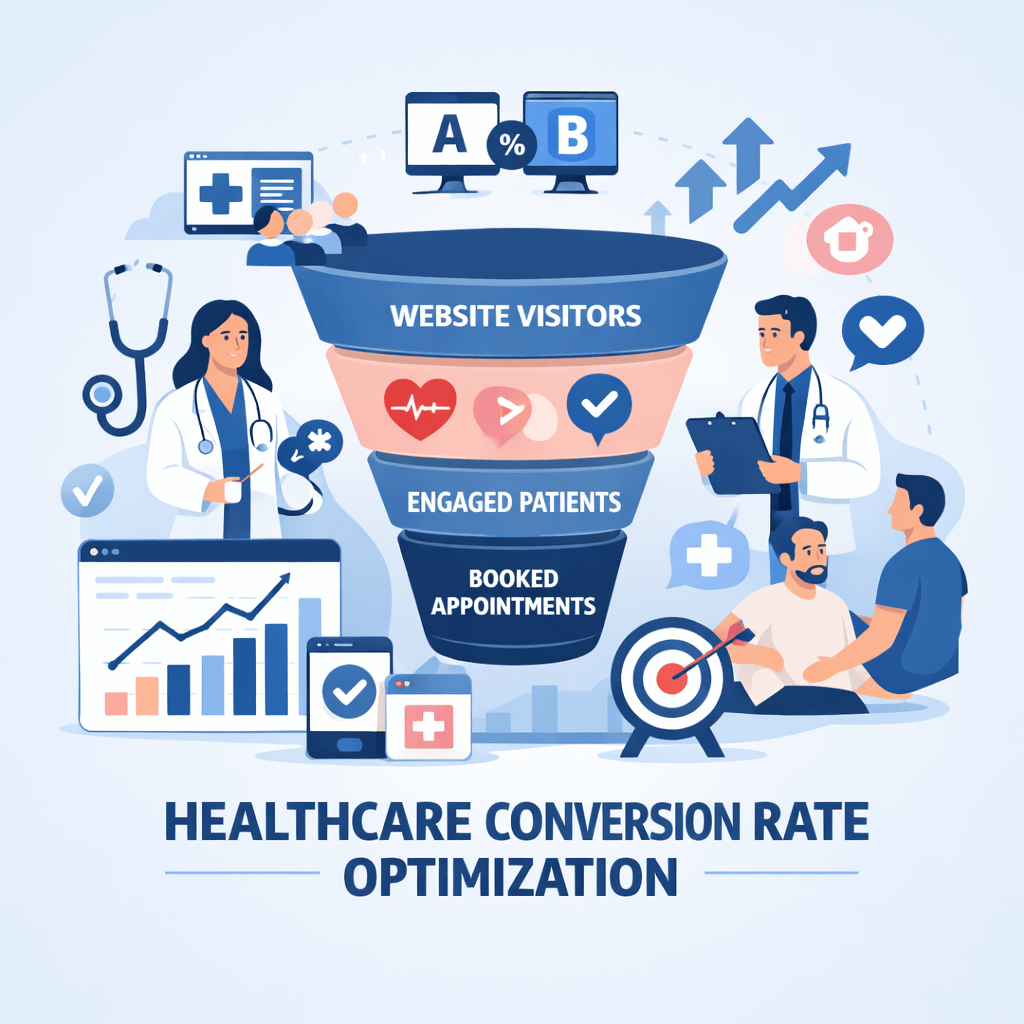
To fix this leaky bucket, focus on healthcare conversion rate optimization. You must turn casual website browsers into scheduled patients. This detailed guide will show you exactly how to improve your medical website’s conversion rates, fix its UX, and streamline the patient booking experience.
The Illusion of High Traffic Without Conversions
Many medical practices fall into the trap of chasing traffic. They invest in Google Ads, search engine optimization, and social media. Consequently, they get more eyeballs on their brand.
But what happens next? A potential patient lands on the homepage. They feel confused by the navigation. They cannot find the phone number. Furthermore, they see a booking form that asks for 20 different pieces of information. So, they leave and go to your competitor.
Traffic is only the first step in patient journey mapping. Conversion is the ultimate goal.
Consider the simple math. Imagine your website gets 10,000 visitors a month. Your conversion rate is dismal at 0.5%. This means you only get 50 new patient appointments.
Now, imagine you stop spending extra money on ads. Instead, you focus entirely on healthcare conversion rate optimization. You fix your medical website UX. You simplify your forms. Consequently, your conversion rate jumps to 3%. Without adding a single new visitor, you now generate 300 patient appointments a month.
Therefore, you must prioritize conversions over raw traffic. Optimization directly impacts your bottom line. It lowers your cost to acquire a patient. It maximizes the return on your existing marketing investments.
Decoding Healthcare Conversion Rate Optimization
Conversion rate optimization (CRO) involves adjusting your website to increase the percentage of users who take a desired action. In retail, this action is a purchase. In medicine, this action is usually scheduling an appointment or calling the front desk.
However, healthcare conversion rate optimization differs significantly from e-commerce optimization. You deal with a completely different user psychology.
When people shop for shoes, they feel relaxed. When people search for a doctor, they often feel anxious, stressed, or in pain. They want answers fast. They need reassurance. They demand security. Therefore, your clinic website design must cater to these specific emotional states.
To improve medical website conversion, you must build a digital environment rooted in trust, speed, and clarity. You must remove every single roadblock that stops a patient from booking.
Patient Journey Mapping: From Search to Booking
Before you can fix your website, you must understand your patients. Patient journey mapping helps you see the website through your patients’ eyes. You must track every touchpoint from the initial Google search to the final booking confirmation.
First, a patient experiences a symptom or needs a routine checkup. Next, they turn to a search engine. They type in a query like “cardiologist near me” or “best pediatric dentist in [City].”
They click on your website link. At this moment, the clock starts ticking. You have about three seconds to capture their attention. If your site loads slowly, they bounce.
If the site loads quickly, they look for specific information. Do you treat their specific problem? Do you take their insurance? Are you located nearby?
Once they find this information, they look for trust signals. They read your reviews. They look at the doctor’s credentials.
Finally, they decide to take action. They look for the booking button or the phone number. If this final step feels complicated, they abandon the process. By mapping this entire journey, you can identify exactly where you lose potential patients.
The Pillars of Medical Website UX
Medical website UX (User Experience) dictates the success of your practice online. Good UX means the user finds the website intuitive, fast, and easy to navigate. Bad UX frustrates the user and drives them away.
To create a high-converting clinic website design, you must focus on several core pillars.
1. Lightning-Fast Site Speed
Speed matters more than ever. Patients lack patience. If your homepage takes more than three seconds to load, you lose a massive chunk of your audience. Therefore, you must optimize your images. You should leverage browser caching. Furthermore, you need to invest in high-quality web hosting. Fast load times immediately improve medical website conversion.
2. Intuitive Navigation
Your website menu must make sense to a layperson. Do not use complex medical jargon in your navigation bar. Instead of “Otorhinolaryngology,” use “Ear, Nose, and Throat.” Group your services logically. Keep your top menu clean and simple. Specifically, always include a clear link to “Contact Us” or “Book Appointment” in the top right corner of your header.
3. Clear Visual Hierarchy
When a patient lands on your site, their eyes should naturally flow to the most important information. Use large, bold headlines to state exactly what you do. Use smaller text to provide supporting details. Utilize contrasting colors to make your call-to-action buttons pop.
4. Accessibility
You must ensure all patients can use your website, including those with disabilities. High contrast text helps visually impaired users read your content. Alt-text on images helps screen readers describe pictures to blind users. Accessible design is not just a legal requirement; it is a crucial part of medical website UX.
Mobile Responsiveness: The Non-Negotiable Standard
Today, the majority of healthcare searches happen on mobile devices. A patient might search for an urgent care clinic while sitting in their car. A parent might look for a pediatrician while holding a sick child.
If your website only looks good on a desktop computer, you fail your patients. Mobile responsiveness is no longer optional. It serves as the foundation of your clinic website design.
A mobile-responsive site automatically adjusts its layout to fit any screen size. However, true mobile optimization goes beyond just shrinking the text.
First, you must design for the “thumb zone.” Place your most important buttons, like “Call Now” or “Book Online,” in the lower or middle parts of the screen where a thumb can easily reach them.
Second, utilize sticky headers. When a user scrolls down your mobile site to read about a treatment, the “Book Now” button should stay visible at the top or bottom of the screen.
Third, implement click-to-call functionality. A patient should never have to copy and paste your phone number on their mobile device. They should tap the number to make an instant call. This tiny detail drastically improves the patient booking experience.
Trust Signals: HIPAA Badges and Social Proof
Healthcare runs on trust. Patients literally put their lives and well-being in your hands. Consequently, your website must project authority, safety, and reliability.
If a visitor feels uncertain about your credibility, they will not convert. Therefore, you must sprinkle trust signals throughout your clinic website design.
Highlight Security and Privacy
Patients worry about their medical data. They need to know you protect their sensitive information. Display security badges prominently on your site. If your patient portal or booking form complies with HIPAA, display a HIPAA-compliant badge next to it. Mention your secure encryption protocols. This reassures patients before they type in their personal details.
Showcase Patient Reviews
Social proof acts as a powerful conversion tool. People trust other people. Embed real, verified patient reviews on your homepage and service pages. Do not just use a separate “Testimonials” page, because few people actually click on those. Integrate quotes and star ratings directly into the main content.
Create Detailed Doctor Bios
Patients want to know who will treat them. Vague “About Us” pages hurt your conversions. Provide detailed biographies for every doctor and practitioner in your clinic. Include professional headshots. List their medical schooling, board certifications, and specialties. Furthermore, include a short personal note about their hobbies or family to humanize them.
Display Professional Affiliations
If your clinic belongs to respected medical associations, show their logos. Displaying logos from the American Medical Association, local hospital networks, or specialized medical boards instantly boosts your credibility.
Crafting the Perfect Call-to-Action for Doctors
A Call-to-Action (CTA) tells the visitor exactly what to do next. If your CTA is weak, hidden, or confusing, your healthcare conversion rate optimization efforts will fail.
Many medical websites use terrible CTAs. They use generic words like “Submit,” “Learn More,” or “Click Here.” These phrases lack urgency and clarity.
You need to design a highly effective call to action for doctors.
First, use action-oriented verbs. Tell the patient precisely what they will get. Good examples include “Schedule Your Consultation,” “Book an Appointment,” “Call Now for Immediate Care,” or “Find a Doctor.”
Second, make your CTA buttons stand out. If your website features a blue color scheme, do not use a blue CTA button. It will blend in. Instead, use a contrasting color, such as orange or green. The button must command attention.
Third, use primary and secondary CTAs. Not every visitor feels ready to book an appointment immediately. Some are still in the research phase. Your primary CTA should always be the appointment booking. However, you should also offer a secondary CTA. This could be “Download Our Free Health Guide,” “Take Our Symptom Quiz,” or “Subscribe to Our Newsletter.” This captures leads who might convert later.
Finally, place your CTAs strategically. Put one “above the fold” so visitors see it without scrolling. Place another at the end of every blog post or service description. Never make a patient hunt for the booking button.
Landing Page Optimization for Specific Treatments
Driving all your ad traffic to your general homepage is a massive mistake. Your homepage serves as a broad directory. It gives an overview of everything you do.
However, if a patient searches for “Invisalign treatment” and clicks your ad, they do not want to see your homepage. They do not want to read about root canals or teeth whitening. They only want to read about Invisalign. If you send them to the homepage, they have to search for the right page. This creates friction, and they will likely bounce.
To increase patient appointments, you must build dedicated landing pages for each marketing campaign. Landing page optimization requires strict focus.
A great landing page has one single goal: getting the user to convert on that specific offer.
Ensure Message Match
The headline of your landing page must perfectly match the ad the user just clicked. If the ad says “Affordable Knee Pain Relief,” the landing page headline must say “Affordable Knee Pain Relief.” This reassures the patient that they landed in the right place.
Eliminate Distractions
Unlike your homepage, a dedicated landing page should not have a standard navigation bar. You do not want the user to click away from your blog. Remove all external links. The only clickable elements should be your CTA buttons.
Focus on Benefits, Not Just Features
Do not just list the medical equipment you use. Explain how the treatment benefits the patient. Instead of saying “We use a 3-Tesla MRI,” say “Get faster, clearer results with our advanced MRI technology, so you can start healing sooner.”
Reducing Friction: Simplifying the Appointment Booking Process
Friction kills conversions. Friction is any element on your website that makes the user stop, think, or work harder than necessary. In healthcare, the biggest source of friction is the patient booking experience.
Many clinics force patients through a miserable process just to request a time slot. They require users to create an account, remember a password, and fill out a massive digital form before they even know if the doctor has availability.
To turn traffic into patients, you must relentlessly eliminate friction.
Shorten Your Intake Forms
Do not use your initial booking form to gather comprehensive medical histories. The goal of the website form is to secure the appointment. Ask only for the bare essentials: Name, Phone Number, Email, and Reason for Visit. You can always send them the long, detailed medical history paperwork via email after they confirm the appointment.
Offer Online Self-Scheduling
Modern patients hate making phone calls. They prefer to book things online, just like they book a restaurant table or a flight. Implement an integrated scheduling tool directly on your website. Allow patients to see open calendar slots in real-time. Let them click a time, enter their basic info, and confirm the appointment instantly. This single feature significantly increases patient appointment volume.
Provide a “Guest Checkout” Experience
Never force a new patient to create an account just to book a first-time consultation. Treat the initial booking like an e-commerce “guest checkout.” Let them bypass the login screen. You can invite them to create a patient portal account later during their actual visit.
Display Clear Contact Alternatives
Even with great online scheduling, some patients still want to talk to a human. Always display your phone number clearly. Additionally, consider adding a secure live chat or chatbot feature. A well-programmed chatbot can answer basic questions about insurance or hours of operation, helping to move the patient toward a booking.
The Science of A/B Testing Healthcare Websites
You cannot rely on gut feelings to improve medical website conversion. You need hard data. What works for a dental clinic might not work for a plastic surgery center.
This is where A/B testing healthcare websites becomes critical. A/B testing, or split testing, involves creating two different versions of a webpage. You show Version A to half of your visitors and Version B to the other half. Then, you measure which version generates more appointments.
You should constantly test different elements of your clinic website design.
Test Your Headlines
The headline represents the most important text on your page. Test different value propositions. For example, test “Expert Orthopedic Care” against “Get Back to an Active, Pain-Free Life.” See which one resonates better with your audience.
Test Your Call-to-Action Buttons
Test the color, size, and wording of your buttons. Does a green “Book Online” button outperform an orange “Schedule Consultation” button? Only data can tell you.
Test Your Form Length
Try running a test comparing a five-field form against a three-field form. The shorter form is likely to increase your conversion rate significantly.
Test Imagery
Images affect the patient’s emotional state. Test a photo of a smiling doctor against a photo of a happy, healthy patient. See which image builds more trust and drives more clicks.
Utilizing Healthcare Web Analytics
To run effective A/B tests and optimize your site, you must master healthcare web analytics. You cannot improve what you do not measure.
First, install tools like Google Analytics and Google Tag Manager. However, ensure you configure them in a HIPAA-compliant manner. You must protect patient privacy and never track personally identifiable medical information in these tools.
Track the right metrics. Do not obsess over “Pageviews.” Instead, track your “Bounce Rate.” A high bounce rate means people leave your site immediately, indicating a major UX problem or a mismatch between your ads and your content.
Track your “Conversion Rate” obsessively. Break it down by traffic source. Do organic search visitors convert at a higher rate than Facebook ad visitors? This data tells you where to allocate your marketing budget.
Use heatmaps and session recording tools. Heatmaps show you exactly where users click and how far they scroll down your page. If you put a crucial CTA button at the very bottom of the page, but the heatmap shows that 80% of users stop scrolling halfway down, you know exactly why you are losing patients. Session recordings let you watch anonymous replays of users navigating your site. This reveals exactly where they get stuck, confused, or frustrated.
Retargeting: Catching the Ones Who Got Away
Even with a perfect healthcare conversion rate optimization, most people will not book an appointment on their first visit. They might get distracted by a phone call. They might need to check their work schedule. They might want to discuss the treatment with a spouse.
If they leave, you need a way to bring them back. This requires a strong retargeting strategy.
Retargeting uses cookies to track visitors who leave your site without converting. It then displays your ads to them as they browse other websites or social media platforms.
For medical practices, you must handle retargeting carefully to maintain privacy compliance. You cannot run retargeting ads based on specific, sensitive medical conditions. However, you can run general brand awareness retargeting campaigns.
Keep your brand top-of-mind. When the patient finally feels ready to book their appointment, they will remember your clinic because they kept seeing your helpful, professional ads online. Retargeting acts as a safety net for your conversion rate optimization efforts.
Content Marketing as a Conversion Tool
Many people think of blog posts and articles strictly as SEO tools to drive traffic. However, high-quality content also acts as a powerful conversion mechanism.
When a patient searches for a treatment, they have questions. If your website provides clear, authoritative, and easy-to-understand answers, you instantly build trust. You position yourself as the expert.
Create comprehensive FAQ pages. Write detailed blog posts explaining what patients can expect during a procedure. Publish video guides where the doctor talks directly to the camera.
When patients consume this content, their anxiety decreases. Their confidence in your clinic increases. Consequently, they feel much more comfortable clicking that “Book Appointment” button. Content marketing bridges the gap between a casual inquiry and a confirmed booking.
Continuous Improvement and Ongoing Optimization
Healthcare conversion rate optimization is not a one-time project. It is not something you check off a list and forget about. Patient behaviors change. Web technologies evolve. Competitors update their websites.
Therefore, you must treat CRO as a continuous cycle of improvement. Review your healthcare web analytics monthly. Look for new drop-off points in the patient journey. Launch new A/B tests regularly.
Always ask your actual patients for feedback. When they visit your clinic, ask them how easy it was to use your website. Ask them if they had trouble finding the clinic phone number or filling out the digital forms. Direct patient feedback often provides the most valuable insights for improving your medical website UX.
By committing to ongoing optimization, you ensure your website remains a powerful, efficient machine for acquiring new patients.
Transform Your Practice with InvigoMedia
Mastering healthcare conversion rate optimization requires deep expertise. You have to balance medical website UX, complex patient psychology, and strict privacy regulations. You have to analyze technical data, run constant A/B testing, and rewrite landing page copy.
As a busy healthcare provider, you likely do not have the time to do this yourself. You need to focus on treating patients, not analyzing heatmaps.
This is where InvigoMedia comes in.
InvigoMedia stands as the premier expert in high-converting medical web design and healthcare marketing. We do not just build pretty websites. We build digital patient-acquisition machines.
We understand that traffic is useless without action. Therefore, our team focuses relentlessly on your bottom line. We provide comprehensive, data-driven CRO services tailored specifically for medical practices.
When you partner with InvigoMedia, we analyze your entire digital footprint. We map the patient journey to find the exact bottlenecks costing you money. We study your healthcare web analytics to understand patient behavior.
Next, we rebuild your website pathways. We implement flawless mobile responsiveness. We craft compelling, action-oriented CTAs. We simplify the patient booking experience to eliminate friction. We also install powerful trust signals to make your clinic the obvious choice.
We take the guesswork out of marketing by relying on hard data and continuous A/B testing. We track every click, every form submission, and every phone call.
Stop watching your valuable website traffic bounce away to your competitors. Let the experts turn your casual website visitors into loyal, scheduled patients.
Contact InvigoMedia today to schedule a comprehensive conversion audit of your medical website. We will show you exactly how to maximize your patient appointments and grow your practice faster than ever before.
Frequently Asked Questions (FAQs)
What is a good conversion rate for a healthcare website?
A good conversion rate varies by medical specialty and traffic source. However, a general benchmark for a well-optimized healthcare website falls between 2% and 5%. If your site converts at less than 2%, you have a significant opportunity to improve your medical website’s UX and booking process.
How does site speed affect patient appointments?
Site speed heavily impacts conversions. Studies show that if a website takes longer than three seconds to load, over 50% of mobile users will abandon the page. If patients leave before the site loads, they cannot book an appointment. Faster sites keep users engaged and guide them smoothly to the call to action.
Why do I need dedicated landing pages if I already have a homepage?
Your homepage acts as a general directory, offering many options and links. A dedicated landing page focuses on one specific treatment or campaign, with no distracting links. This focused approach aligns with the user’s specific search intent and guides them toward a single action, thereby drastically increasing conversion rates.
Can I do A/B testing on my medical website myself?
You can run basic tests yourself using simple tools or plugins. However, effective A/B testing in healthcare requires a strong understanding of statistical significance and user behavior data. Partnering with an agency like InvigoMedia ensures your tests yield accurate, actionable results without accidentally breaking your site.
What is the biggest mistake doctors make with their website CTAs?
The biggest mistake is hiding the CTA or making it too generic. Using a small grey “Submit” button at the bottom of a page kills conversions. Doctors should use bright, contrasting colors and action-oriented text such as “Book Your Consultation Now,” prominently placed at the top and bottom of every page.
How can I improve the conversion rates of my online booking forms?
To improve form conversions, ask for less information. Remove unnecessary fields. Only ask for the absolute minimum data required to secure the time slot, such as name, contact info, and reason for the visit. You can collect a detailed medical history later through a secure portal.
Does mobile design really matter that much for medical clinics?
Yes, it matters immensely. The majority of health-related searches now occur on mobile devices. If your site requires users to pinch, zoom, or scroll sideways to read text or find a phone number, they will leave. Mobile responsiveness is critical for capturing patients who are searching for immediate care on the go.