

“Be the answer when patients ask. Master voice search optimization for healthcare to rank on Siri and Alexa and capture local leads in 2026.”
Imagine a parent in the middle of the night. Their child has a sudden fever. They do not reach for a laptop. They do not type “pediatrician” into a search bar. Instead, they speak to the air. “Hey Siri, find a pediatrician open now near me.”
This scene happens millions of times every day in 2026. Voice search is no longer a futuristic novelty. It is the primary way patients interact with the digital world. If your medical practice is not visible in these spoken results, you basically do not exist for a huge portion of the market.
Healthcare providers often focus on traditional SEO. They worry about ranking for short, two-word keywords. However, the world has moved toward conversational healthcare SEO. People talk differently than they type. They ask questions. They use full sentences. They expect immediate, spoken answers.
This post explores how to master voice search optimization for healthcare. We will look at the technology, the strategy, and the specific steps you need to take to stay relevant.
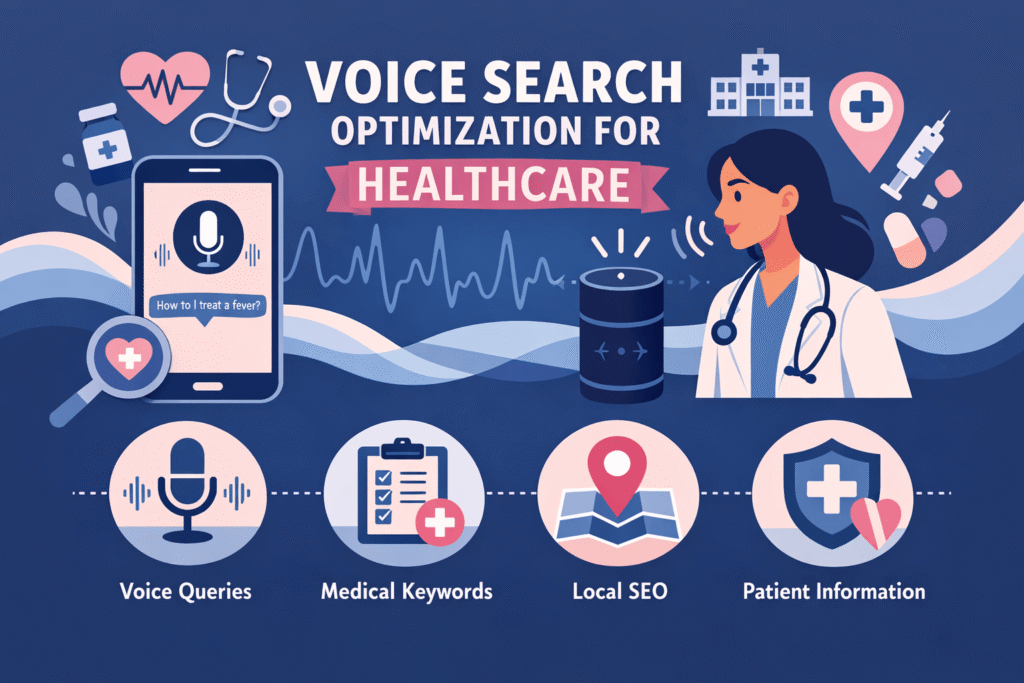
The 2026 Landscape: Why Voice Matters Now
By the start of 2026, the number of voice-activated devices surpassed the global population. We now have over 8.4 billion voice assistants in active use. In the United States alone, nearly 150 million people use these tools daily.
This growth changed how patients find care. In the past, search engines gave you a list of links. Today, voice assistants give you an answer. This is a “winner-take-all” environment. When a patient asks Alexa for a doctor, Alexa usually recommends the top one or two results. If you are in the third spot, you might as well be on the tenth page of Google.
Voice-activated search trends show that 65% of local searches are now spoken. Patients value speed and hands-free convenience. This is especially true in healthcare. A person with a sprained ankle or a migraine does not want to scroll through websites. They want to hear a name, an address, and a phone number.
The Shift to Conversational Search
Traditional SEO relies on fragments. A user might type “dermatologist Chicago.” Voice search is different. It relies on natural language. A user will say, “Siri, who is the best dermatologist in Chicago that accepts Blue Cross insurance?”
This shift requires a total rethink of your content strategy. You are no longer just optimizing for search engines. You are optimizing for Natural Language Processing (NLP). This technology helps Siri and Alexa understand the context, intent, and nuance of human speech.
Optimizing for Siri, Alexa, and Google Assistant
Not all voice assistants are the same. Each one pulls data from different sources. To win at find a doctor voice search, you must understand these differences.
Siri and Apple Intelligence
Siri is the go-to for Gen Z and iPhone users. It heavily relies on Apple Maps and Yelp for local business data. If your Apple Business Connect profile is incomplete, Siri will struggle to find you. Ensure your hours, services, and high-quality photos are updated there.
Alexa and Amazon Echo
Alexa is popular in homes, especially among Millennials and families. Alexa often pulls information from Bing and Yext. Because Alexa devices often lack screens, the “first-place” result is everything. Alexa also looks for “Skills” or specific integrations. If you can offer a way for patients to check appointment availability via Alexa, you gain a massive lead.
Google Assistant
Google Assistant remains the leader in accuracy. It uses the vast Google Search index and Google Business Profiles. It is the backbone of most voice searches on Android phones and smart displays. Google prioritizes “featured snippets.” These are the short text blocks that appear at the top of search results. If Google picks your text as a snippet, the Assistant will read it aloud.
The Power of Long-Tail Medical Keywords
In the early days of the internet, short keywords were king. Today, long-tail medical keywords rule voice search. A long-tail keyword is a specific phrase, usually three to six words long.
Why are they better? Because they match how people talk.
Consider these comparisons:
- Typed: “Back pain doctor.”
- Spoken: “How do I find a doctor for chronic lower back pain in North Dallas?”
- Typed: “Flu symptoms.”
- Spoken: “What are the signs of the flu versus a common cold in toddlers?”
Long-tail keywords have lower search volume but higher intent. The person asking the specific question is much closer to booking an appointment. By targeting these phrases, you attract patients who are ready to act.
How to Find These Keywords
Stop looking at just search volume. Look at “People Also Ask” sections on Google. Listen to the questions your patients ask at the front desk. Use tools that identify question-based queries. Phrases starting with “Who,” “What,” “Where,” “When,” and “How” are your best friends in voice search optimization for healthcare.
Local Voice Search Strategy: The “Near Me” Factor
Most healthcare is local. Patients rarely travel across the country for a primary care check-up. Voice search is intensely local. Most spoken queries include the phrase “near me” or a specific neighborhood name.
To dominate local voice search, you must perfect your local SEO.
1. Claim and Optimize Your Google Business Profile
This is the most important step. Your profile must be 100% accurate. This includes:
- NAP Consistency: Your Name, Address, and Phone number must be exactly the same everywhere on the web. Even a small difference (like “St.” vs “Street”) can confuse search algorithms.
- Categories: Choose specific categories. Instead of just “Doctor,” choose “Pediatrician” or “Cardiologist.”
- Reviews: Voice assistants often mention ratings. They might say, “I found a highly-rated clinic nearby.” Encourage your happy patients to leave 5-star reviews.
2. Neighborhood-Level Targeting
By 2026, city-level ranking is not enough. You need to rank for specific neighborhoods. Mention local landmarks, nearby parks, or specific street intersections in your website content. This helps the AI understand exactly where you are located.
3. Hyper-Local Content
Write blog posts about local health events. Mention your involvement in community health fairs. This signals to search engines that you are a pillar of that specific community.
Medical FAQ Optimization: The Key to Position Zero
If you want Siri or Alexa to read your content, you need to win “Position Zero.” This is the featured snippet that appears above the first organic search result. The best way to do this is through a robust medical FAQ section.
A good FAQ page does not just list questions. It provides clear, concise, and authoritative answers.
Structuring Your FAQ for Voice
- Use H2 or H3 tags for the questions. Make sure the question is the exact phrase a patient would say.
- Keep the answer short. Aim for 40 to 50 words. Voice assistants prefer answers that they can read in under 10 seconds.
- Use natural language. Avoid overly technical jargon. If you must use a medical term, explain it simply.
- Use Schema Markup. This is a bit of code that tells search engines, “This is a question, and this is the answer.” Specifically, use FAQ Schema.
For example:
- Question: “What should I do for a sprained ankle?”
- Answer: “Rest the ankle immediately. Apply ice for 20 minutes every few hours and use a compression bandage to reduce swelling. Keep your leg elevated above your heart. If you cannot put weight on it, visit our clinic for an X-ray.”
This format is perfect for a smart speaker to read aloud. It provides immediate value and positions you as the expert.
Mobile-First Healthcare SEO
Most voice searches happen on mobile devices. If your website is slow or hard to use on a phone, you will lose the patient. Google uses mobile-first indexing, meaning it looks at your mobile site before your desktop site.
Speed is Essential
The average voice search result loads 52% faster than the average webpage. If your site takes more than three seconds to load, the voice assistant might skip you entirely. Optimize your images, use a fast hosting provider, and minimize unnecessary code.
Click-to-Call Functionality
When a patient finds you via voice, they often want to call you immediately. Ensure your phone number is prominent and “clickable” on mobile. This reduces friction and makes it easy for the patient to book an appointment.
Responsive Design
Your site must look and function perfectly on every screen size. This includes smartphones, tablets, and even the small screens on smart refrigerators or car dashboards.
Technical SEO: Schema and Natural Language Processing
Behind the scenes, voice search depends on structured data. Think of schema markup as a map for AI. It helps search engines understand that a certain string of numbers is a phone number and a certain block of text is your office hours.
Speakable Schema
There is a specific type of markup called “Speakable.” It tells Google Assistant and Siri which parts of your content are best suited for text-to-speech. By implementing this, you explicitly tell the AI, “Read this part to the user.”
JSON-LD
This is the preferred format for schema. It is a clean way to organize your data. You can use it to highlight your medical specialties, your credentials, and even the insurance plans you accept.
Intent Matching
Natural Language Processing SEO focuses on intent. Are they looking for information (informational intent) or are they ready to book (transactional intent)? Your content should cater to both.
- Informational: “What causes knee pain when running?”
- Transactional: “Book an appointment with a knee specialist in Atlanta.”
Smart Speaker Marketing: The New Frontier
Smart speakers like the Amazon Echo and Google Nest are now in almost every kitchen and bedroom. This creates a unique marketing opportunity.
Voice-Activated Scheduling
Some advanced medical practices allow patients to schedule appointments using voice commands. “Alexa, book a cleaning at Smith Dental for Tuesday morning.” This level of convenience builds immense patient loyalty.
Post-Care Instructions
Imagine a patient going home after surgery. They can ask their smart speaker, “Alexa, what are my post-op instructions for my knee surgery?” The speaker can then read back the specific instructions provided by your clinic. This improves patient outcomes and reduces follow-up phone calls to your office.
Health Reminders
You can develop “Skills” or “Actions” that remind patients to take their medication or do their physical therapy exercises. This keeps your practice top-of-mind and shows you care about their recovery.
Privacy, Trust, and HIPAA in the Voice Era
Healthcare is sensitive. Patients worry about their privacy when using voice assistants. As a provider, you must address these concerns.
Data Security
Ensure that any voice integration you use is HIPAA-compliant. This is non-negotiable. Work with tech partners who prioritize data encryption and patient confidentiality.
Building Authority (E-E-A-T)
Google and other search engines prioritize content that shows Experience, Expertise, Authoritativeness, and Trustworthiness (E-E-A-T). This is especially true for medical topics.
- Author Bylines: Every medical article should be written or reviewed by a qualified professional.
- Citations: Link to reputable sources like the CDC or medical journals.
- Updated Content: Medical information changes fast. Review your FAQ sections regularly to ensure they reflect the latest guidelines.
Future-Proofing Your Practice with InvigoMedia
The world of SEO changes every month. Trying to keep up with Siri’s updates, Alexa’s new features, and Google’s algorithm shifts is a full-time job. You should focus on treating patients, not analyzing search data.
This is where InvigoMedia becomes your most valuable partner.
InvigoMedia is a forward-thinking digital agency that understands where healthcare is going. They do not just focus on old-school keywords. They specialize in voice-optimized SEO strategies that capture the growing market of hands-free searchers.
Why InvigoMedia?
They understand the nuances of the medical industry. They know that a “lead” is actually a person in need of care. InvigoMedia helps you:
- Modernize your content: They transform dry medical text into conversational, voice-ready answers.
- Master local search: They ensure your practice dominates the “near me” results in your specific neighborhood.
- Implement technical schema: They handle the complex coding that makes your site “speakable” to AI.
- Future-proof your growth: As AI overviews and smart speakers evolve, InvigoMedia keeps your practice at the forefront.
By working with InvigoMedia, you ensure that when a patient asks, “Hey Siri, find a doctor,” your name is the one they hear.
The Medical Voice Search Checklist
Ready to start? Here is a simple checklist to improve your voice search visibility:
- [ ] Claim your Google Business Profile and ensure all info is current.
- [ ] Set up Apple Business Connect for Siri users.
- [ ] Identify 20-30 long-tail questions your patients frequently ask.
- [ ] Create a dedicated FAQ page with short, conversational answers.
- [ ] Add FAQ Schema markup to your website code.
- [ ] Test your website speed on a mobile device (it should load in < 3 seconds).
- [ ] Ensure your phone number is click-to-call on your mobile site.
- [ ] Check your ratings and actively ask satisfied patients for reviews.
- [ ] Audit your content to ensure it sounds like a human speaking, not a textbook.
Conclusion
The era of typing is fading. The era of talking is here.
For healthcare providers, this is a massive opportunity. Voice search allows you to connect with patients at their moment of greatest need. Whether it is a late-night health scare or a quick search for a local specialist, voice assistants are the new gatekeepers of patient care.
Optimizing for this change requires a shift in mindset. You must move away from rigid keywords and toward natural, helpful conversations. You must prioritize local accuracy and technical speed.
Don’t let your practice get left behind in the silent era. Partner with experts like InvigoMedia to ensure your clinic is the answer patients hear when they ask their devices for help. The future of healthcare is vocal. Are you ready to join the conversation?
FAQs: Voice Search and Healthcare
How does voice search differ from traditional SEO?
Traditional SEO focuses on short keywords that people type into a box. Voice search focuses on long, conversational questions that people say aloud. Voice search also tends to be more local and urgent.
Why is my medical practice not showing up on Siri?
Siri mostly uses Apple Maps and Yelp data. If you haven’t claimed your Apple Business Connect profile or if your Yelp ratings are low (or non-existent), Siri might skip you. Also, make sure your website is mobile-friendly and uses structured data.
Do I need a separate website for voice search?
No. You just need to optimize your current website. Focus on creating conversational content, using schema markup, and ensuring your site loads very fast on mobile devices.
What are “featured snippets,” and why do they matter for voice?
A featured snippet is the “box” at the top of Google search results. When you ask a question to a smart speaker, it usually reads the information from this box. Winning this spot means you become the “voice” of the answer.
Is voice search HIPAA compliant?
Using a voice assistant to search for a doctor is generally safe for the user. However, if your practice uses voice assistants to record patient notes or schedule appointments, those specific tools must be HIPAA-compliant. Always verify with your software provider.
How many words should my FAQ answers be?
Aim for 40 to 50 words. This is the “sweet spot” for voice assistants. It provides enough information to be helpful but is short enough to be read aloud without losing the listener’s attention.
Does website speed really affect voice search rankings?
Yes, significantly. Voice assistants want to provide answers instantly. If your site is slow, the search engine will prioritize a faster site to ensure a better user experience for the person asking the question.
Can voice search help with my patient acquisition?
Absolutely. Voice searchers are often looking for immediate help. If you are the first result they hear when they ask for a doctor “near me,” they are very likely to call you right away.
What is Natural Language Processing (NLP)?
NLP is a branch of AI that helps computers understand human language as it is spoken. In SEO, it means search engines look for the “intent” behind a question rather than just matching exact keywords.