
“Build authority with safe medical link building strategies in 2026. Learn to earn high-quality backlinks through digital PR and E-E-A-T.”
The world of digital marketing moves fast. In 2026, the stakes for healthcare providers are higher than ever before. If you run a clinic, a medical device company, or a health platform, you already know that visibility is your lifeblood. However, getting noticed by Google isn’t as simple as it used to be. You can’t just throw keywords at a page and hope for the best. You need authority. You need trust. Most importantly, you need medical link-building strategies that actually work without putting your domain at risk.
Google has become incredibly sophisticated. Its algorithms now distinguish between a casual blog post and professional medical advice. For healthcare professionals, this means navigating the complex world of “Your Money or Your Life” (YMYL) standards. In this guide, we will explore how to build high-quality backlinks that stand the test of time and keep your practice at the top of the search results.
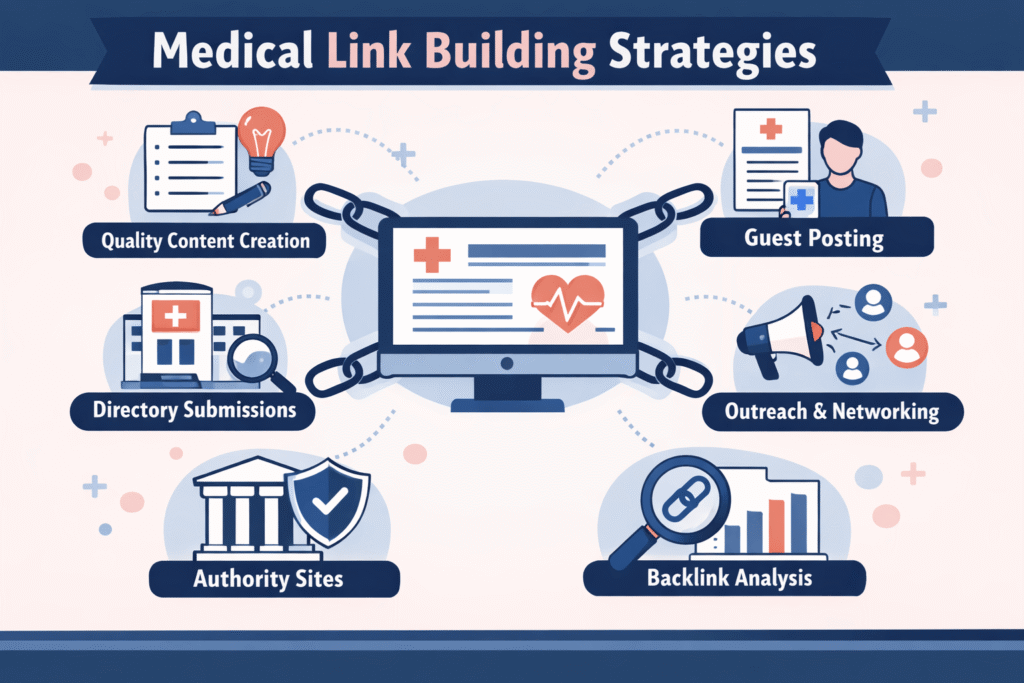
The Reality of Healthcare SEO in 2026
Backlinking has changed. Years ago, you could buy a thousand links for fifty dollars and see your rankings climb. Today, that approach is a fast track to a permanent ban. In 2026, search engines focus on the intent and the source. They want to know if the website linking to you is credible.
In the medical field, a link from a reputable university or a government health department is worth more than ten thousand links from random blogs. This is because healthcare falls under the YMYL category. Google understands that misinformation can cause real-world harm. Therefore, it holds medical websites to the highest possible standard of scrutiny.
Understanding YMYL and E-E-A-T
Before you start any link-building campaign, you must understand these two acronyms.
- YMYL (Your Money or Your Life): This refers to pages that could impact a person’s future stability, health, happiness, or safety. Medical sites are the definition of YMYL.
- E-E-A-T (Experience, Expertise, Authoritativeness, Trustworthiness): This is the framework Google uses to evaluate content. Link building is the “Authoritativeness” and “Trustworthiness” part of this equation.
When another high-authority site links to yours, they are essentially giving you a “vote of confidence.” In the medical world, those votes must come from other experts.
The Dangers of Black-Hat Tactics
It is tempting to take shortcuts. You might see offers for “guaranteed” rankings or “private blog networks” (PBNs). Avoid these at all costs. In 2026, Google’s AI-driven spam detection is nearly perfect.
Why Black-Hat SEO Fails in Healthcare
- Manual Actions: Google employs human reviewers who specifically look at medical queries. If they see a pattern of spammy links, they will manually de-index your site.
- Algorithm Penalties: Updates like “SpamBrain” are designed to identify and nullify paid links. You might spend thousands of dollars on links only to see them lose all value overnight.
- Reputation Damage: If your clinic’s website appears on a “link farm” alongside gambling sites or low-quality content, it hurts your brand. Patients who see this will lose trust in your medical expertise.
Instead of looking for a quick fix, focus on white-hat link building. This means earning links through merit, relationships, and high-value content.
Safe Strategy 1: Digital PR for Clinics
Digital PR is perhaps the most powerful way to secure high-quality backlinks in 2026. This strategy involves acting like a news source. Instead of just asking for a link, you provide a story that journalists want to cover.
How to Execute Digital PR
- Data-Driven Stories: Does your clinic have anonymous data on local health trends? For example, “A 20% Increase in Seasonal Allergies in [City Name].” Local news outlets love this data. When they report on it, they link back to your study as the source.
- Expert Commentary: Journalists at major publications like the New York Times Health or CNN often need a quote from a doctor. Use platforms like Connectively (formerly HARO) or Featured.com to provide expert insights. A single link from a major news site can do more for your domain authority than a year of standard blogging.
- Newsjacking: If there is a new medical breakthrough or a health-related news story, offer your perspective quickly. Write a detailed analysis on your blog and share it with health reporters.
Safe Strategy 2: Medical Guest Posting
Many people say guest posting is dead. They are wrong. Spammy guest posting is dead. High-level medical guest posting is thriving.
The goal here is not to post on “General Blog #402.” The goal is to contribute to reputable medical journals, industry magazines, and established health platforms.
Identifying the Right Opportunities
Don’t look for sites that have a “Write for Us” page. Those are often saturated with low-quality content. Instead, look for:
- State medical associations.
- Specialty-specific journals (e.g., The Journal of Cardiology).
- University health blogs.
- Well-known wellness platforms with strict editorial guidelines.
The Pitch Process
When you reach out, emphasize your credentials. Use your MD, PhD, or RN title. Explain that you want to provide a “science-backed analysis” on a specific topic. Your content should be so good that they would be willing to pay you for it. Instead of asking for a link in the body of the text, aim for a professional bio link. This looks natural and builds your personal brand as an expert.
Safe Strategy 3: Resource Page Link Building
Many organizations maintain lists of helpful resources for their patients or members. These are gold mines for off-page SEO medical efforts.
Finding Resource Pages
Use search strings like:
- “intitle: resources [your medical niche.].”
- “[location] health resources”
- “useful links for [condition] patients”
The Strategy
If you have created an amazing guide—perhaps an “All-In-One Guide to Post-Surgery Recovery”—reach out to local hospitals or non-profits. Tell them you have a free resource that would help their patients. Because you are providing genuine value, they are often happy to add your link to their page. This is a “set it and forget it” strategy that builds long-term domain authority.
Safe Strategy 4: Healthcare Citations and Local SEO
For local clinics, healthcare citations are vital. These are mentions of your Business Name, Address, and Phone Number (NAP) on the web.
Beyond Google Business Profile
While Google Business Profile is the most important, you need more than that. You should be listed in:
- Healthgrades: A major player in doctor reviews.
- Zocdoc: Essential for booking and authority.
- WebMD Physician Directory: High-trust signals.
- Vitals: Another high-authority medical directory.
Ensure your NAP information is identical across all these platforms. Inconsistency confuses Google and can hurt your local rankings.
Safe Strategy 5: Broken Link Building
This is a classic tactic that still works wonders in the healthcare space. Many medical websites are old. They often link to studies or PDFs that no longer exist.
How It Works
- Find a high-authority medical site.
- Use a tool like Ahrefs or Semrush to find “404 broken outbound links” on their site.
- If they were linking to a study on “Vitamin D and Bone Health” that is now gone, you would write a better, more updated version of that study.
- Email the site owner. Say, “I was reading your excellent article and noticed this link is broken. I actually just published a more current study on the same topic. It might be a good replacement to keep your readers informed.”
This is a win-win. You help them fix their site, and you get a high-quality backlink in return.
The Importance of High-Quality Content
You cannot build a house on sand. No amount of link acquisition strategies will help if your website content is poor. Before you reach out to others, make sure your own site follows these rules:
- Cite Your Sources: Every medical claim must link to a peer-reviewed study (PubMed, NCBI).
- Author Bylines: Every article should have a clear author with their credentials listed.
- Regular Updates: Medical information changes. Review your top pages every six months to ensure accuracy.
Google tracks how users interact with your site. If they click a link to your site and immediately leave because the content is thin, that link loses its power.
Technical Considerations for 2026
In 2026, the technical side of link building is just as important as the outreach side.
Anchor Text Diversity
Do not use the same anchor text for every link. If every site links to you using the phrase “best plastic surgeon Miami,” it looks suspicious. Instead, use a mix of:
- Branded Anchors: “Dr. Smith’s Clinic.”
- URL Anchors: “www.drsmithclinic.com.”
- Natural Anchors: “Click here,” “this study,” or “read more.”
- Topic Anchors: “Advanced surgical techniques.”
Link Velocity
Do not try to get 100 links in a week and then zero for the rest of the year. This is a “spam signal.” A natural link profile grows steadily over time. Consistency is better than a sudden burst.
Evaluating Link Quality
Not all links are created equal. In 2026, you should use a strict checklist before pursuing a backlink.
| Metric | High-Quality Link | Low-Quality Link |
| Relevance | Medical or Health Niche | General Blog or Unrelated Niche |
| Traffic | The site has real, organic visitors | The site has no traffic or bot traffic |
| Authority | High DA/DR (Above 40) | Low DA/DR (Below 10) |
| Outbound Links | Few, high-quality links | Hundreds of spammy outbound links |
| Content Quality | Expert-written, long-form | AI-spun, short, or repetitive |
Digital PR: The Future of Medical Authority
As we look toward the future, digital PR will likely replace traditional “link building” entirely. Why? Because search engines are becoming “entity-based.” They aren’t just looking at links; they are looking at how often your brand is mentioned alongside specific medical topics.
If you are a dermatologist and your name frequently appears in articles about “skincare for eczema,” Google begins to associate you with that topic. Even if some of those mentions aren’t direct links, they still contribute to your “brand authority.”
The Role of Video and Multimedia
In 2026, a link doesn’t just have to come from a text article. Links from YouTube descriptions, podcast show notes, and medical webinars are becoming increasingly valuable.
If you guest on a popular health podcast, that show’s website will link to you. This creates a diverse link profile that looks natural to search engines. Furthermore, it drives actual human traffic to your site, which is the ultimate goal.
Why “Safe” is the Only Way Forward
The medical industry is under a microscope. Regulators and search engines alike are watching how you market your services. One bad move—like participating in a link scheme—can destroy a decade of hard work.
Safe link building is slow. It requires patience. However, it builds a foundation that can survive any algorithm update. When Google releases its next core update, while your competitors are panicking about losing their rankings, you will likely see yours go up. This is because you played by the rules and focused on authority.
The InvigoMedia Advantage
Building authority in the medical space is a full-time job. You spent years becoming an expert in your field; you shouldn’t have to spend years becoming an SEO expert too. That is where we come in.
InvigoMedia is a premier partner for healthcare businesses looking to dominate the search results. We understand the nuances of the medical industry and the strict requirements of YMYL SEO. Our specialized team doesn’t just “find links.” We build relationships with high-authority medical platforms to secure placements that move the needle.
Why Choose InvigoMedia?
- Deep Medical Expertise: We know the difference between a general practitioner and a specialist. Our content reflects that.
- Safety First: We strictly adhere to Google’s safety guidelines. We never use PBNs or black-hat tactics.
- Custom Strategies: Every clinic is different. We tailor our link acquisition strategies to your specific goals and local market.
- Transparent Reporting: You will always know exactly where your links are coming from and how they are impacting your growth.
If you are ready to stop worrying about algorithm updates and start building a permanent competitive advantage, we are here to help. Our approach ensures that your medical practice isn’t just a website, but an authoritative voice in the healthcare community.
Final Thoughts on 2026 Link Building
The era of “tricking” search engines is over. In 2026, the only way to win is to be the best. By focusing on white hat link building, digital PR for clinics, and high-level medical guest posting, you can build a digital presence that reflects your real-world expertise.
Remember, link building is not an isolated task. It is part of a larger ecosystem that includes technical SEO, expert content creation, and patient trust. When you combine these elements, your authority becomes undeniable.
Don’t let your clinic get lost in the noise. Start building your authority today, and ensure that when patients look for the best care, they find you first.
Step-by-Step Action Plan for Your Clinic
If you are feeling overwhelmed, start with these five steps:
- Audit Your Content: Ensure your current pages have medical citations and expert bylines.
- Claim Your Citations: Make sure you are on Healthgrades, Zocdoc, and WebMD.
- Find One Guest Post Opportunity: Look for a state medical blog or a niche journal.
- Create a Resource: Write a 2,000-word guide on a common patient question.
- Reach Out: Email three local organizations about your new resource.
Success in healthcare SEO doesn’t happen overnight. It happens through consistent, ethical, and strategic effort. By following the strategies outlined in this guide, you are setting your practice up for a decade of digital success.
Advanced Link Building: The Power of Original Research
To truly stand out in 2026, consider publishing original research. This is the ultimate magnet for high-quality backlinks.
The “Survey” Method
You don’t need a laboratory to conduct research. You can use patient surveys (anonymized and compliant with privacy laws). For example, “A Survey of 500 Patients on the Impact of Telehealth in 2025.”
When you publish these findings with clear charts and infographics, other health bloggers and journalists will use your data. Every time they mention your data, they give you a backlink. This is how you build “passive” authority. Once the research is live, it can continue to earn links for years without any additional work from you.
Partnering with Universities
If you have a unique case study, consider reaching out to a local medical department at a university. They often look for real-world examples to include in their academic papers or newsletters. A link from a “.edu” domain is one of the strongest signals of authority you can receive. It tells Google that the academic world trusts your work.
The Technical Side of E-E-A-T: Schema Markup
While not a direct “link,” Schema Markup helps search engines understand who you are and why you are an authority. This is the “hidden code” that tells Google: “This person is a Doctor, they went to this University, and they wrote this article.”
In 2026, the medical schema is more detailed than ever. It allows you to link your social profiles, your medical license information, and your published works directly to your website. This creates a “web of trust.” When a high-authority site links to you, and your schema matches that authority, the impact on your rankings is magnified.
Common Pitfalls to Avoid
Even with the best intentions, some clinics make mistakes that stall their progress.
- Ignoring the “No-Follow” Myth: Some people think NoFollow links are useless. They aren’t. They drive traffic and diversify your profile.
- Over-Optimizing Anchor Text: If 90% of your links use the same keyword, you are asking for a penalty. Keep it natural.
- Neglecting User Experience (UX): If a backlink brings a user to your site but it’s slow or hard to navigate, the link’s value is wasted.
- Focusing Only on New Links: Sometimes, the best strategy is to improve the pages that already have links. Update them with new data to keep them relevant.
Conclusion
The future of medical link-building strategies is rooted in authenticity. As AI continues to flood the internet with generic content, the value of real human expertise increases. High-authority backlinks are the currency of that expertise.
Securing these links requires a blend of creativity, persistence, and technical knowledge. By avoiding the traps of black-hat SEO and embracing the power of digital PR and high-quality contributions, you position your medical practice as a leader in its field.
For those who want to accelerate this process with a team that lives and breathes healthcare SEO, InvigoMedia is ready to help. We bring the tools, network, and experience needed to secure your place at the top of search results in 2026 and beyond.
Don’t wait for the next algorithm update to wish you had started sooner. Authority is built one link at a time. Start building yours today.
Frequently Asked Questions (FAQs)
1. How many backlinks do I need to rank for a medical keyword?
There is no magic number. It depends on the competition. Some local keywords might only require five high-authority links. Highly competitive national keywords (like “best cancer treatment”) might require hundreds of bids. Focus on the quality of the links rather than the quantity.
2. Is it okay to pay for medical guest posts?
Generally, no. Paying for a link violates Google’s guidelines. However, paying a PR firm to help you create content and pitch it to journals is a standard business practice. The distinction is whether you are paying for the link or the service of securing a legitimate placement.
3. How long does it take to see results from link building?
In the medical niche, SEO is a long game. It usually takes 3 to 6 months to see significant ranking improvements after securing high-quality links. This is because Google needs time to crawl the new links and reassess your site’s authority.
4. What is the difference between a DoFollow and a NoFollow link?
A DoFollow link passes “link juice” (authority) to your site. A NoFollow link does not. In 2026, Google treats NoFollow links as “hints.” While DoFollow links are more valuable for SEO, a healthy link profile should have both.
5. Can I build links to my homepage only?
It is better to link to specific, high-value pages. For example, if you have a page about “Invisalign for Adults,” you should build links directly to that page. This tells Google exactly what that page is about and helps it rank for specific searches.
6. Are directories still useful for medical SEO?
Only if they are niche-specific and high-quality, avoid general web directories. Stick to medical directories like Healthgrades, Vitals, and local Chamber of Commerce sites.