

“Master semantic search in healthcare to rank for intent, not just keywords. Learn how NLP and entities connect your clinic with patients.”
The world of healthcare marketing is changing. Years ago, you could rank a website by repeating “best cardiologist in Miami” dozens of times. Search engines were simple. They looked for exact matches. If a user typed a phrase, Google looked for that exact string of letters. This led to “keyword stuffing.” It created a poor patient experience. Doctors and clinics wrote for bots, not for people.
Today, those days are gone. Search engines have grown up. They no longer just see strings of text. They understand concepts. They recognize the intent behind a patient’s question. This shift is what we call semantic search in healthcare.
If you want your medical practice to stay visible, you must move beyond the keyword. You need to understand how Natural Language Processing (NLP) and entity-based strategies dictate who gets the top spot on Google.
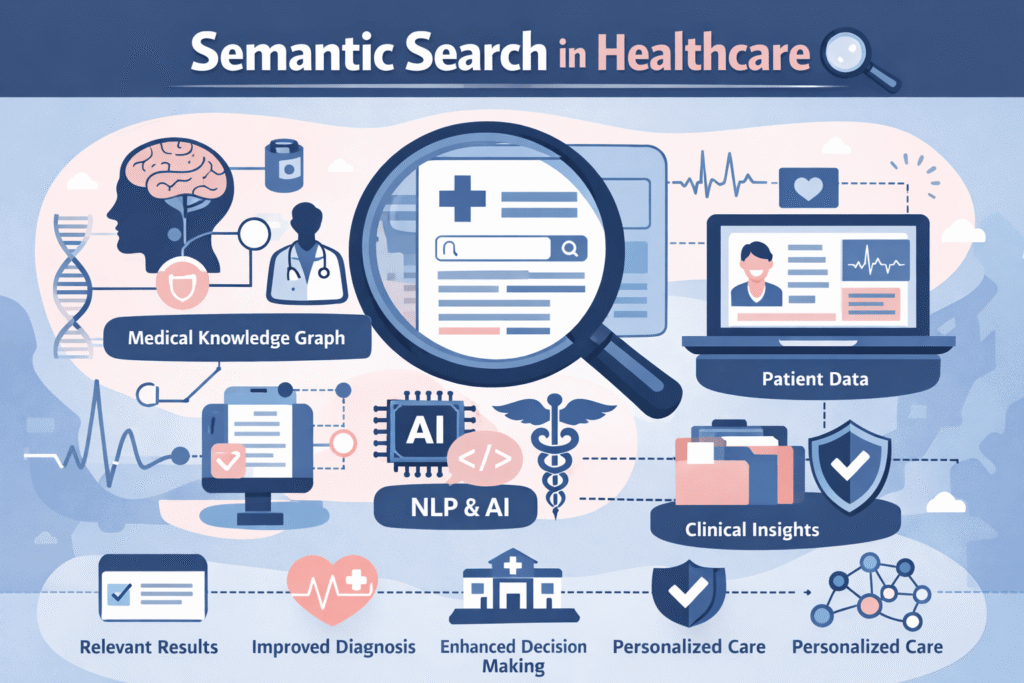
What is Semantic Search in Healthcare?
Semantic search is about meaning. The word “semantics” refers to the study of meaning in language. In the context of SEO, it means that search engines try to understand the searcher’s intent and the contextual meaning of terms.
In the past, if a patient searched for “joint pain,” the engine looked for pages with that exact phrase. Now, the engine understands that “joint pain” is related to “arthritis,” “inflammation,” “orthopedics,” and “physical therapy.” It recognizes that the person might be seeking a diagnosis, a specialist, or home remedies.
Why Context Matters for Patients
When a patient searches for health information, they are often stressed. They use natural, conversational language. They might type, “Why does my knee pop when I walk?” A traditional keyword-based system might struggle with this. A semantic system, however, understands the relationship between “knee,” “popping sound,” and “meniscus tear” or “crepitus.”
By focusing on semantic search, you ensure your content reaches the right person at the right time. You aren’t just matching words. You are solving problems.
The Role of NLP in Healthcare
Natural Language Processing (NLP) is the technology behind this shift. It is a branch of artificial intelligence. It helps computers understand, interpret, and generate human language.
How NLP Changes the Game
NLP allows Google to read your medical articles almost like a doctor would. It looks for:
- Entities: People, places, and things (e.g., “Mayo Clinic,” “Metformin,” “Diabetes”).
- Relationships: How those entities connect (e.g., “Metformin treats Diabetes”).
- Sentiment: The tone of the content.
- Syntax: The structure of the sentences.
NLP in healthcare is specifically trained to handle medical jargon and complex terminology. Because of this, Google can tell the difference between a high-quality medical study and a low-effort blog post. If your content lacks depth or logical flow, NLP algorithms will notice. They will favor content that shows actual expertise.
The Evolution of Google’s Algorithms
To understand where we are, we must look at where we started. Google has released several major updates that pushed semantic search forward.
1. Hummingbird (2013)
This was the first big step. Hummingbird allowed Google to analyze the entire sentence rather than just a few words. It started focusing on the “why” behind the search.
2. RankBrain (2015)
RankBrain added machine learning to the mix. It helped Google process queries it had never seen before. It began to guess what users meant based on their location and previous searches.
3. BERT (2019)
BERT stands for Bidirectional Encoder Representations from Transformers. This was a massive leap for NLP in healthcare. It allowed Google to understand the context of words based on the words that come before and after them. For example, the word “stand” means something different in “stand by me” versus “stand in line.” BERT helped Google understand these nuances.
4. Google MUM (2021)
Multitask Unified Model (MUM) is 1,000 times more powerful than BERT. It can understand information across different languages, including images and videos. For healthcare, this means if a patient uploads a photo of a rash, MUM can help identify what it might be and suggest relevant medical content.
Understanding User Intent in Medicine
User intent is the goal a person has when typing a query into a search engine. In healthcare, intent is vital. A person looking for “types of heart surgery” has a different intent than someone looking for “heart surgeon near me.”
The Four Main Categories of Intent
- Informational Intent: The patient wants to learn.
- Example: “What are the symptoms of Lyme disease?”
- Strategy: Provide comprehensive, easy-to-read guides.
- Navigational Intent: The patient wants to find a specific website.
- Example: “Cleveland Clinic patient portal.”
- Strategy: Ensure your technical SEO and site structure are perfect.
- Commercial Investigation: The patient is comparing options.
- Example: “Best Lasik surgeons in Chicago reviews.”
- Strategy: Use testimonials, case studies, and clear benefit lists.
- Transactional Intent: The patient is ready to book.
- Example: “Schedule an appointment with a dermatologist.”
- Strategy: Make your “Book Now” buttons clear and functional.
When you optimize for user intent medical queries, you build trust. Patients feel understood. Consequently, they are more likely to choose your practice.
Entity-Based SEO: Moving from Strings to Things
Google’s “Knowledge Graph” is a database of billions of facts about entities. An entity is a well-defined object or concept. In healthcare, an entity could be a disease, a medication, or a specific doctor.
Entity-based SEO is the practice of optimizing your content around these concepts rather than just keywords. Instead of just using the phrase “heart doctor,” you should mention “Cardiology,” “American Heart Association,” “Stethoscopes,” and “EKG tests.”
By mentioning related entities, you prove to Google that your content is authoritative. You are providing a complete picture of the topic. This tells the search engine that you are a reliable source of information.
The Impact of Voice Search in Healthcare
More patients are using smart speakers and mobile assistants. They ask Siri, Alexa, or the Google Assistant for health advice while driving or cooking.
Conversational Queries
Voice search healthcare queries are different from typed ones.
- Typed: “Flu symptoms.”
- Voiced: “Hey Google, do I have the flu if I have a fever and a headache?”
Voice searches are longer. They are full sentences. They often start with “Who,” “What,” “Where,” “When,” and “How.” To capture this traffic, your content should answer these direct questions. Using a “Question and Answer” format in your blog posts is a great way to do this.
Building Topic Clusters for Medical Authority
If you want to dominate a specific medical field, you cannot just write random blog posts. You need a structure. This is where topic clusters medical strategies come in.
The Hub and Spoke Model
A topic cluster consists of three main parts:
- Pillar Page: A comprehensive guide on a broad topic (e.g., “The Ultimate Guide to Spinal Health”).
- Cluster Content: Smaller articles that dive deep into specific sub-topics (e.g., “Exercises for lower back pain,” “How to sleep with sciatica,” “When to see a spine surgeon”).
- Internal Links: These connect the cluster content back to the pillar page.
This structure helps search engines understand that you have deep subject-matter expertise. It organizes your site in a way that makes sense for both bots and humans. Therefore, your authority grows, and your rankings follow.
LSI Keywords and Contextual Relevance
LSI stands for Latent Semantic Indexing. These are words and phrases that are mathematically related to your primary keyword. They are not just synonyms. They are context clues.
For example, if your primary keyword is “Diabetes,” LSI keywords would include:
- Insulin
- Blood sugar
- Glucose monitor
- Type 2
- Pancreas
- A1C test
If a page about “Diabetes” never mentions “insulin” or “blood sugar,” Google might think the content is low-quality. It lacks content relevance. Including these terms naturally throughout your writing helps search engines verify that your content is legitimate and helpful.
How to Create Content for Semantic Search
Writing for semantic search requires a shift in mindset. You are no longer writing for an algorithm; you are writing for a patient. Follow these steps to improve your SEO.
1. Research Questions, Not Just Keywords
Use tools to find out what patients are actually asking. Look at the “People Also Ask” section on Google. This tells you exactly what answering patient queries looks like in the real world.
2. Be Comprehensive
Don’t write a 300-word post and expect it to rank. Deep-dive into topics. Address the causes, symptoms, treatments, and prevention methods. Use data and cite your sources.
3. Use Clear Headings
Headings (H2S and H3S) act as a map for both readers and search engines. They should be descriptive. Instead of “Introduction,” use “What Causes Chronic Migraines?”
4. Implement Structured Data (Schema)
Schema markup is a code you add to your website. It helps search engines understand your data. For healthcare, you can use the “MedicalCondition” or “Physician” schema. This makes it easier for Google to display your information in “Rich Snippets.”
Answering Complex Patient Queries
Patients today are well-informed. They often come to your site after doing hours of research. They are looking for specific, complex answers.
If a patient asks, “Can I take Ibuprofen after my cardiac stent surgery?”, they aren’t looking for a general article on heart health. They need a specific, authoritative answer.
To rank for these queries:
- Be Direct: Answer the question in the first paragraph.
- Be Authoritative: Have your content reviewed or written by a medical professional.
- Be Clear: Avoid overly technical language that a layperson won’t understand.
Google prioritizes E-E-A-T (Experience, Expertise, Authoritativeness, and Trustworthiness). In the medical field, this is non-negotiable. If your site doesn’t prove it’s trustworthy, you won’t rank for semantic queries.
Understanding Patient Search Behavior
Patients don’t search in a straight line. They often follow a “messy middle” path. They move between exploration and evaluation.
The Search Journey
- Symptom Awareness: “Why do my fingers feel numb?”
- Condition Education: “Difference between carpal tunnel and neuropathy.”
- Treatment Search: “Non-surgical treatments for carpal tunnel.”
- Provider Selection: “Top hand surgeons in [City].”
Your content strategy should map to every stage of this journey. If you only focus on the final stage (Provider Selection), you miss out on building a relationship with the patient early on. By providing value during the “Symptom Awareness” stage, you become the trusted expert by the time they are ready to book.
Technical SEO for a Semantic World
While content is king, technical SEO is the castle that protects it. Semantic search relies on a clean, well-organized website.
Site Speed and Mobile Usability
Most medical searches happen on mobile devices. If your site is slow, patients will leave. Google uses “Core Web Vitals” to measure user experience. A fast site is a signal of a professional practice.
URL Structure
Your URLs should be readable.
- Bad: www.clinic.com/p=123
- Good: www.clinic.com/treatments/physical-therapy-for-back-pain
Secure Connections (HTTPS)
In healthcare, privacy is paramount. If your site isn’t secure, Google will warn users. This destroys trust before the patient even reads your first sentence.
Measuring Success in Semantic SEO
How do you know if your focus on semantic search in healthcare is working? Traditional metrics like “keyword rankings” are still useful, but they don’t tell the whole story.
Look for Topical Authority
Are you ranking for a broad range of related terms? If you rank for “knee replacement surgery,” “rehab after knee surgery,” and “best knee surgeons,” you have topical authority.
Monitor Click-Through Rate (CTR)
If your content effectively answers patient queries, your CTR will improve. People will see your informative snippets in the search results and click because they believe you have the answer.
Engagement Metrics
Look at “Time on Page.” If patients spend 4 minutes reading your guide, they find it useful. This sends a strong signal to Google that your content is relevant.
The Future: AI and the Search Landscape
The future of SEO is even more conversational. With the rise of Generative AI, search engines are increasingly providing direct answers in search results.
This might sound scary. If Google provides the answer, why would a patient click on your site? The answer is Trust. AI can give a general answer, but it cannot provide the personal, authoritative voice of a local doctor. Your goal should be to become the source that the AI cites. When you use entity-based strategies, you position yourself as the “source of truth.”
Why Choose InvigoMedia for Your Healthcare SEO?
The transition from keyword stuffing to semantic search is complex. It requires a mix of technical skill, medical knowledge, and creative content marketing. Many agencies still use outdated tactics that don’t work in a post-BERT world.
InvigoMedia is different. We are a forward-thinking agency that specializes in modern healthcare SEO. We don’t just find keywords; we build authority.
Our Specialized Content Marketing Services
We understand how NLP in healthcare dictates rankings. Our team focuses on:
- Entity-Based SEO: We map out the medical entities relevant to your practice to ensure Google sees you as a leader.
- Voice Search Optimization: We help you capture the growing market of patients using conversational queries.
- Topic Cluster Development: We organize your content into hubs that prove your expertise and keep users on your site longer.
- Comprehensive Question Answering: We create content that answers complex patient queries, moving them down the funnel from “just looking” to “booking.”
Your patients are searching for answers. They aren’t just looking for a doctor; they are looking for a solution. InvigoMedia ensures that your practice provides it. We help you navigate the nuances of semantic search in healthcare so you can focus on what you do best: caring for patients.
Conclusion
The shift to semantic search is a win for everyone. Patients get better information. Search engines provide better results. And high-quality healthcare providers finally get the visibility they deserve.
By moving beyond keywords and embracing the power of context, intent, and entities, you future-proof your practice. You stop chasing the algorithm and start helping people. That is the true goal of healthcare marketing.
Frequently Asked Questions
What is the biggest difference between keyword search and semantic search?
Keyword search looks for exact matches of specific words. Semantic search looks for the intent and meaning behind those words. Semantic search understands context and the relationships between different medical concepts.
How does NLP affect my medical blog?
Natural Language Processing allows search engines to understand your writing more like a human does. It identifies medical entities and determines if your content is truly helpful or just trying to manipulate search rankings.
What are topic clusters, and why do I need them?
Topic clusters are a way of organizing your website content. You have one main “pillar” page and several related “spoke” articles. This structure tells Google you are an authority on a specific medical subject, which helps improve your overall rankings.
Will voice search really change how patients find me?
Yes. Voice search queries are more conversational and longer than typed queries. If you don’t optimize for these natural-language questions, you may miss out on traffic from patients using mobile assistants and smart speakers.
What is entity-based SEO?
Entity-based SEO involves optimizing for specific concepts (like a disease or a treatment) rather than just words. It involves using related terms and structured data to show Google that your content is comprehensive and authoritative.
How can InvigoMedia help my practice with semantic search?
InvigoMedia uses advanced strategies like topic clustering, entity mapping, and NLP-focused content creation. We help your practice show up for complex queries and voice searches, ensuring you stay ahead of the competition in a changing digital landscape.