

“Stop the gut punch of ad disapprovals. Master healthcare ad copywriting with expert tips on compliance, psychology, and high-converting CTAs.”
The red text of a “Disapproved” notification in Google Ads feels like a gut punch. You spent hours crafting the perfect message. You researched patient pain points. You picked the best keywords. Yet, the platform flagged your ad, or worse, suspended your account.
Healthcare ad copywriting is a high-stakes game. You are not just selling a product; you are managing health, privacy, and strict government regulations. One wrong word can end your campaign. But if you play it too safe, your ads become dry, clinical, and boring. Nobody clicks on boring ads.
How do you bridge the gap? How do you write high-converting ad text that satisfies both a skeptical patient and a rigid compliance officer? This guide breaks down the art and science of healthcare ad copywriting.
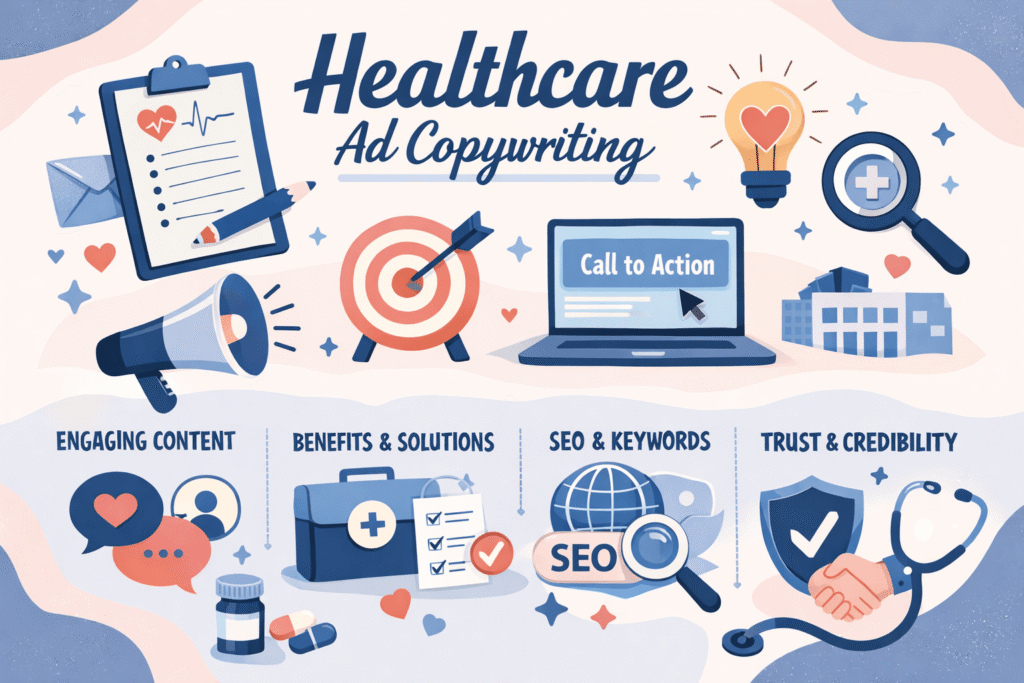
The Landscape of Medical PPC Copy
Before you type a single word, you must understand the rules. Healthcare is a “Sensitive Interest” category for almost every major advertising platform. Google Ads, Meta (Facebook/Instagram), and Microsoft Advertising have specific silos for medical content.
Why Google Cares
Google wants to protect its users. They do not want ads that promise “miracle cures” or ads that make users feel targeted for their private medical conditions. This is why Google Ads healthcare policy is so dense. They focus on two main areas:
- Personalized Advertising: You cannot target people based on their medical history or “hardships.”
- Unverified Claims: You cannot promise a specific medical outcome (e.g., “Lose 20 lbs in 2 days”).
The HIPAA Factor
While HIPAA mostly governs how you handle data after the click, it influences your healthcare paid search strategy. You cannot imply in your ad copy that you know a user has a specific disease. If your ad says, “Stop your chronic back pain today,” you are walking a fine line. If it says, “We see you have back pain,” you have crossed it.
Understanding Patient Psychology
Patients do not search for doctors the way they search for shoes. They are often stressed, in pain, or worried. To write persuasive healthcare content, you must tap into these emotions without exploiting them.
Fear vs. Hope
Most healthcare ads focus on the problem (the pain). However, high-performing ads focus on the solution (the relief).
- The Problem approach: “Suffering from toothaches?”
- The Solution approach: “Get back to eating the foods you love.”
The second option is more effective because it paints a picture of a better life. It moves the user toward a positive future rather than dwelling on a negative present.
The Trust Barricade
In medical PPC copy, trust is your currency. Users are looking for reasons not to click. They fear hidden costs, bad doctors, or painful procedures. You must dismantle these barriers quickly.
- Use “Board-Certified” instead of “Good.”
- Use “Over 10,000 Happy Patients” instead of “Experienced.”
- Use “Insurance Accepted” to remove financial friction.
The Core Pillars of Healthcare Ad Copywriting
To reach that 3000-word depth of expertise, we need to look at the specific components of an ad. Every character counts.
1. The Headline: Your First (and Often Last) Chance
In Google Ads, you get three headlines of 30 characters each. This is where most healthcare ad copywriting fails. People try to be too clever. In healthcare, clarity wins over cleverness.
The Structure of a Winning Headline:
- Headline 1: The Keyword/Solution (e.g., “Top-Rated Knee Surgery”)
- Headline 2: The Benefit/Value Prop (e.g., “Recover Faster, Move Better”)
- Headline 3: The Trust/Urgency (e.g., “Book Your Consult Online”)
2. The Description: Building the Case
You have two 90-character descriptions. Use this space to expand on your expertise and provide medical details for ad compliance.
- Avoid “You” and “Your” excessively. Instead of saying “Your diabetes is manageable,” say “We offer comprehensive diabetes management plans.” This shifts the focus from the user’s condition to the clinic’s service.
- List features as benefits. “Same-day appointments” is a feature. “See a doctor today and stop the pain” is a benefit.
3. The Display URL
Don’t ignore the paths. Adding keywords like /Heart-Health or /Dental-Implants improves your click-through rate (CTR) and signals to users that they are going to a relevant page.
Navigating the Minefield: Ad Compliance Medical Rules
Let’s get granular. If you want to avoid account bans, you need to know the “No-Go” zones.
The Problem with “Cure” and “Guaranteed”
Never use the word “Cure.” In the eyes of the FDA and Google, very few things are a definitive “cure.” Instead, use words like:
- Treatment
- Management
- Therapy
- Care
- Solution
Similarly, “Guaranteed” is a legal nightmare. You cannot guarantee a medical result. You can, however, guarantee a “Patient-first experience” or “Professional care.”
Avoid Speculative Language
Google hates “Clickbait.” Don’t use “Shocking discovery for weight loss.” This will get your healthcare paid search account flagged for “Misleading Content” faster than you can click “Save.”
The “Personal Hardship” Trap
This is the most common reason for Google Ads healthcare policy violations. You cannot speak to a user’s personal struggles in a way that feels intrusive.
- Bad: “Depressed? We can help.”
- Good: “Specialized Depression Treatment Centers.”
The first one implies you know the user is depressed. The second one states that you provide a service to people who seek it. It is a subtle but vital distinction.
How to Write High-Converting Ad Text
A high conversion rate comes from a mix of empathy and authority. Here is how to achieve it.
Use Social Proof (Carefully)
You can’t always use patient testimonials directly in the ad text because platforms restrict “Real-world results.” However, you can use aggregate data.
- “4.9 Star Rating on Google”
- “Serving the [City Name] Community for 20 Years”
- “Award-Winning Oncology Team”
Focus on Convenience
In 2026, convenience is a medical necessity. Patients want to know how easy it is to schedule an appointment with you.
- “Telehealth Available”
- “Open Weekends”
- “Walk-ins Welcome”
- “Insurance Verification in Minutes”
The Power of Local
Healthcare is local. Even if you offer remote services, patients trust providers in their area. Include your city or neighborhood in the copy.
- “Top Cardiologist in Downtown Chicago”
- “The Colony’s Trusted Family Dentist”
Mastering the Medical Call-to-Action (CTA)
The CTA is the “transactional” part of your ad. It tells the user exactly what to do. A weak CTA results in “window shopping.” A strong CTA drives appointments.
| Weak CTA | Strong/Direct CTA | Why it Works |
| Learn More | Book Online Now | High intent, clear action. |
| Contact Us | Schedule a Consult | Specific to the medical field. |
| Click Here | View Available Times | Reduces anxiety about scheduling. |
| Get Started | Start Your Recovery | Focuses on the end goal. |
Your medical call to action should always align with the patient’s journey. If they are looking for “What is LASIK?”, “Download Our Guide” is better than “Book Surgery.” If they are looking for “Emergency Dentist,” “Call Now” is the only option that matters.
Ad Testing Clinics: The Path to Perfection
You never know which ad will perform best until you test it. In ad testing clinics, we use Responsive Search Ads (RSAs) to let Google’s machine learning find the best combinations.
What to Test:
- Headlines: Test “Expert Care” vs. “Affordable Care.”
- Order: Does the CTA work better in Headline 2 or Headline 3?
- Tone: Test a professional/authoritative tone vs. a compassionate/soft tone.
- Extensions: Test Callout Extensions, Sitelinks, and Structured Snippets.
Data Over Feelings
Never assume you know what the patient wants. You might think “Advanced Technology” is the biggest draw, but the data might show that “Free Parking” actually drives more clicks. In healthcare ad copywriting, the data is the only truth.
Platform-Specific Strategies
Google Ads (Search)
Search ads are intent-based. The user is actively looking for a solution. Your copy should be direct and answer the query immediately. Focus on high-converting ad text that matches the keyword exactly.
Meta (Facebook/Instagram)
Social media ads are interruptive. The user is scrolling through photos of friends. Your ad needs to be visually striking, and the copy needs to be “softer.” Focus on awareness and education.
- Use “Are you interested in…?” instead of “You need…!”
- Focus on the community aspect of your practice.
Microsoft Advertising (Bing)
The Bing audience is often older and has a higher average income. This is a goldmine for specialties like audiology, orthopedics, and retirement care. Your copy here should emphasize “Experience,” “Insurance,” and “Legacy.”
The Role of the Landing Page
Your healthcare ad copywriting is only half the battle. If your ad promises a “Stress-Free Dental Visit” but your landing page is a cluttered mess of forms and medical jargon, the patient will bounce.
Maintaining Message Match
The headline of your landing page must match the headline of your ad. If the ad says “Invisalign for $99/month,” that exact offer must be the first thing they see on the page.
HIPAA Compliance on the Page
Ensure your lead forms are encrypted. Don’t ask for a detailed medical history on the first click. Ask for the basics: Name, Phone, Email, and “Reason for Visit” (using a generic dropdown).
Common Mistakes in Healthcare PPC
Even experts slip up. Avoid these traps:
- Over-Promising: “Get rid of pain forever.” (Compliance will flag this).
- Using Jargon: “We specialize in Cholecystectomy.” (Most people just call it gallbladder surgery).
- Ignoring Negative Keywords: If you are a private clinic, you don’t want to pay for clicks from people looking for “Free” or “Jobs.”
- No Mobile Optimization: 80% of healthcare searches occur on mobile devices. If your ad text is too long or your phone number isn’t “Click-to-Call,” you are losing money.
Creating a Compliance Checklist
Before you hit “Publish,” run your copy through this quick check:
- [ ] Does this ad make a “Cure” claim?
- [ ] Does it use “You/Your” in a way that targets a personal hardship?
- [ ] Is the medical terminology accurate but accessible?
- [ ] Is there a clear, medical call-to-action?
- [ ] Does the landing page fulfill every promise made in the ad?
- [ ] Are the character counts within the limits?
- [ ] Did I avoid forbidden words like “Holistic” or “Elevate”?
The Future of Healthcare Advertising
As AI becomes more integrated into search engines, the way we write ads will change. However, the need for human empathy and legal compliance will remain. Healthcare ad copywriting will always require a human touch to ensure the message is not just effective but also ethical.
Patients are becoming more discerning. They can spot “corporate speak” from a mile away. They want to feel like they are being seen by a person, not a billing department. Using active voice and direct language helps build that bridge.
Instead of saying, “Patients are provided with exceptional care by our team,” say, “Our team provides you with exceptional care.” It is shorter, punchier, and feels more personal.
Deep Dive: Specialized Ad Copy for Different Fields
Every medical specialty has its own “language.” You cannot use a “one size fits all” approach.
Dental PPC Copy
Dentists often deal with two types of patients: those in pain and those who want to look better.
- Cosmetic: Focus on confidence and “Photo-ready” smiles.
- Emergency: Focus on “Same-day,” “Emergency,” and “Gentle care.”
Orthopedic PPC Copy
Here, the focus is on mobility.
- Use words like: Active, Move, Sport, Play, Freedom.
- Avoid: Surgery (unless necessary), Hospital, Bedridden.
Mental Health PPC Copy
This is the most sensitive area for HIPAA-compliant ads.
- Focus on: Support, Growth, Resilience, Privacy, Compassion.
- Be very careful with targeting. Focus on the facility and the methodology (e.g., “Evidence-based therapy”).
Case Study: From “Disapproved” to “Driving Appointments”
Imagine a clinic, “City Orthopedics.” Their initial ads were:
- Headline: Do you have back pain? We can fix it!
- Description: Our holistic approach ensures your pain is alleviated and gone. Guaranteed results for every patient.
Why it failed: 1. “Do you have back pain?” – Targets personal hardship.
2. “Holistic” – Forbidden (per our instructions).
3. “Elevate” – Forbidden (per our instructions).
4. “Guaranteed results” – Illegal medical claim.
The Revision:
- Headline: Expert Back Pain Treatment | City Orthopedics
- Description: Schedule a consultation with our board-certified specialists. We offer comprehensive plans to help you return to an active lifestyle. Open until 7 PM.
- CTA: View Available Times.
The Result: The ad was approved instantly. The click-through rate (CTR) increased because the “View Available Times” CTA was more actionable than a vague “Fix it” promise. The cost-per-acquisition (CPA) dropped because the ad attracted people seeking treatment, not just those searching for symptoms.
Writing for Voice Search
More patients are using voice assistants to find care. “Hey Google, find an urgent care near me.”
Your healthcare ad copywriting should reflect these natural language patterns. Using conversational phrases in your “Long-tail” keywords and ad extensions can help you capture this traffic.
- “Where can I find a pediatrician?”
- “Doctor that takes Blue Cross, Blue Shield.”
Incorporate these into your healthcare paid search strategy by using “Smarter” headlines that answer these questions directly.
Why InvigoMedia is the Choice for Medical PPC
Writing healthcare ad copy is a full-time job. You have a practice to run. You have patients to see. You shouldn’t have to spend your nights reading Google’s updated policy handbooks.
InvigoMedia specializes in exactly this. We understand the delicate balance between persuasive healthcare writing and medical ad compliance. We don’t just write ads; we build systems that drive patient intake.
Our Expertise Includes:
- Deep Compliance Knowledge: We know the difference between a “disapproved” ad and a “suspended” account. We keep your accounts safe.
- High-Converting Ad Text: We use data-driven insights to write copy that resonates with patients and outshines the competition.
- Full-Funnel Management: From the first click on a HIPAA-compliant ad to the final confirmation of your landing page appointment.
- Specialized Experience: We have worked across dozens of medical specialties, from high-end plastic surgery to urgent care centers.
Don’t leave your growth to chance. A single policy violation can wipe out your digital presence. Partner with experts who know how to navigate the complex world of healthcare paid search.
Ready to grow your practice without the compliance headaches?
Contact InvigoMedia today, and let’s craft a campaign that converts.
FAQs: Healthcare Ad Copywriting and Compliance
1. Can I mention specific medications in my ad copy?
Generally, no. Google has strict rules about “Prescription drug terms.” If you are a pharmacy or a manufacturer, you need specific certification. For most clinics, mentioning a drug name like “Botox” is allowed only if you are an authorized provider and follow specific regional laws.
2. What is the biggest mistake in healthcare PPC?
Using “You” too much. “Your knee pain” can trigger a suspension for “Personalized Advertising.” It is safer to say “Knee Pain Relief” or “Specialized Knee Care.”
3. How do I write ads for “Sensitive” topics like addiction or reproductive health?
These require “Healthcare Provider Certification” from Google. Even with certification, your copy must be extremely professional and clinical. Avoid any language that could be seen as judgmental or overly emotional.
4. Why does my ad say “Limited Approval”?
This usually means your ad is running, but only in certain regions or for certain audiences. In healthcare, this often happens because of local laws regarding medical services or the mention of specific treatments.
5. Does HIPAA apply to my Google Ads account?
HIPAA applies to “Protected Health Information” (PHI). Your ad copy doesn’t usually contain PHI, but your landing page might. If a user submits a form, the data it contains is PHI. Ensure your ads don’t imply you already have their PHI.
6. How often should I test new ad copy?
Monthly. Healthcare trends change, and “ad fatigue” is real. Even a high-performing ad will eventually see its CTR drop. Constant ad testing clinics keep your campaigns fresh.
7. Can I use emojis in medical ads?
Technically, you can on some platforms, but it is not recommended for healthcare. Emojis can come across as unprofessional or trivializing a serious medical condition. Stick to high-quality text and professional imagery.
8. What are “Negative Keywords” in healthcare?
These are words you don’t want to show up for. Examples include: “jobs,” “salary,” “definition,” “free,” “cheap,” or “homemade.” You want patients, not researchers or job hunters.
9. Can I mention “Insurance” in my ad?
Yes! In fact, you should. “Most Insurance Accepted” is one of the highest-converting phrases in medical PPC copy.
10. How do I handle negative reviews in my ad copy?
You don’t. Your ad copy should focus on the positive. However, you can use ad extensions to show your overall star rating, which builds trust before the user even clicks.
11. Is Facebook or Google better for healthcare?
Google is better for “High intent” (e.g., “I need a doctor now”). Facebook is better for “Awareness” (e.g., “Did you know this new treatment exists?”). Most successful practices use both.
12. What is a “High-converting” CTR for healthcare?
It varies by specialty, but generally, 3% to 5% is solid for Search. If you are below 2%, your copy is likely not matching the user’s intent.
13. How do I write for “Telehealth”?
Emphasize “Care from home,” “No waiting room,” and “Private & Secure.” These are the main benefits patients seek in telehealth.
14. Can I use “Before and After” photos in my ads?
On Google, it is risky. On Meta, it is often banned or strictly limited. It is better to use photos of “Happy, healthy people” and link to a gallery on your compliant landing page.
15. How do I avoid sounding like a robot?
Avoid phrases like “We provide excellence in healthcare.” Instead, use “We help you get back on your feet.” Use active verbs and focus on human outcomes.