

“Stop overpaying for patients. Learn 7 expert strategies to reduce the cost per lead medical practices face and maximize your PPC budget ROI.”
Managing a medical practice requires more than just clinical expertise. You need a steady stream of patients to keep your doors open and your staff busy. Many healthcare providers turn to Pay-Per-Click (PPC) advertising on Google and Bing to find these patients. However, the medical field is one of the most expensive industries for digital ads.
If you do not manage your budget carefully, your Cost Per Lead (CPL) will skyrocket. You might spend thousands of dollars only to receive a handful of phone calls. This guide will show you how to reduce the cost per lead generated by medical campaigns. We will explore data-driven strategies to improve your ad spend efficiency and maximize your healthcare paid search ROI.
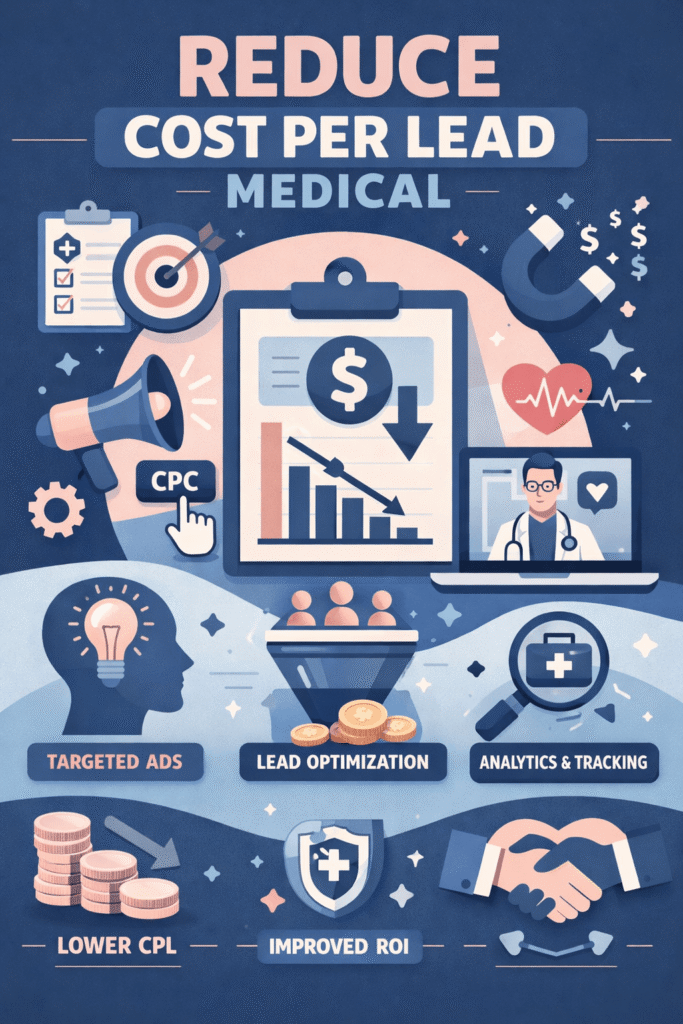
Understanding the Medical PPC Landscape
Before we dive into the tactics, we must acknowledge what makes medical PPC unique. Google has strict policies regarding healthcare. You cannot remarket to users based on sensitive health conditions in the same way a shoe store retargets customers. Furthermore, competition is fierce. Local clinics compete against massive hospital networks and national lead-generation sites.
High competition drives up the Cost Per Click (CPC). If your CPC is high and your conversion rate is low, your CPL becomes unsustainable. To fix this, you must stop thinking about “buying clicks” and start thinking about “buying outcomes.”
Why High CPL Happens in Healthcare
- Broad Targeting: Bidding on general terms like “doctor” or “hospital” instead of specific treatments.
- Poor Quality Scores: Paying a “penalty” tax to Google because your ads do not match user intent.
- Irrelevant Traffic: Paying for clicks from people looking for jobs, free advice, or symptoms rather than treatment.
- Weak Landing Pages: Sending expensive traffic to a homepage that doesn’t tell the user what to do next.
Strategy 1: Master the Google Ads Quality Score
Google does not always give the top spot to the highest bidder. They want to show the most relevant ad to the user. They measure this through a metric called Quality Score.
Quality Score is a diagnostic tool that shows how well your ad quality compares to other advertisers’. It is measured on a scale of 1 to 10. A higher Quality Score leads to lower prices and better ad positions.
Components of Quality Score
- Expected Click-Through Rate (CTR): How likely is someone to click your ad?
- Ad Relevance: Does your ad text match the search query?
- Landing Page Experience: Is the page useful, fast, and easy to navigate?
How to Improve Your Score
To reduce the cost per lead of medical campaigns, you must improve these three areas.
- Granular Ad Groups: Instead of one ad group for “Orthopedics,” create separate groups for “Knee Surgery,” “Shoulder Pain,” and “Sports Medicine.” This allows your ad text to match the specific keyword exactly.
- Use Dynamic Keyword Insertion (DKI): This tool automatically inserts the user’s search term into your ad headline. It makes the ad feel highly personal.
- Improve Page Speed: If your landing page takes more than three seconds to load, Google will lower your score, and users will leave.
| Quality Score | Impact on CPC |
| 10/10 | 50% Discount |
| 7/10 | Benchmark Price |
| 5/10 | 25% Increase |
| 1/10 | 400% Increase |
As the table shows, a low score acts as a tax. Improving your score from a 5 to a 10 can literally cut your costs in half without changing your budget.
Strategy 2: Use Negative Keywords to Filter Waste
In medical PPC, what you don’t show up for is just as important as what you do. Negative keywords prevent your ads from appearing for specific search terms.
Many clinics waste 30% to 50% of their budget on “junk” clicks. For example, if you are a private plastic surgeon, you do not want to pay for clicks from people searching for “free plastic surgery” or “plastic surgery jobs.”
Essential Negative Keyword Categories for Medical
- Employment Searches: Jobs, careers, salary, hiring, internship.
- Educational Searches: Definition, what is, symptoms of, research, journal, class, school.
- Low-Intent Searches: Free, cheap, DIY, home remedy, reviews of [Competitor Name].
- Irrelevant Services: If you are a cardiologist, add “pediatric” if you only treat adults.
How to Build Your List
Regularly check your Search Terms Report in Google Ads. This report shows exactly what people typed before clicking your ad. If you see a term that isn’t a lead, add it as a negative keyword immediately. This is the fastest way for budget management clinics to survive.
Strategy 3: Optimize Your Landing Pages (CRO)
You can have the best ads in the world, but if your landing page is confusing, you will lose the lead. Conversion Rate Optimization (CRO) is the process of increasing the percentage of visitors who take action.
The Anatomy of a High-Converting Medical Landing Page
- Clear Headline: State exactly what you offer. “Expert Knee Replacement in Chicago” is better than “Welcome to Our Clinic.”
- Trust Signals: Display board certifications, patient testimonials, and “As Seen On” logos.
- HIPAA-Compliant Forms: Ensure users feel safe sharing their data.
- Single Call to Action (CTA): Don’t give too many options. Use a single large button labeled “Request an Appointment” or “Call Now.”
- Click-to-Call Buttons: Most medical searches are done on mobile devices. Make it easy for them to call your office with one tap.
Landing Page Comparison
| Feature | Low-Converting Page | High-Converting Page |
| Navigation | Full menu with 10+ links | No menu (keeps user focused) |
| Images | Generic stock photos | Real photos of the doctor and staff |
| Form Length | 15 fields | 3-5 essential fields |
| Social Proof | None | 5-star Google review snippets |
By improving your conversion rate from 2% to 4%, you effectively cut your CPL in half. This makes landing page CRO one of the most profitable activities in your marketing strategy.
Strategy 4: Refine Your Keyword Strategy
Not all keywords are created equal. In the medical field, keywords usually fall into three categories:
- Symptom-Based: “Why does my back hurt?” (High volume, low intent).
- Condition-Based: “Sciatica treatments.” (Medium volume, medium intent).
- Treatment-Based: “Back surgeon near me” or “Spine clinic appointment.” (Low volume, high intent).
To reduce cost per lead, medical practices should focus on treatment-based keywords. These users are ready to book an appointment. While symptom-based keywords are cheaper per click, they rarely convert into actual patients.
Long-Tail Keywords
Instead of bidding on “dentist,” bid on “emergency tooth extraction downtown.” These long-tail phrases are less competitive and much cheaper. They also attract patients who know exactly what they need.
Strategy 5: Leverage Ad Extensions
Ad extensions make your ad larger and more informative. They give users more reasons to click. Best of all, Google does not charge extra to use them.
- Location Extensions: Show your office address and the distance to the user.
- Call Extensions: Put your phone number right in the ad.
- Sitelink Extensions: Link to specific pages, such as “Meet the Doctors” or “Insurance Accepted.”
- Callout Extensions: Highlight unique selling points like “Open Saturdays” or “Same-Day Appointments.”
Using extensions improves your CTR. Because CTR is a major part of Quality Score, extensions indirectly help lower CPL healthcare costs.
Strategy 6: Geographic and Time-of-Day Bidding
Why pay for ads at 3:00 AM if your office is closed and no one is there to answer the phone? Why show ads to people 50 miles away if your patients usually come from within a 10-mile radius?
Location Targeting
Analyze your patient data. If 80% of your patients live in five specific zip codes, increase your bids for those areas. Decrease or stop spending in zip codes that don’t produce leads.
Ad Scheduling
Look at your conversion data. If you notice that leads coming in after 8:00 PM never actually book an appointment, stop showing ads at night. Focus your ad spend efficiency on the hours when your front desk is staffed and ready to convert callers into patients.
Strategy 7: The Importance of a PPC Audit
You cannot fix what you do not measure. A regular PPC audit is essential for any growing clinic. An audit helps you find “bleeding” budgets and missed opportunities.
Checklist for a Medical PPC Audit:
- [ ] Check for broken landing page links.
- [ ] Review the “Search Lost IS (budget)” metric to see if you are missing out on leads due to low funds.
- [ ] Review the “Search Lost IS (rank)” to see if your Quality Score is the problem.
- [ ] Ensure conversion tracking is actually working (test your forms!).
- [ ] Analyze mobile vs. desktop performance.
Strategy 8: Focus on Healthcare Paid Search ROI
Ultimately, CPL is just one piece of the puzzle. You must also track your Return on Investment (ROI).
If a lead costs $50 for a cleaning but only $100 for a dental implant, the implant lead is much more valuable. You must integrate your Google Ads account with your Patient Management Software (PMS) or CRM. This allows you to see which keywords lead to actual procedures, not just phone calls.
By focusing on healthcare paid search ROI, you can justify spending more on high-value keywords while cutting the “fluff” that doesn’t contribute to your bottom line.
How Relevance Lowers Your Costs
There is a direct correlation between relevance and cost. Google operates as an auction, but it is a “Vickrey auction” modified by quality.
When your ad is highly relevant to the search query, Google rewards you. They want the user to have a good experience, so they keep using Google. If you provide that experience, Google lets you “win” the auction even if your bid is lower than a competitor’s with a messy, irrelevant campaign.
This is why medical PPC optimization is a continuous process. You must constantly refine your ads to stay relevant to changing patient behaviors.
Specific Strategies for Medical Niches
Different medical specialties require different approaches to reduce CPL.
For Plastic Surgeons
Visuals matter. Since you cannot easily use remarketing images, focus your landing page on “Before and After” galleries. Use high-intent keywords like “pricing” or “consultation.”
For Orthopedic Surgeons
Focus on “pain” and “recovery.” People searching for orthopedic help are often in distress. Your ad copy should emphasize quick relief and expert care. Use location extensions heavily, as patients won’t travel far for physical therapy or post-op checks.
For Dentists
Emergency keywords are gold. “Broken tooth repair” or “root canal today” have incredibly high conversion rates. Make sure your call extensions are active and that your “Emergency” button is the most prominent element on your mobile site.
The Role of Professional Management
Managing a high-performance PPC campaign is a full-time job. Between HIPAA compliance, keyword research, and bid management, it’s easy for a busy doctor or office manager to feel overwhelmed.
Small mistakes in Google Ads can lead to thousands of dollars in wasted spend. This is where professional medical PPC optimization comes into play.
Why Choose InvigoMedia?
InvigoMedia specializes in healthcare marketing. They understand the nuances of patient behavior and the strict requirements of medical advertising.
- Data-Driven Decisions: They don’t guess. They use advanced analytics to see exactly where your money goes.
- Niche Expertise: They know which keywords work for dermatology, cardiology, and every specialty in between.
- Lowering Acquisition Costs: Their primary goal is to reduce the cost per lead that medical practices face, allowing you to grow your patient base without draining your bank account.
- Transparency: You get clear reports on your spend, leads, and ROI.
By partnering with experts, you ensure your budget is managed with the precision of a surgeon. You can focus on treating patients while InvigoMedia focuses on finding them.
Conclusion
Reducing your cost per lead is not about spending less; it is about spending smarter. By focusing on medical PPC optimization, you can weed out irrelevant traffic and speak directly to the patients who need you most.
Remember these core pillars:
- Improve Quality Score to stop paying the “low-quality tax.”
- Use negative keywords to stop paying for junk clicks.
- Optimize landing pages to ensure every click has the best chance to convert.
- Track everything to focus on ROI, not just clicks.
If you want to take the guesswork out of your marketing, InvigoMedia is ready to help. Their data-driven approach to PPC management ensures that every dollar of your budget works toward growing your practice. Stop wasting money on inefficient ads and start seeing the ROI your healthcare practice deserves.
Lowering your CPL is the first step toward a more profitable, sustainable clinic. Start auditing your account today, or have the pros handle it for you. Your future patients are searching—make sure they find you at the right price.
FAQs
1. What is a good Cost Per Lead for medical PPC?
A “good” CPL varies by specialty. A general practitioner might aim for $20-$40, while a specialized surgeon might see $150-$300. The key is to compare the CPL to a patient’s lifetime value. If a $200 lead turns into a $10,000 surgery, your ROI is excellent.
2. How long does it take to see results from PPC optimization?
You will often see changes in click quality within days of adding negative keywords. However, significant drops in CPL usually take 30 to 90 days. This time allows Google’s algorithm to learn from your new data and for you to A/B test your landing pages.
3. Why are my competitors always above me, even when I bid high?
This usually happens because of a low Quality Score. If their ad is more relevant or their landing page is better, Google will place them higher even if they pay less. Focus on relevance rather than just raising your budget.
4. Should I bid on my own practice name?
Yes. Bidding on your brand name is usually very cheap. It prevents competitors from “stealing” your patients by bidding on your name and showing their ads above your organic listing. It also gives you more control over what a user sees when they search for you.
5. Is Facebook Ads better than Google Ads for medical leads?
Google Ads is “intent-based,” meaning people are actively looking for a solution. Facebook is “interest-based,” meaning you are interrupting their scrolling. Google usually produces higher-quality leads for medical treatments, while Facebook is great for awareness and elective procedures like aesthetics.
6. How do I know if my conversion tracking is working?
You should perform a “test” conversion. Click your own ad (yes, it costs a few dollars, but it’s worth it) and fill out your form. Check your Google Ads “Conversions” tab 24 hours later to see if the action was recorded. If not, your tracking code is likely installed incorrectly.
7. Can I mention specific medications in my ads?
Google has very strict rules about pharmaceutical terms. Mentioning certain drugs can cause your ads to be disapproved or your account to be flagged. It is usually safer to focus on the condition or the treatment name rather than the specific medication.