

“Expand your reach with international patient SEO. Learn how to use hreflang tags and cultural localization to attract global patients.”
The world has changed. Patients no longer limit their healthcare choices to their local neighborhoods. Today, a patient in London might fly to Turkey for dental implants. A couple in New York might travel to Spain for fertility treatments. This shift has turned healthcare into a global marketplace. However, if your clinic wants to catch the eye of these global travelers, you need more than just a great medical team. You need a digital strategy that crosses borders.
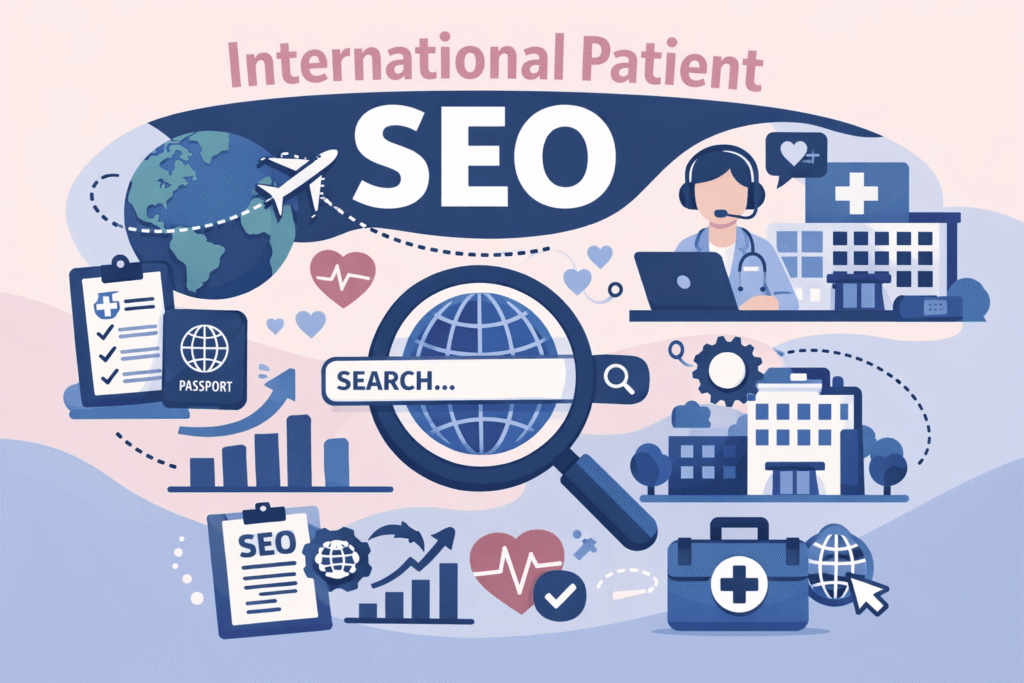
This is where international patient SEO comes into play. It is the engine that drives your visibility in foreign search engines. Without it, your clinic remains invisible to the very people looking for your services. In this guide, we will break down the complex world of medical tourism marketing and show you how to dominate the global search results.
The Rise of the Global Patient
Medical tourism is a multi-billion-dollar industry. People travel for three main reasons: cost, quality, and availability. Some countries offer procedures at a fraction of the price found in the West. Others provide specialized treatments that are not yet approved elsewhere.
To tap into this market, you must understand the mindset of an international patient. They are not just looking for a doctor. They are looking for a destination, a solution, and safety. Your international SEO strategy must address all these needs simultaneously.
Why International SEO Matters for Clinics
Most clinics make the mistake of thinking a single English website is enough. It isn’t. If you want to reach a patient in Germany, your content needs to rank on Google.de. If you want to reach someone in Saudi Arabia, you need to be visible in Arabic search queries.
Multilingual healthcare SEO ensures that your website speaks the language of your target audience. It tells search engines exactly which regions you serve. When done right, it builds a bridge between your clinic and a patient thousands of miles away.
Technical Foundations: Setting the Stage for Global Growth
Before you write a single word of content, you must get the technical side right. Search engines need to know where your website belongs. If Google is confused about which country you are targeting, your rankings will suffer.
1. Choosing the Right URL Structure
There are three main ways to structure a global website. Each has pros and cons.
- ccTLDs (Country Code Top-Level Domains): Examples include .de for Germany or .fr for France. This is the strongest signal to search engines. However, it is expensive and hard to maintain across dozens of countries.
- Subdirectories: Examples include yourclinic.com/es/ or yourclinic.com/ar/. This is the most popular choice for cross-border medical marketing. It keeps all your “authority” on one domain while separating languages.
- Subdomains: Examples include es.yourclinic.com. This is easier to host on different servers, but it can be harder for SEO because Google might treat them as separate sites.
2. Mastering Hreflang Tags
If there is one technical element you cannot ignore, it is the hreflang tag. Hreflang for clinics is a small piece of code that tells Google which version of a page to show based on the user’s location and language.
For example, if you have a page about “Hair Transplants” in English and a Spanish version, the hreflang tag ensures that Spanish users see the Spanish page. This prevents “duplicate content” issues. It also reduces your bounce rate because users land on a page they can actually read.
3. Server Location and Site Speed
Speed is a ranking factor. If your clinic is in Thailand, but your server is in Singapore, a patient in Canada might experience slow load times. Use a Content Delivery Network (CDN). A CDN stores copies of your site on servers all over the world. This ensures that your global search visibility delivers a fast user experience, regardless of the patient’s location.
Cultural Localization: More Than Just Translation
Many clinics use Google Translate and think they are done. This is a massive mistake in multilingual healthcare SEO. Translation is word-for-word. Localization is culture-for-culture.
Speaking the Local Medical Language
Medical terms vary even between people who speak the same language. A patient in the UK looks for a “Consultant,” while a patient in the US looks for a “Specialist.” In Mexico, a patient might use different slang for cosmetic surgery than a patient in Spain.
Cultural localization means researching how locals actually search. You must use the terms they use. If you don’t, you won’t appear in their search results.
Visual and Social Localization
Images matter. If your website only shows Western patients but you are targeting the Middle East, you may create a cultural disconnect. Your destination marketing healthcare strategy should include visuals that reflect the diversity of your target markets.
Furthermore, consider currency and units of measure. A patient in Europe wants to see prices in Euros and measurements in centimeters. A patient in the US wants Dollars and inches. Small details like this build massive trust.
Building Cross-Border Trust Signals
Trust is the most important currency in medical tourism. A patient is literally putting their life in your hands in a foreign country. Your international patient SEO strategy must prioritize “E-E-A-T” (Experience, Expertise, Authoritativeness, and Trustworthiness).
International Accreditations
Display your credentials prominently. Are you JCI (Joint Commission International) accredited? Do you have ISO certifications? These logos act as a universal language of safety. Make sure these are visible on every localized version of your site.
The Power of Video Testimonials
Written reviews are easy to fake. Video testimonials are not. When a patient sees someone from their own country talking about their successful surgery at your clinic, the “fear factor” drops.
- Tip: Create specific landing pages for different nationalities. Feature “Patients from the UK” or “Patients from Australia.” This makes the prospect feel like they aren’t the first person to make the trip.
Transparency in Pricing and Logistics
Hidden costs kill conversions in global patient acquisition. Be upfront about what the price includes. Does it include the hotel? The airport pickup? The follow-up medication?
Provide a clear “International Patient Guide.” This should cover everything from visa requirements to local weather. When you provide this much value, Google sees you as a high-quality resource, which boosts your efforts to target overseas patients.
Content Strategy for Global Reach
You cannot rank for “Best Heart Surgeon” globally. It is too competitive. Instead, you need a granular content strategy.
1. Educational Blog Posts
Address the specific concerns of the medical traveler.
- Is it safe to travel for surgery after 24 hours?
- How to choose a dental clinic in Hungary.
- Recovery tips for the long flight home.
These topics target “top-of-funnel” patients who are just starting to research.
2. Comparison Pages
Patients are comparing you to their local options. Create content that honestly compares the costs and technologies of your country versus theirs. Use tables and charts to make this data easy to digest. This is a core part of cross-border medical marketing.
3. Local PR and Backlinks
To rank in a specific country, you need links from that country. If you want patients from Germany, try to get featured in German health blogs or news sites. This tells Google that your clinic is a relevant authority for German users.
Navigating Legal and Compliance Barriers
Every country has different rules about medical advertising. In some places, you cannot show “before and after” photos. In others, you cannot mention specific prices in ads.
Your international SEO strategy must respect these rules. For example, Google’s healthcare policies vary by region. If you violate these, your entire domain could be penalized. Always work with a team that understands the legal landscape of medical tourism marketing.
Technical Requirements for Different Search Engines
While Google is the king of search in most of the world, it isn’t the only player.
- Baidu (China): If you want patients from China, you need to optimize for Baidu. This requires a Chinese hosting provider and a different set of technical rules.
- Yandex (Russia): Yandex has its own algorithms and values different signals than Google.
- Naver (South Korea): This is a highly visual, community-driven platform.
If your global search visibility goals include these regions, your SEO strategy must be tailored to the specific platforms in those regions.
The Role of Mobile Optimization
In many emerging markets, patients skip the desktop entirely. They do all their research on smartphones. If your site is not “Mobile-First,” you are losing the majority of the global market.
Ensure your site loads in under three seconds on a 4G connection. Use large buttons and easy-to-read fonts. Remember, the patient might be looking at your site while sitting in a waiting room or on a bus. Make the experience seamless.
Measuring Success in International SEO
How do you know if your international patient SEO is working? You need to look beyond simple traffic numbers.
Key Performance Indicators (KPIs)
- Organic Traffic by Country: Are you actually getting visitors from your target regions?
- Conversion Rate by Language: Does the Spanish version of your site convert as well as the English version?
- Cost Per Acquisition (CPA): How much does it cost to get one international lead via SEO versus paid ads?
- Assisted Conversions: SEO often starts the journey, even if the patient eventually calls you directly or sends an email.
Use tools like Google Search Console and localized rank trackers to keep a close eye on your progress.
Expanding the Strategy: A Deep Dive into High-Value Procedures
To truly reach 3000 words, we must examine how specific procedures require unique international SEO strategies. Not all medical tourism is the same. A patient seeking a life-saving surgery has different search habits than someone seeking a cosmetic “mommy makeover.”
Dental Tourism SEO
Dental tourism is one of the fastest-growing sectors. Countries like Hungary, Mexico, and Thailand are hotspots.
- Keywords: Patients often search for “Dental implants abroad” or “Full mouth restoration cost [Country].”
- Content: Focus on “Before and After” galleries. Use high-resolution photos.
- Trust: Mention the brands of implants you use. If you use Nobel Biocare or Straumann, say it. These are global brands that patients recognize and trust.
Cosmetic and Plastic Surgery SEO
This is a highly visual and emotional market.
- Keywords: Use terms like “Affordable rhinoplasty,” “Best plastic surgeons in [City],” and “Cosmetic surgery packages.”
- Localization: In Latin America, the aesthetic standards differ from those in East Asia. Your cultural localization must reflect the “look” that the local market desires.
- Trust: Focus on the facility’s safety. Show the recovery suites. International patients want to know they will be pampered and safe during their healing process.
Fertility and IVF Tourism SEO
Fertility is a deeply sensitive topic. The search intent is often driven by legal restrictions in the patient’s home country or high costs.
- Keywords: “IVF with egg donation abroad,” “Gender selection clinics,” and “Success rates for IVF in [Country].”
- Content: This requires a lot of “Long-form” educational content. Explain the legal landscape. Explain the science.
- Trust: Success rates are everything here. However, be honest. Over-promising can lead to legal issues and a ruined reputation. Use verified data to back up your claims.
Advanced Technical SEO: Data Sovereignty and Privacy
When you move data across borders, you run into legal hurdles. International patient SEO isn’t just about rankings; it’s about staying within the law.
GDPR and HIPAA in a Global Context
If you are targeting European patients, your website must be GDPR compliant. This means clear cookie banners and data protection protocols. If you are a clinic in Asia targeting US patients, understanding HIPAA-like privacy standards is vital for building trust.
Include a “Privacy and Data Security” section on your localized pages. Explain how you protect patient records. In an era of data breaches, being a “Safe Harbor” for patient information is a powerful cross-border advantage in medical marketing.
The Power of Video SEO in Medical Tourism
YouTube is the second-largest search engine in the world. For medical tourism, it is the most influential.
Creating a Global YouTube Strategy
- Closed Captions: Upload professional subtitles in your target languages. Don’t rely on auto-generated ones.
- Localized Titles and Descriptions: Use your international patient SEO keywords in the video metadata.
- The “Virtual Tour”: Create a high-quality video tour of your clinic. Show the patient exactly where they will be staying. Show the state-of-the-art equipment. This removes the “unknown” factor.
Videos often rank in Google’s main search results. A well-optimized video can give you a “double dip” in visibility, appearing in both the video tab and the main search page.
Building a “Destination” Brand
You aren’t just selling a medical procedure. You are selling a destination. Your destination marketing healthcare strategy should highlight the beauty and convenience of your location.
Integrating Travel and Tourism Content
Why not rank for “Best things to do in [Your City] while recovering”? By providing travel tips, you capture the patient’s interest early. You show that you care about their entire experience, not just the time they spend in the operating room.
- Where to stay? (Partner with local hotels for “medical rates”).
- What to eat? (List healthy, post-op-friendly restaurants.)
- How to get around? (Explain the local Uber or taxi situation.
This type of content builds “Topical Authority.” Google sees you as the ultimate expert on both the medical procedure and the location. This is a secret weapon in overseas patient targeting.
Case Study: The Impact of a Global Footprint
Imagine a dental clinic in Costa Rica. By implementing a strict international SEO strategy, they moved from 100 local leads a month to 500 global leads.
They didn’t just translate their site. They created specific content for Americans (focusing on cost savings) and Canadians (focusing on avoiding long wait times). They used hreflang for clinics to ensure each group saw the right message.
The result? A 400% increase in revenue within 18 months. Their digital footprint now spans two continents, and they are the top-ranked clinic for their specialty in the entire region. This is the power of a dedicated medical tourism marketing plan.
Final Thoughts on Global Visibility
The competition for international patients is fierce. Clinics in Singapore, India, Turkey, and Mexico are all fighting for the same eyes. To win, you cannot afford a “generic” digital presence.
Your international patient SEO must be precise. It must be technical. Most importantly, it must be human. It must speak to the fears, hopes, and dreams of a person who is willing to travel thousands of miles for a better life.
By focusing on cultural localization, mastering the technical requirements of multilingual healthcare SEO, and building undeniable trust, you can transform your clinic into a global powerhouse.
And remember, you don’t have to do it alone. InvigoMedia is here to guide you through every step of this journey. We have the tools, the talent, and the track record to make your clinic the first choice for patients worldwide. Your global reach starts here. Let’s build your international future together.
Key Takeaways for Your Strategy:
- Infrastructure: Use subdirectories and correct hreflang tags.
- Content: Localize, don’t just translate. Use native speakers.
- Trust: Prioritize international accreditations and video proof.
- Authority: Build links from the countries you want to attract.
- Speed: Use a CDN to ensure your site is fast everywhere.
- Compliance: Respect the medical advertising laws of each target region.
With these pillars in place, your clinic will be well-positioned to dominate the world of medical tourism. The patients are out there—make sure they can find you.
Conclusion: Partner with the Global Leaders
Expanding your clinic’s reach to the global stage is a massive undertaking. It requires a blend of technical mastery, cultural empathy, and medical marketing expertise. You cannot leave your global patient acquisition to chance.
This is where InvigoMedia excels. We don’t just “do SEO.” We build global digital footprints for world-class medical institutions. With a proven track record in medical tourism marketing, we understand the nuances of international patient SEO better than anyone else.
We know how to navigate the complexities of hreflang for clinics, the subtleties of cultural localization, and the technical demands of ranking in diverse markets. Our strategies are designed to build trust across borders and turn international searchers into loyal patients.
Are you ready to take your clinic to the world? Don’t let your competitors capture the global market while you stay local. Contact InvigoMedia today. Let us help you expand your digital footprint and achieve the global reach your medical expertise deserves. Together, we will make your clinic a destination for patients everywhere.
FAQs: International Patient SEO
What is the most important factor in international SEO for clinics?
The most important factor is a combination of technical setup (hreflang tags) and cultural localization. You must prove to both the search engine and the patient that you understand their specific needs and language.
How long does it take to see results from medical tourism marketing?
SEO is a long game. Typically, you will start seeing significant movement in international rankings within 6 to 12 months. However, this depends on the level of competition and the country you are targeting.
Should I translate my entire website?
Not necessarily. Start with your most profitable procedures and your highest-potential markets. It is better to have five perfectly localized pages than 50 pages of poor-quality automated translations.
Do I need a different website for every country?
No. Using subdirectories (yourclinic.com/es/) is usually the most efficient way to manage multiple languages and countries without the massive overhead of managing dozens of domains.
How do I handle SEO for patients who speak different versions of the same language?
Use specific hreflang codes. For example, es-MX for Mexico and es-ES for Spain. This allows you to tailor the currency, slang, and local references for each group while still using Spanish.
Can I just use AI to write my localized content?
AI can help with drafts, but it often misses cultural nuances and medical accuracy. For multilingual healthcare SEO, always have a native-speaking medical professional review the content. Accuracy is a major trust signal.