

“Stop guessing your growth. Use the patient acquisition cost formula to identify profitable channels, reduce CPL, and increase practice ROI.”
Running a medical practice often feels like balancing on a tightrope. You want to provide the best care possible. At the same time, you have to keep the lights on and the staff paid. Many practice owners look at their bank accounts at the end of the month and wonder where the money went. They see new patients coming through the door. They see the waiting room full. Yet, the profit margins remain slim.
If this sounds familiar, you likely have a “leaky bucket” problem. You are pouring resources into growth without knowing if that growth is actually profitable. To fix this, you must master one specific metric: the patient acquisition cost formula.
Understanding this formula changes everything. It moves you from “guessing” to “knowing.” It transforms your marketing from an expensive gamble into a predictable machine for clinic revenue growth.
What Exactly is the Patient Acquisition Cost (PAC)?
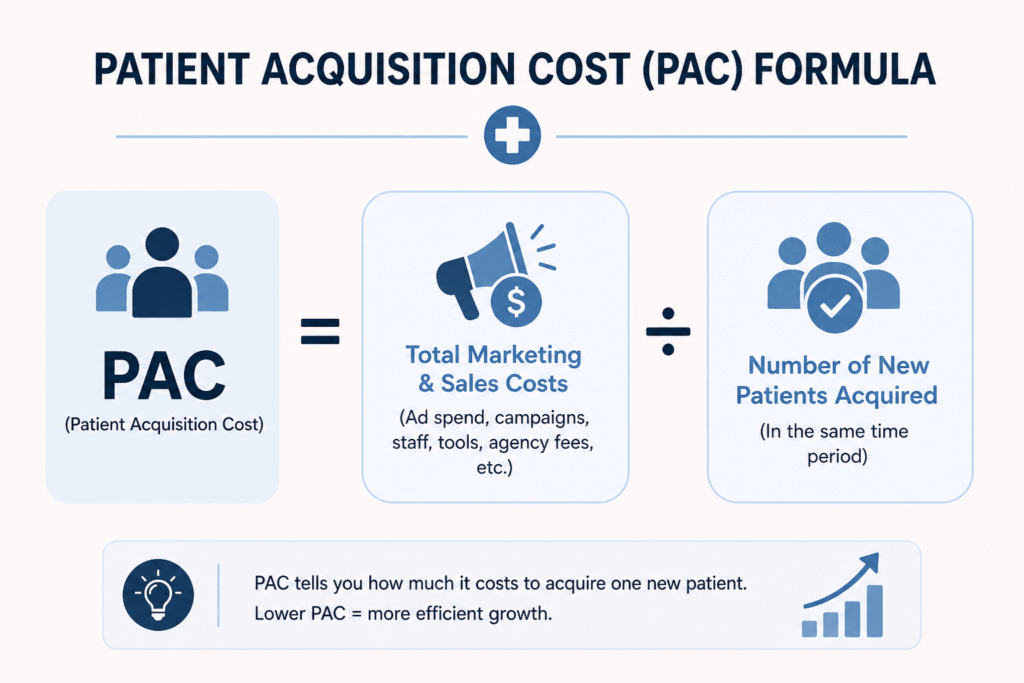
At its simplest level, the Patient Acquisition Cost (PAC) tells you how much money you spend to get one new patient to walk through your door. It is one of the most vital medical financial metrics you can track. Without it, you are flying blind.
The Basic Patient Acquisition Cost Formula
The standard way to calculate this is straightforward:
$$PAC = \frac{\text{Total Marketing Spend}}{\text{Total New Patients Acquired}}$$
For example, if you spend $5,000 on Facebook ads in one month and those ads bring in 50 new patients, your PAC is $100.
On the surface, this looks easy. However, most practice owners stop here. They forget to look deeper. To find the “true” number, you have to account for more than just your ad spend.
Digging Deeper: Finding the “True” PAC
A basic calculation gives you a rough idea. But if you want to ensure medical practice profitability, you need to include the hidden costs. Marketing doesn’t happen in a vacuum. It requires tools, people, and time.
1. Marketing Software and Technology
Do you use a CRM like HubSpot or Salesforce? Do you pay for email marketing software like Mailchimp? Are you using tracking tools like CallRail? These monthly subscriptions are part of your acquisition costs. If you pay $500 a month for software that helps you manage leads, you must add that to your “Total Marketing Spend.”
2. Staff Salaries and Commissions
Who handles your marketing? If you have an in-house marketing manager, their salary is a direct acquisition cost. Even if your front desk person spends five hours a week managing your Instagram account, a portion of their salary belongs in the formula.
3. Creative and Production Costs
Did you hire a photographer for new headshots? Did you pay a freelancer to write a blog post? Did you hire a video editor for your YouTube channel? These one-time costs often slip through the cracks. They are essential components of your marketing budget allocation.
4. Agency Fees
If you hire a firm like InvigoMedia to handle your SEO and PPC, their monthly retainer is part of your spend. While an agency often lowers your cost per lead over time, you must account for the investment you make in their expertise.
Why PAC is the Heartbeat of Your Practice
Why should you care about this specific number? Why not just look at total revenue?
Revenue can be deceiving. You can have a million-dollar practice that is actually losing money. This happens when your PAC is higher than the initial value of the patient.
PAC and Medical Practice Profitability
Imagine you run a dental clinic. Your PAC is $300. A new patient comes in for a cleaning that costs $150. In this scenario, you lost $150 the moment that patient sat in the chair.
If you don’t know your PAC, you might keep running that same marketing campaign. You might think you are winning because the office is busy. In reality, you are spending your way into bankruptcy. By knowing the patient acquisition cost formula, you can identify which services are profitable to market and which ones are not.
Measuring Healthcare Marketing ROI
Marketing is an investment, not an expense. But every investment needs a return. PAC allows you to calculate your healthcare marketing ROI with precision. If you know a new surgical patient brings in $5,000 in profit, and your PAC for that patient is $500, you have a 10x return. That is a winning strategy. You should double down on that channel immediately.
The Golden Ratio: PAC vs. Lifetime Value (LTV)
You cannot look at PAC in isolation. To understand the health of your business, you must compare it to the lifetime value of a patient (LTV).
LTV is the total amount of money a patient will spend at your practice over the entire course of your relationship.
Calculating LTV
To find the LTV, you look at:
- The average value of a visit.
- The number of times a patient visits per year.
- The average number of years a patient stays with your practice.
If a patient spends $200 per visit, visits twice a year, and stays for ten years, their LTV is $4,000.
The 3:1 Rule
In the world of data-driven marketing, a healthy ratio is often considered 3:1. Your LTV should be at least three times higher than your PAC.
- If your ratio is 1:1, you are just breaking even. You are working for free.
- If your ratio is 5:1, you are highly profitable. You should probably spend more on marketing to grow even faster.
Understanding this ratio helps you decide how much you can afford to pay for a lead. It stops the panic when you see a high “cost per click” because you know the long-term value justifies the short-term spend.
Strategies for Reducing Cost Per Lead
If your PAC is too high, you have two choices: raise your prices or lower your acquisition costs. Lowering the costs is usually the more sustainable path. Here is how you can achieve reducing cost per lead without sacrificing quality.
1. Optimize Your Website for Conversion
Many practices spend thousands of dollars driving traffic to a website that doesn’t work. If 1,000 people visit your site and only 10 call, your conversion rate is 1%. If you improve the site so that 20 people call, you have just cut your PAC in half without spending an extra dime on ads. Use clear “Call to Action” buttons and make sure your site loads fast on mobile phones.
2. Focus on Local SEO
Organic traffic is “free” in the sense that you don’t pay per click. By appearing in the “Google Map Pack,” you capture patients who are searching for care in their immediate area. These leads often have a much lower PAC than those from paid ads. Healthcare key performance indicators should always include organic search rankings.
3. Implement Patient Retention Strategies
It is always cheaper to keep a patient than to find a new one. By using patient retention strategies like email newsletters, recall systems, and loyalty programs, you increase the LTV. When LTV goes up, the “weight” of the PAC feels much lighter.
4. Refine Your Marketing Budget Allocation
Not all channels are equal. You might find that Facebook brings in cheap leads, but those leads never show up for appointments. Meanwhile, Google Search ads might be expensive but result in high-value surgical cases. Use data to shift your money to the channels that actually result in deposited checks, not just “likes” or “clicks.”
Common Pitfalls When Calculating PAC
Even with the best intentions, owners make mistakes. Avoid these common traps to keep your data clean.
Ignoring the “No-Show” Rate
If your marketing generates 100 leads and 50 of them book, but only 25 actually show up, your PAC calculation must be based on those 25 people. Many owners calculate PAC based on “leads” or “bookings.” This inflates your success and hides the truth. Always calculate based on patients who actually receive (and pay for) care.
Failing to Attribute Leads Correctly
Where did the patient come from? If you don’t ask, you don’t know. If a patient finds you on Google but tells the front desk they “saw a sign,” your data is wrong. Use unique phone numbers for different ad campaigns. Use UTM codes for your digital links. Data-driven marketing relies on accurate attribution.
Overlooking Seasonality
Some months are naturally slower in healthcare. If you calculate your PAC in December (a busy month for many due to insurance benefits) and apply that same logic to July, you will be disappointed. Look at your PAC on a rolling 12-month average to get the most accurate picture.
Essential Healthcare KPIs to Track Alongside PAC
PAC doesn’t tell the whole story. To get a 360-degree view of your practice, you should monitor several other healthcare key performance indicators.
1. Cost Per Lead (CPL)
Before a person becomes a patient, they are a lead. Tracking CPL helps you see how your ads are performing before the sales/booking process takes over. If CPL is low but PAC is high, the problem is likely your front desk or your booking process.
2. Conversion Rate
This measures how many people who see your ad or visit your site take the desired action. Improving this is the fastest way to improve your medical financial metrics.
3. Patient Churn Rate
This is the percentage of patients who stop coming to your practice over a certain period. If your churn rate is high, your LTV will drop, making even a low PAC unsustainable.
4. Net Promoter Score (NPS)
Do your patients like you? High patient satisfaction leads to referrals. Referrals are the ultimate “PAC killer” because they cost almost nothing to acquire.
Moving Toward Data-Driven Marketing
The days of “post and pray” marketing are over. You cannot afford to throw money at a billboard and hope for the best. Modern clinic revenue growth requires a scientific approach.
By using the patient acquisition cost formula, you take control of your destiny. You can tell your marketing team exactly how much you are willing to pay for a lead. You can cut the campaigns that are draining your bank account. You can scale the campaigns that are making you wealthy.
This shift in mindset—from seeing marketing as a “black box” to seeing it as a predictable formula—is what separates successful practices from those that struggle to stay afloat.
How InvigoMedia Can Transform Your Numbers
Calculating these numbers is one thing. Acting on them is another. This is where many practice owners feel overwhelmed. You went to medical school to help people, not to stare at spreadsheets and Google Analytics all day.
InvigoMedia understands this struggle. They aren’t just another agency that talks about “brand awareness” or “engagement.” They are a results-oriented partner that focuses on the metrics that matter.
Data-Driven Strategies
InvigoMedia uses sophisticated tracking to see exactly where every dollar goes. They specialize in reducing cost per lead by optimizing your entire funnel. They look at your website, your ad copy, and your landing pages to ensure you aren’t wasting a single cent.
Improving Profitability
The goal of InvigoMedia is simple: to make your practice more profitable. They use their deep authority in the healthcare space to implement strategies that lower your PAC while increasing the quality of the patients you attract. They focus on the lifetime value of the patient, ensuring that the growth you see today translates into long-term stability.
If you are tired of wondering if your marketing is actually working, it is time to work with experts who speak the language of data. InvigoMedia helps you master your marketing budget allocation so you can focus on what you do best: caring for your patients.
Final Thoughts: Ownership Through Information
Numbers can be intimidating. It is tempting to ignore them and focus on the clinical side of your practice. But as a business owner, you cannot afford that luxury.
The patient acquisition cost formula is the most powerful tool in your arsenal. It gives you the clarity to make bold decisions. It gives you the confidence to invest in your growth. It ensures that every new patient you see is a step toward a more secure and profitable future.
Don’t let your practice be a “leaky bucket.” Start tracking your marketing spend, accounting for your software and overhead, and comparing those costs to the value of your patients. When you know your numbers, you own your future.
If you want to take the guesswork out of your growth, reach out to InvigoMedia. Let them show you how a data-driven approach can lower your costs and transform your practice into a high-performance machine.
Frequently Asked Questions (FAQ)
1. What is a “good” Patient Acquisition Cost in healthcare?
There is no single “good” number because it depends entirely on your specialty. A neurosurgeon can afford a much higher PAC than a general practitioner because the value of a single case is much higher. Generally, you should aim for your PAC to be no more than 25% to 30% of the profit from the first visit, or 10% of the total LTV.
2. Should I include the cost of my website in the PAC formula?
Yes. Your website is your primary marketing tool. You should include the monthly hosting fees and any maintenance costs. If you paid $10,000 for a new website, you might choose to amortize that cost over 12 or 24 months and add that monthly portion to your total marketing spend.
3. How often should I calculate my PAC?
You should review your numbers at least once a month. This allows you to catch trends early. If you wait until the end of the year, you might find that you wasted thousands of dollars on a campaign that stopped working months ago.
4. Can social media management be included in PAC?
Absolutely. If you pay an agency or an employee to manage your social media, that is a marketing expense. Even if you don’t run “paid ads” on those platforms, the cost of the labor required to maintain them is part of your acquisition cost.
5. Why is my PAC increasing even though my marketing hasn’t changed?
The digital landscape is becoming more competitive. Platforms like Google and Facebook use auction-based systems. As more medical practices bid for the same keywords, the prices go up. This is why you must constantly optimize your conversion rates and focus on reducing cost per lead through better ad creative and targeting.
6. Is PAC the same as Cost Per Acquisition (CPA)?
In the marketing world, these terms are often used interchangeably. However, in a medical context, PAC is a more accurate term because it emphasizes that you are acquiring a patient, not just a one-time transaction or a “lead.”
7. Does PAC include the cost of medical supplies used during a visit?
No. Medical supplies, rent, and clinical staff salaries are part of your “Cost of Goods Sold” (COGS) or general overhead. PAC specifically measures the costs required to get the patient to the door. Once they are in the door, other metrics take over to measure the profitability of the service itself.