
“Protect your practice and patients with medical website hosting services. Ensure HIPAA compliance, 99.9% uptime, and military-grade security.”
Imagine a patient feeling unwell in the middle of the night. They grab their smartphone. They search for a local doctor. They find your clinic’s website. They click the link. They want to book an appointment immediately. At this exact moment, your website becomes the front door to your practice. Does this digital door protect their private information? Does it open quickly? Does it inspire trust?
For medical professionals, a website does more than display office hours. It acts as a vital communication tool. It handles sensitive patient data. It processes appointment requests. Therefore, you cannot treat your website like a standard business brochure. You must prioritize security. You must focus on speed. You must ensure reliability. Consequently, selecting the right foundation for your website is critical. This foundation is your hosting provider.
Today, we will discuss the crucial topic of medical website hosting services. We will explain why generic hosting options put your practice at serious risk. We will explore the strict requirements for patient data protection. We will outline the exact features you need to stay compliant with federal laws. Finally, we will show you how the right hosting partner protects your reputation and grows your practice.
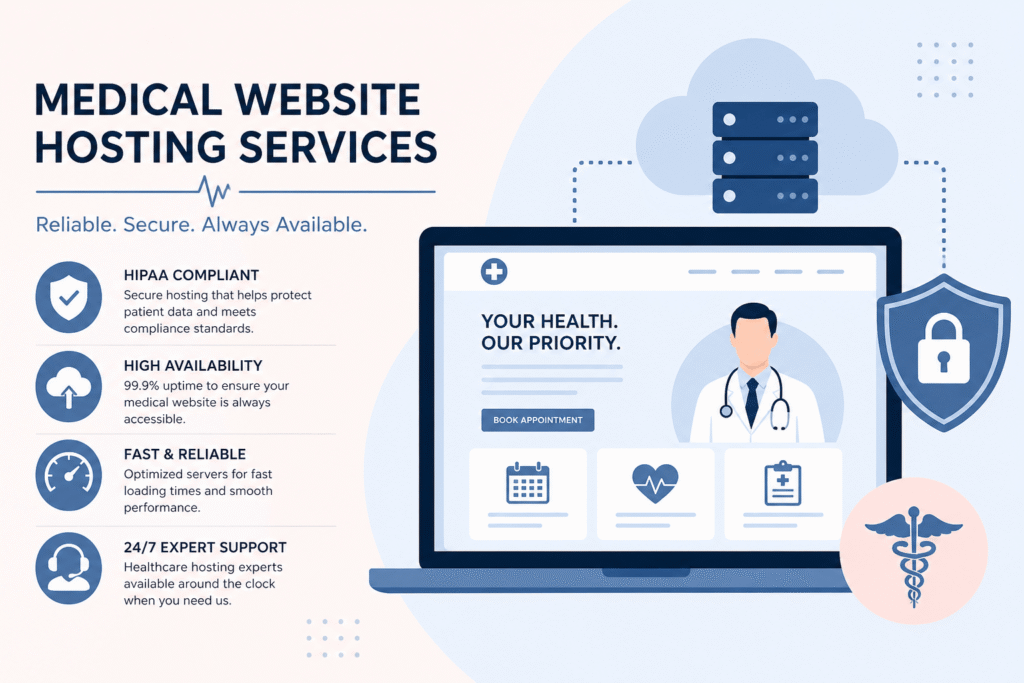
The Hidden Dangers of Generic Hosting in Healthcare
Many small businesses start with generic, cheap hosting plans. These plans cost a few dollars a month. They seem like a good deal. However, these plans present massive dangers for healthcare providers.
Generic hosting usually means shared hosting. In a shared hosting environment, your website lives on a single server alongside hundreds of other websites. You might share a server with a local bakery, a personal blog, and an online shoe store. This setup creates severe vulnerabilities.
First, consider cross-site contamination. If hackers target the bakery’s website because it has weak security, they can gain access to the entire shared server. Once they breach the server, they can easily access your medical website’s files. They can steal your patient data. You suffer a data breach, even if your specific website had strong passwords.
Second, generic hosts do not understand healthcare regulations. They do not monitor your server for medical compliance. They provide basic customer support. If your website goes down due to a cyber attack, you wait in line with everyone else for help. They do not prioritize your emergency.
Third, cheap hosting limits your server resources. If another website on your shared server gets a sudden spike in traffic, your website slows down. Your patients experience long load times. They might even see error pages. This poor experience drives patients away.
In short, generic hosting treats your medical practice like any other hobby website. This approach is dangerous. It leaves you exposed to cyber threats. It puts your patients at risk. It sets the stage for legal disasters.
Understanding Protected Health Information (PHI)
To understand why you need specialized hosting, you must first understand what you are protecting. Medical practices handle Protected Health Information, commonly known as PHI. Federal law heavily regulates this data.
PHI includes any information that can identify a patient and relates to their past, present, or future health status. This data includes names, addresses, and birth dates. It includes Social Security numbers. It also covers appointment dates, medical conditions, test results, and payment records.
Your website interacts with PHI constantly. For example, a new patient fills out an intake form online. They type in their name, phone number, and reason for the visit. As soon as they hit “submit,” your website transmits PHI. If a patient logs into a portal to check test results, your website handles PHI. If someone requests a prescription refill through a contact form, your website processes PHI.
Because your website touches this highly sensitive data, you must implement strict PHI security standards. Hackers actively hunt for PHI. They sell medical records on the dark web for high prices. Medical records contain enough personal details to commit identity theft, medical fraud, and financial crimes. Therefore, protecting patient data is not just a best practice. It is a legal and moral obligation.
The Absolute Necessity: HIPAA Compliant Hosting
In the United States, the Health Insurance Portability and Accountability Act (HIPAA) governs how healthcare providers handle patient data. If your website collects, stores, or transmits PHI, your hosting environment must comply with HIPAA regulations. You cannot negotiate this point.
HIPAA-compliant hosting differs fundamentally from standard hosting. A standard host simply gives you space on a computer. A HIPAA-compliant host provides a fortified, legally sound environment for medical data.
To achieve compliance, your hosting provider must implement rigorous physical and technical safeguards.
First, let us look at physical safeguards. The hosting company must secure the actual, physical servers. They store these servers in highly restricted data centers. Only authorized personnel can enter the building. Security teams use biometric scanners, security cameras, and armed guards to prevent unauthorized physical access. Furthermore, the data centers feature advanced fire suppression systems and backup power generators.
Second, technical safeguards protect the data digitally. The host encrypts all data at rest. This means that even if a thief stole the physical hard drive, they could not read the data. The host also enforces strict access controls. They log every single time an engineer logs into the server. They monitor the network 24/7 for suspicious activity.
Crucially, HIPAA-compliant hosting requires a Business Associate Agreement (BAA). A BAA is a legally binding contract. By signing it, the hosting company acknowledges its role in protecting your PHI. They agree to follow all HIPAA security rules. They accept legal responsibility and financial liability in the event of a breach. If a hosting company refuses to sign a BAA, you cannot use them for your medical website. Period.
Core Features of Secure Medical Servers
When you invest in specialized medical website hosting services, you gain access to secure medical servers. These servers include specific security tools designed to block modern cyber threats. Let us examine the essential components of a secure healthcare server architecture.
1. Robust Firewalls and Intrusion Detection
A secure medical server operates behind an enterprise-grade firewall. Think of a firewall as a heavily armed security checkpoint for internet traffic. The firewall inspects every piece of data trying to enter your website. It blocks malicious traffic automatically. It stops automated bot attacks.
In addition to firewalls, medical servers use Intrusion Detection Systems (IDS). The IDS constantly monitors network behavior. If it detects unusual activity, such as multiple failed login attempts from a foreign country, it triggers an alarm. The hosting security team instantly investigates the alert. They block the attacker before they can access your site.
2. Comprehensive Malware Scanning and Removal
Cybercriminals constantly create new viruses and malicious software (malware). They try to inject this malware into vulnerable websites. Secure hosting services include daily, automated malware scans. The system scans all your website files and databases. If it finds a malicious file, it isolates it immediately. Expert technicians then remove the infection. This proactive approach prevents malware from stealing patient data or taking your website offline.
3. Strict Server Access Controls
Standard hosts allow anyone with a password to access server control panels. Secure medical servers implement much stricter rules. They require Multi-Factor Authentication (MFA) for all administrative access. MFA forces users to provide two forms of identification before logging in. They need a password and a unique code sent to their mobile device. This simple step stops hackers from accessing your server, even if they guess your password.
Furthermore, secure servers use IP whitelisting. This means only computers with specific, pre-approved IP addresses can access the server’s backend. If a hacker tries to log in from an unknown location, the server completely blocks their connection.
The Power of SSL Certificates in Healthcare
When you visit a secure website, you see a small padlock icon next to the web address in your browser. This padlock indicates an active SSL certificate. SSL stands for Secure Sockets Layer. For medical websites, SSL certificates are absolutely mandatory.
An SSL certificate creates an encrypted connection between the patient’s web browser and your server. Why does this matter? Imagine a patient filling out an appointment request form at a local coffee shop. They use the public Wi-Fi network. Without an SSL certificate, the patient’s information travels across the internet in plain text. A hacker sitting in the same coffee shop can easily intercept this text. They can read the patient’s name, phone number, and medical issue.
When you install an SSL certificate, the technology scrambles the data into an unreadable code before it leaves the patient’s browser. The data remains scrambled as it travels across the internet. Only your specific server holds the digital key to unscramble and read the data. Even if a hacker intercepts the transmission, they only see meaningless strings of characters.
Furthermore, SSL certificates verify your website’s identity. They assure patients that they are interacting with your legitimate clinic, not a fake website designed to steal their information. Google also mandates SSL certificates. If your site lacks one, Google Chrome displays a massive “Not Secure” warning to visitors. This warning destroys patient trust instantly.
The Lifeline: Off-Site Backups and Disaster Recovery
Healthcare cybersecurity requires planning for the worst-case scenario. Despite your best efforts, disasters happen. Hackers deploy sophisticated ransomware. Natural disasters flood data centers. Human error accidentally deletes critical files. In these situations, your backups save your practice.
However, simple backups do not suffice for healthcare. You need regular, automated, off-site backups.
Many practice owners make the mistake of storing backups on the same server as their website. This strategy fails to cure a severe attack. If ransomware encrypts your main server, it encrypts your local backups, too. You lose everything.
Secure medical hosting services automate the backup process. They take full snapshots of your website, databases, and files every single day. More importantly, they store these backups in a separate, secure, off-site location. This off-site facility sits geographically far away from your primary server.
If a cyberattack destroys your main website, your hosting team accesses the clean, off-site backup. They restore your website to its exact state from the previous day. You experience minimal downtime. You lose almost no data. You avoid paying expensive ransomware demands.
Additionally, HIPAA rules require healthcare organizations to maintain a formal disaster recovery plan. Regular, tested backups form the core of this plan. Your hosting provider should regularly test these backups to ensure they actually work when you need them most.
Server Architecture: Why Dedicated Server Hosting Wins
When choosing a hosting plan, you must select a server architecture. The three main options include shared hosting, Virtual Private Servers (VPS), and dedicated servers. For growing medical practices, dedicated server hosting provides the ultimate solution.
As we discussed earlier, shared hosting puts your website on a server with hundreds of strangers. You share security risks. You share computing power. You share network bandwidth. It represents the lowest tier of hosting.
Virtual Private Server (VPS) hosting offers a middle ground. You still share a physical server with other websites. However, the hosting company uses software to divide the server into isolated virtual compartments. You get a dedicated portion of the server’s resources. The security risks drop significantly compared to shared hosting. VPS hosting works well for small clinics with moderate website traffic.
Dedicated server hosting stands at the top tier. When you choose a dedicated server, you rent an entire physical machine located in the data center. Your medical website is the only website on this server.
The benefits of dedicated hosting for healthcare are enormous.
First, you eliminate cross-site contamination. No other website can compromise your server. You have total control over the security configurations. You can customize firewalls specifically for your practice’s needs.
Second, you gain incredible performance. You never share processing power or memory with anyone else. If your website experiences a massive surge in traffic, the server handles it effortlessly. Your pages load instantly.
Third, dedicated servers simplify HIPAA compliance. You know exactly where your data lives. You have complete authority over access controls. For large hospitals, multi-location clinics, and practices processing large volumes of patient data, dedicated server hosting provides unmatched security and peace of mind.
The Performance Factor: Why a Fast Medical Website Matters
Security protects your data, but performance dictates the user experience. You must provide a fast medical website. In today’s digital age, patience is incredibly low. Research shows that if a website takes longer than three seconds to load, over half of the visitors will abandon the site.
Consider the mindset of your patients. They often visit your website when they feel stressed, sick, or worried. They want immediate answers. They want to find your phone number quickly. They want to book an appointment without hassle. If your website takes five seconds to load a page, you add to their frustration. They click the “back” button. They search for a different doctor. You lose a patient because of a slow server.
Your hosting provider plays the biggest role in website speed. Cheap hosts use old, slow hard drives. Premium medical hosts use Solid State Drives (SSDs). SSDs read and write data incredibly fast. They serve your website files to visitors in milliseconds.
Furthermore, top-tier hosts configure their servers specifically for speed. They use advanced caching technologies. Caching stores copies of your website pages in temporary memory. When a patient requests a page, the server delivers the cached copy instantly. It bypasses complex database queries. This process dramatically reduces page load times.
Speed also directly impacts your bottom line through Search Engine Optimization (SEO). Google wants to provide its users with the best possible experience. Google knows users hate slow websites. Therefore, Google actively monitors website speed. They use metrics called Core Web Vitals to measure how fast your pages load and become interactive.
If your website loads quickly, Google rewards you. They push your clinic higher in the search engine rankings. You appear on the first page when local patients search for medical services. If your website loads slowly, Google penalizes you. They drop your rankings. Your competitors capture your potential patients. Investing in fast, premium hosting directly translates into better visibility and more new patients.
Guaranteeing Access: Website Uptime Reliability
Speed matters when a patient is on your site. However, the site must actually be available. This concept is called uptime. Website uptime reliability is a critical metric for any medical practice.
Uptime refers to the percentage of time your website functions perfectly and remains accessible to the public. Downtime refers to periods when your website crashes, goes offline, or shows error messages.
Downtime causes massive problems for healthcare providers.
First, it damages your reputation. Imagine a patient tries to access your secure patient portal to check important lab results. The website fails to load. The patient panics. They call your front desk, angry and frustrated. They lose trust in your practice’s technological competence.
Second, downtime disrupts your operations. If your website goes down, patients cannot download intake forms. They cannot use your online scheduling tool. Your front desk staff suddenly receives a flood of phone calls. Your daily workflow grinds to a halt.
Third, frequent downtime hurts your Google rankings. When Google’s search bots try to crawl your website and find it offline, they take note. If this happens often, Google assumes your website is unreliable. They lower your position in search results.
You cannot settle for average uptime. You must demand excellence. The industry standard for high-quality hosting is 99.9% uptime. This metric means your website should experience no more than roughly 43 minutes of downtime per month, including planned maintenance.
Achieving 99.9% website uptime reliability requires advanced server infrastructure. The best hosting providers use redundant systems. If one piece of hardware fails, a backup system immediately takes over. They use redundant power supplies. They use redundant internet connections. They monitor the servers 24 hours a day, 7 days a week, 365 days a year. If a server issue arises at 3:00 AM on a Sunday, their engineers fix it before your patients even wake up.
The Benefits of Managed WordPress Hosting for Clinics
Most modern medical websites run on WordPress. WordPress powers over 40% of the entire internet. It offers incredible flexibility, powerful plugins, and user-friendly content management. However, managing a WordPress site requires ongoing technical maintenance. Doctors and medical staff do not have the time to perform this maintenance. This reality makes managed WordPress hosting incredibly valuable.
Standard hosting leaves you entirely responsible for your website’s health. You must update the core WordPress software yourself. You must update your theme and plugins. If an update breaks your website, you must fix it. You act as your own IT department.
Managed WordPress hosting completely removes this technical burden. The hosting provider handles all the heavy lifting. They manage the server environment specifically for WordPress performance.
More importantly, a managed host takes care of all software updates. They monitor new releases for WordPress core, themes, and plugins. They test these updates in a safe staging environment first. Once they confirm the updates will not break your site, they apply them automatically.
This automated updating process is vital for healthcare cybersecurity. Hackers constantly look for websites running outdated, vulnerable plugins. When a plugin developer discovers a security flaw, they release an update to fix it. If you forget to update the plugin, hackers exploit the flaw. They break into your website. Managed hosting ensures your site always runs the latest, most secure software versions.
Furthermore, managed WordPress hosts provide expert support. If you experience a strange error on your site, you do not talk to a generic call center agent. You speak to a WordPress expert. They understand the software deeply. They diagnose the problem quickly. They fix the issue efficiently, allowing you to focus on treating patients instead of troubleshooting code.
Securing Patient Communications Through Your Website
A medical website is not just a digital billboard. It serves as a two-way communication channel. Patients send you messages. They request appointments. They ask medical questions. Every time a patient interacts with your site, they trust you to keep their words private.
Standard email is inherently insecure. You cannot guarantee the privacy of an email as it travels from a patient’s outbox to your clinic’s inbox. Therefore, you must use secure, encrypted forms on your website for all patient communications.
Your hosting environment plays a crucial role in supporting these secure forms. A HIPAA-compliant host ensures that the data submitted through these forms routes through secure, encrypted databases. They prevent unauthorized access to the database logs.
Additionally, many medical practices integrate secure patient portals into their websites. These portals allow patients to log in, view medical records, and message doctors directly. Hosting a patient portal demands the highest level of security. Your host must provide the dedicated resources necessary to keep the portal running smoothly. They must enforce strict session timeouts. If a patient leaves their computer while logged into the portal, the server automatically logs them out after a few minutes of inactivity. This feature prevents unauthorized individuals from walking up to the computer and reading the patient’s medical history.
By choosing specialized medical hosting, you build a fortress around patient communications. You encourage patients to interact with your practice digitally, knowing their privacy remains fully protected.
The Financial Cost of Ignoring Security
Some practice owners hesitate to pay for premium medical website hosting services. They look at the monthly fee and consider it an unnecessary expense. They decide to stick with their $5-per-month generic host to save money. This decision represents a massive financial miscalculation.
You must view secure hosting as an insurance policy. The cost of premium hosting is microscopic compared to the devastating costs of a data breach.
Let us break down the financial consequences of a cyberattack on a non-compliant medical website.
First, consider HIPAA violation fines. The Office for Civil Rights (OCR) enforces HIPAA rules. If the OCR discovers that your website leaked PHI because you used insecure, generic hosting, they will fine you aggressively. Fines for “willful neglect” of HIPAA rules can reach up to $50,000 per single violation. The total fines for a single data breach easily stretch into hundreds of thousands, or even millions, of dollars. These fines alone can force a small medical practice into bankruptcy.
Second, you face massive remediation costs. After a breach, you must hire forensic cybersecurity experts. They charge exorbitant hourly rates to investigate the hack and secure your systems. You must notify every single affected patient by mail. You must provide free credit monitoring services to the victims.
Third, you expose your practice to civil lawsuits. Patients whose data was stolen will likely join class-action lawsuits against your clinic. You will spend tens of thousands of dollars on legal defense fees. Settlements and judgments can destroy your financial reserves.
Finally, calculate the cost of a ruined reputation. News of a medical data breach spreads quickly. Local media outlets will report on the incident. When prospective patients search for your practice, they will see articles about your failure to protect patient data. They will take their families to a different doctor. You lose current patients. You fail to attract new ones. Your revenue plummets.
Investing in HIPAA-compliant hosting, secure medical servers, and daily off-site backups costs a few hundred dollars a month. It protects you against millions of dollars in potential losses. Premium hosting is not an expense. It is a vital investment in the survival of your practice.
Choosing the Right Partner: The InvigoMedia Advantage
You understand the dangers of generic hosting. You recognize the critical importance of HIPAA compliance. You know you need speed, reliability, and robust security. Now, you must choose a partner to provide these services.
You need more than a technology company. You need a partner who deeply understands the unique challenges of the healthcare industry. We strongly recommend InvigoMedia for your medical website hosting services.
InvigoMedia does not treat medical practices as just another client category. They specialize in healthcare marketing and digital infrastructure. They understand exactly how to handle and protect sensitive medical data. They do not guess at compliance; they engineer their systems for it from the ground up.
When you choose InvigoMedia, you gain an authoritative, managed hosting partner. They eliminate the technical headaches of running a medical website.
First, InvigoMedia provides true HIPAA-compliant hosting environments. They readily sign Business Associate Agreements. They take legal responsibility for securing your patient data. They implement military-grade encryption, rigorous access controls, and comprehensive firewall protections. With InvigoMedia, you rest easy knowing your website meets all federal security standards.
Second, they deliver exceptionally secure medical servers. Their infrastructure actively monitors for malware, blocks intrusion attempts, and stops bot attacks before they reach your site. They provide and manage your SSL certificates, ensuring every piece of data remains encrypted in transit.
Third, InvigoMedia prioritizes performance and reliability. They guarantee 99.9% website uptime reliability. Your site stays online, functioning perfectly, day and night. They utilize lightning-fast servers designed to provide a fast medical website experience. Your patients enjoy instant page loads, and your practice benefits from the SEO boost that speed provides.
Finally, InvigoMedia offers fully managed WordPress hosting specifically tailored for healthcare. They handle all core updates. They manage plugin patches. They execute daily, secure, off-site backups. If an issue ever arises, their dedicated team of experts resolves it quickly and efficiently.
Do not gamble with your patient’s data or your practice’s reputation. Generic hosting fails the healthcare test. Secure your digital front door today. Partner with InvigoMedia to experience superior security, unmatched speed, and absolute peace of mind.
Frequently Asked Questions (FAQs)
1. What happens if I use standard, non-HIPAA-compliant hosting for my medical website?
Using standard, non-compliant hosting puts your practice in direct violation of federal law if your website collects or transmits any Protected Health Information (PHI). If a data breach occurs, the Office for Civil Rights (OCR) will investigate. When they discover you used generic hosting and failed to obtain a Business Associate Agreement (BAA), they will classify the violation as “willful neglect.” This classification carries the highest tier of financial penalties, often resulting in tens of thousands of dollars in fines per violation. Furthermore, standard hosts lack the security infrastructure to stop targeted cyberattacks. Hackers can easily steal patient names, contact details, and medical inquiries. This theft leads to severe reputational damage, loss of patient trust, and potential class-action lawsuits.
2. Does a contact form on my website really require HIPAA-compliant hosting?
Yes, absolutely. Many practice owners mistakenly believe that only patient portals or electronic health record (EHR) systems require HIPAA compliance. This is false. If a patient fills out a simple “Contact Us” form and includes their name, phone number, and a message saying, “I need to schedule an appointment for my chronic back pain,” they have just transmitted PHI. If your website database stores this form submission, your hosting environment must be HIPAA compliant. The server storing the database must use encryption. The data traveling from the form to the server must use strong SSL encryption. If you cannot guarantee this level of security, you must disable the form or upgrade your hosting immediately.
3. What is a Business Associate Agreement (BAA) and why does my hosting company need to sign one?
Under HIPAA regulations, your medical practice is a “Covered Entity.” Any third-party vendor that handles, stores, or transmits PHI on your behalf is a “Business Associate.” A Business Associate Agreement (BAA) is a mandatory legal contract between your practice and the vendor. It clearly outlines the vendor’s responsibilities to protect the patient data. It requires them to implement specific security safeguards. Most importantly, it holds the vendor legally and financially liable if they cause a data breach due to negligence. Many generic hosting companies refuse to sign BAAs because they do not want to assume this liability. You must only use a hosting provider willing to sign a BAA. Without it, you are breaking the law.
4. How does website speed actually impact my ability to get new patients?
Website speed directly impacts patient acquisition in two major ways: user experience and Google rankings. First, modern patients expect immediate results. If a prospective patient clicks a link to your site and the page takes five seconds to load, they will likely hit the “back” button. They will move on to the next doctor on their search list. You lose a patient simply because of a slow server. Second, Google uses page speed as a primary ranking factor. Google’s algorithm measures “Core Web Vitals,” which track how fast your site loads and becomes interactive. Faster websites rank higher in search results. If your site is slow, your competitors will outrank you. A fast medical website ensures you capture traffic and convert those visitors into booked appointments.
5. What is the difference between shared hosting and dedicated server hosting for a medical practice?
Shared hosting involves placing your website on a single server alongside hundreds of unrelated websites. You share all processing power, memory, and security vulnerabilities. If another site on the server gets hacked, hackers can often access your files too. If another site gets a traffic spike, your website slows down. Dedicated server hosting means you rent an entire physical server solely for your practice. No other websites exist on that machine. You control all resources. Your site never slows down due to someone else’s traffic. Most importantly, dedicated servers isolate your data completely, eliminating cross-site contamination risks. For medical practices handling sensitive data, dedicated hosting offers the highest level of security and performance.
6. Why are off-site backups critical for healthcare cybersecurity?
Off-site backups act as your ultimate safety net against data loss and ransomware. If a hacker manages to breach your server and deploy ransomware, they will encrypt all your files and demand a massive payment to unlock them. If you store your backups on the same server as your website, the ransomware encrypts the backups, too. You lose everything. Off-site backups are stored in completely separate geographic locations on different networks. If your main server gets attacked, your hosting provider simply wipes the infected server clean. They then retrieve the uninfected, off-site backup and restore your website to normal operations. You avoid paying the ransom and minimize your downtime significantly.
7. How does Managed WordPress Hosting benefit a busy medical clinic?
WordPress is an excellent platform, but it requires continuous technical maintenance. You must constantly update the core software, the theme, and various plugins to patch security vulnerabilities. If you ignore these updates, hackers will exploit the outdated code to breach your site. A busy medical clinic does not have the time or technical staff to manage these daily updates. Managed WordPress hosting solves this problem entirely. The hosting company takes over all technical maintenance. They monitor for updates. They test the updates to ensure they won’t break your site. They apply the patches automatically. They optimize the server specifically for WordPress speed. This service allows doctors and staff to focus entirely on patient care while experts manage the digital infrastructure.
8. Can I just buy an SSL certificate and use a cheap host?
No. An SSL certificate is just one piece of the security puzzle. It encrypts data in transit between the patient’s browser and your server. However, once the data arrives at the cheap host’s server, it remains vulnerable. If the cheap host does not encrypt data at rest, does not have strong firewalls, and shares your server space with compromised websites, hackers can easily steal the data directly from the server database. Furthermore, a cheap host will not sign a Business Associate Agreement (BAA). Therefore, combining an SSL certificate with generic, cheap hosting still leaves you entirely non-compliant with HIPAA laws and highly vulnerable to devastating cyberattacks. You need a comprehensive, secure hosting environment, not just a padlock icon.