

“Deciding between medical stock photos vs. custom? Learn how authentic visuals can increase retention by 65% and boost patient trust.”
When a prospective patient lands on your medical website, they make a judgment in less than a second. They do not read your biography first. They do not check your insurance list or your degrees immediately. Instead, they look at your images. This split-second reaction determines whether they feel safe or skeptical. In the digital age of 2026, where every clinic claims to be the best, visual trust has become the primary currency of healthcare marketing.
Doctors often face a difficult choice: should they use high-quality medical stock photos or invest in custom photography? One is fast and cheap, while the other requires time and a larger budget. This guide explores the deep psychological impact of these choices and how they influence your bottom line.
The Psychology of Seeing: Why Patients Look Before They Book
Humans are hardwired to process visual information faster than text. In a clinical setting, this is even more critical. Patients often visit your site while feeling anxious, in pain, or uncertain. They are looking for a “signal of safety.”
Mirror Neurons and Medical Trust
When a patient sees a photo of a doctor smiling warmly at a patient, their brain activates “mirror neurons.” These neurons allow the viewer to feel a shadow of the emotion they see on screen. If the photo feels fake or “too perfect,” the brain detects a mismatch. This mismatch creates a small amount of friction.
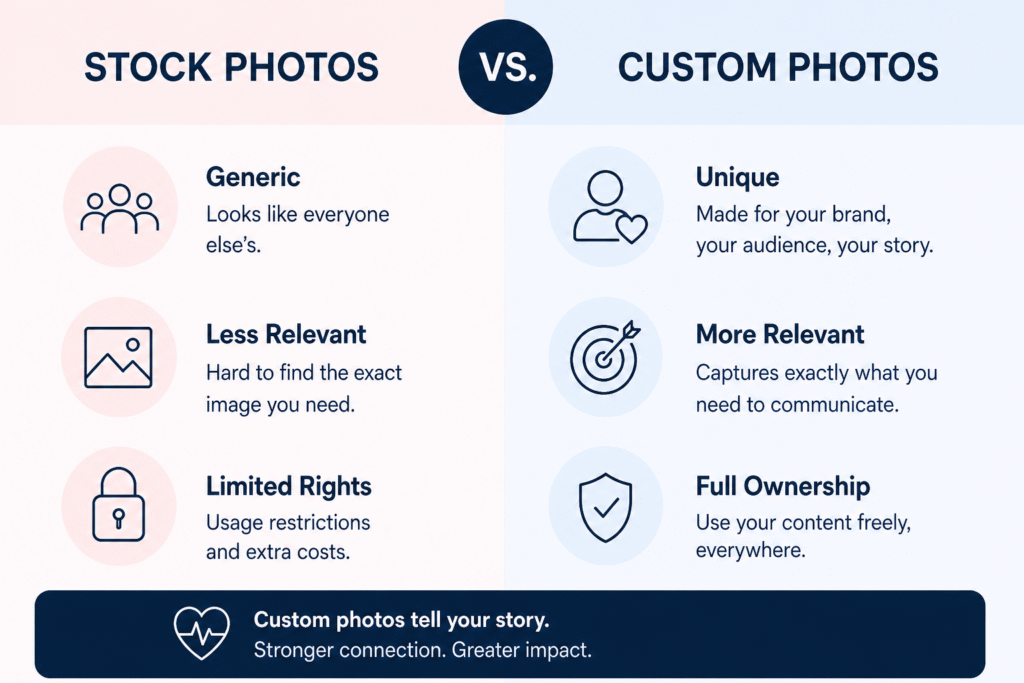
Stock photos often feature models with perfect teeth and staged poses. While these look “professional,” they often lack the authentic warmth of a real medical team. Consequently, the patient might feel that your practice is also “staged” or impersonal.
Medical Stock Photos: The Cost-Effective Starting Line
Stock photography has its place. For a new practice or a small clinic with a limited budget, these assets provide a quick way to fill a website. However, you must weigh the convenience against the long-term impact on your brand identity.
The Pros of Stock Imagery
- Immediate Availability: You can download and upload a stock photo in minutes. If you need to launch a landing page for a new service tomorrow, stock is the only way to go.
- Low Cost: Most stock licenses cost between $10 and $50. Compared to a professional photoshoot that costs thousands, the savings are clear.
- High Technical Quality: Stock photographers use top-tier equipment and lighting. You get high-resolution files that look crisp on any screen.
- Diversity of Choice: You can find photos representing every age, ethnicity, and medical condition. This helps you show inclusivity without needing a massive casting call.
The Cons of Stock Imagery (The “Uncanny Valley” of Healthcare)
- The “Seen It Before” Effect: Many medical practices use the same popular stock photos. If a patient sees the same “doctor” on three different websites, your credibility drops.
- Lack of Specificity: A stock photo cannot show your actual office. If your website shows a high-tech hospital wing but your office is a cozy private suite, the patient will feel misled when they arrive.
- Emotional Distance: Stock models are trained to look “generic.” They lack the specific personality of your actual staff.
- Negative Brand Signals: Overusing stock photos can signal that you are cutting corners. Patients might wonder if you also cut corners in your clinical care.
Custom Photography: Capturing the Heart of Your Practice
Custom photography involves hiring a professional to take photos of your actual doctors, nurses, receptionists, and facility. It is a long-term investment in your brand identity for doctors.
Why Real Faces Drive More Bookings
Trust is built on the “Know, Like, and Trust” factor.
- Know: Patients see who you are before they meet you.
- Like: They see your personality and the way your team interacts.
- Trust: They see the real environment where they will receive care.
Data shows that websites featuring authentic medical imagery see significantly higher conversion rates. When people see the real doctor who will perform their surgery or treat their child, their anxiety decreases. They aren’t just buying a service; they are entering a relationship.
Showcasing Your Facility and Technology
Custom photos allow you to highlight your unique selling points. Do you have a state-of-the-art MRI machine? Take a photo of it. Is your waiting room designed to feel like a spa? Show it off. These authentic details serve as patient trust signals that stock photos can never replicate.
Conversion Rate Optimization (CRO) Through Visuals
In marketing, “Conversion” means getting a visitor to take an action, like booking an appointment. Authentic visuals are one of the strongest tools for conversion rate optimization.
The Retention Advantage
Research shows that people remember only 10% of what they read. However, when information is paired with an authentic image, retention jumps to 65%. If a patient visits five different websites today, they will likely remember the one with the real, friendly faces.
Reducing the “Bounce Rate”
A “bounce” happens when a visitor leaves your site quickly. High-quality, real photos keep people on the page longer. They spend time looking at your team and your office. This increased engagement tells search engines like Google that your site is valuable, which also helps your SEO.
Modern Medical Website Design Trends (2026 Edition)
In 2026, the trend has shifted away from “corporate” looks. Patients now prefer “editorial” styles. This means photos that look like they belong in a high-end magazine rather than a catalog.
- Candid Interactions: Instead of looking at the camera, doctors are shown talking to patients or looking at charts.
- Natural Lighting: Moving away from harsh studio lights and toward soft, natural sunlight that makes the clinic feel welcoming.
- Micro-Moments: Close-up shots of a hand on a shoulder or a doctor listening intently. These small details communicate empathy.
Visual Storytelling: More Than Just a Headshot
Visual storytelling in healthcare isn’t just about one photo. It is about a sequence of images that tells the story of a patient’s journey.
- The Arrival: A photo of the clinic exterior and the friendly receptionist.
- The Consultation: A photo of the doctor listening to a patient in a comfortable room.
- The Care: Images of the nurses or technicians using equipment with a gentle touch.
- The Result: Healthy, happy individuals (ideally, real patients with consent) enjoying their lives after treatment.
This narrative helps the patient visualize themselves in your care. It removes the “mystery” of the visit, which is a major barrier to booking.
Personalized Patient Marketing
Today’s patients expect a personalized experience. If you are a pediatrician, your photos should be bright, colorful, and energetic. If you are an oncologist, your photos should be calm, professional, and supportive.
Using custom photography allows you to tailor your visual assets to your specific audience. You can show that you understand their unique needs. This level of personalized patient marketing creates a bond that stock photos simply can’t achieve.
The Practical Side: Pros and Cons Comparison Table
| Feature | Medical Stock Photos | Custom Photography |
| Initial Cost | Very Low | Moderate to High |
| Time to Launch | Minutes | Days or Weeks |
| Brand Uniqueness | Low (Used by others) | High (Unique to you) |
| Trust Factor | Low to Moderate | Very High |
| Conversion Impact | Baseline | Significantly Higher |
| Effort Required | Minimal | Coordination required |
How to Transition from Stock to Custom (The Roadmap)
You don’t have to replace every photo overnight. Many successful practices use a hybrid approach as they grow.
Step 1: The Audit
Look at your current website. Identify the “hero” images—the big photos at the top of your pages. These are the most important. If these are stock photos, plan to replace them first.
Step 2: Focus on the “About” Page
The “About Us” page is often the second most-visited page on a medical site. Replace generic office photos with professional headshots of your actual team.
Step 3: Schedule a “Content Day”
Instead of many small shoots, hire a photographer for one full day. Prepare a “shot list” in advance. This should include:
- Headshots of all providers.
- Action shots of staff in the hallway or at the desk.
- Photos of your signature technology or equipment.
- Wide shots of your waiting room and exam rooms.
Step 4: Update Your Digital Assets
Once you have your custom photos, use them everywhere. Put them on your website, your Google Business Profile, and your social media pages. This creates a consistent brand identity for doctors across all platforms.
Why InvigoMedia is Your Creative Partner
Creating a visual strategy is hard work. You are a doctor, not a creative director. This is where InvigoMedia helps. We are a comprehensive digital partner specializing in healthcare growth.
Our team doesn’t just build websites; we design experiences that convert. We help practices curate their visual assets by:
- Creative Consulting: We help you decide which photos will have the most impact on your specific patient base.
- Design Integration: We ensure your custom photos are placed perfectly on your site to maximize website user experience.
- Conversion Focus: We use data-driven design to ensure your images lead the patient directly to the “Book Now” button.
- Authentic Storytelling: We help you move away from generic stock and toward a brand that feels real, trustworthy, and professional.
By partnering with InvigoMedia, you ensure that your visual investment actually results in more patients in your waiting room.
Conclusion: Investing in the Future of Your Practice
In the competitive world of modern healthcare, “good enough” is no longer an option. Patients have more choices than ever. They want to see the person who will be taking care of them. They want to see the rooms they will be sitting in.
While medical stock photos offer a quick fix, they can’t build the deep, lasting trust required for a successful practice. Custom photography is an investment in your reputation. It tells your patients that you are a real person in a real office who cares about real people.
If you are ready to stop blending in and start standing out, it is time to look at your visual strategy. Let the team at InvigoMedia help you build a brand that looks as professional as the care you provide.
FAQs: Frequently Asked Questions about Medical Photography
1. Are stock photos bad for SEO?
Not directly. Google doesn’t penalize you for using a stock photo. However, unique, high-quality images can improve your “Time on Site” and lower your “Bounce Rate.” These are indirect signals that tell Google your site is high-quality, which can improve your ranking over time.
2. How much does a professional medical photoshoot cost?
Costs vary by location and the photographer’s experience. Generally, you can expect to pay between $1,500 and $5,000 for a full day. While this seems high, the increase in patient conversions often pays for the shoot within the first month.
3. Do I need my patients’ permission to use their photos?
Yes, absolutely. You must have a signed HIPAA-compliant media release form before using any photo of a real patient. Many practices find it easier to use staff members as “patients” for action shots to avoid legal risks.
4. Can I use my smartphone for custom photos?
Modern smartphones have great cameras, but they often struggle with the lighting in medical offices. For your main website images, we recommend professional photography. For daily social media updates (like Instagram or Facebook), smartphone photos are perfectly fine and actually feel more authentic.
5. How often should I update my photos?
You should refresh your team’s headshots whenever a new provider joins or if someone leaves. A full website visual refresh is a good idea every 2 to 3 years to stay current with medical website design trends.
6. What if my office isn’t “pretty” enough for photos?
You would be surprised what a professional photographer can do with lighting and angles. Additionally, a clean, professional office—even if it’s simple—is always better than a fake-looking stock photo of a billion-dollar hospital.
7. Should I use stock photos for my blog posts?
Yes. For educational blog posts about specific conditions (like “What is a cavity?”), Stock photos are perfectly acceptable. You should save your custom photography for your service pages, home page, and about page, where trust is most critical.