

“Ensure your practice is found with local citation building for clinics. Master NAP consistency to boost trust, improve SEO, and win patients.”
Imagine a patient waking up with severe back pain. They grab their smartphone and search for “chiropractor near me.” Your clinic pops up. They click on the map, follow the driving directions, and arrive at… an empty parking lot. Your clinic moved three years ago, but an old medical directory still lists your previous address.
Frustrated and in pain, that patient will not take the time to hunt down your actual location. Instead, they will call your competitor.
This scenario happens every single day. Bad data costs clinics thousands of dollars in lost revenue. It damages patient trust. Furthermore, it destroys your search engine rankings.
If you want to master local citation building for clinics, you must understand one core concept: NAP consistency. NAP stands for Name, Address, and Phone number. Keeping this information identical across the entire internet forms the absolute foundation of your digital marketing strategy.
In this comprehensive guide, we will break down exactly how you can audit your current listings, clean up bad data, and optimize your online presence. Finally, we will show you how InvigoMedia can handle this heavy lifting so you can focus on treating patients.
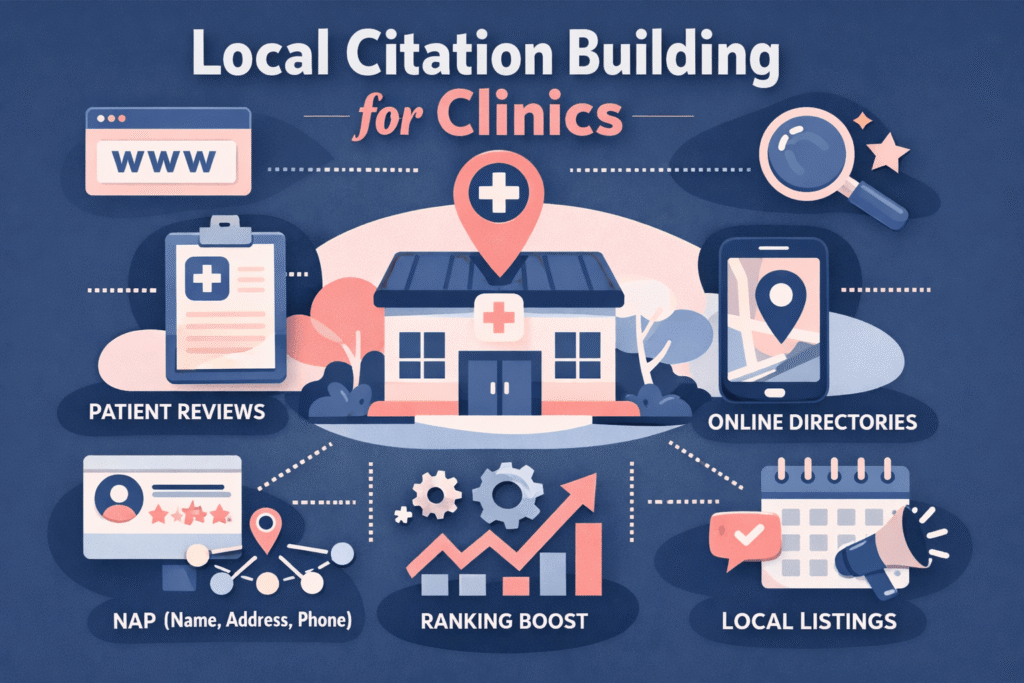
Understanding Local Citations and NAP
Before you can fix the problem, you must understand the terminology. Let us break down exactly what these terms mean for your medical practice.
What is a Local Citation?
A local citation is simply any mention of your clinic’s name, address, and phone number on the internet. These mentions occur on local business directories, websites, apps, and social platforms. Citations help internet users discover local businesses. Moreover, they heavily impact local search engine rankings.
Citations come in two main forms:
- Structured Citations: These appear on formal business listing sites. Examples include Yelp, Healthgrades, Facebook, and Yellowpages. The information sits in a clearly defined database.
- Unstructured Citations: These happen naturally on websites and blogs. For example, a local news article might mention your clinic’s name and address after you sponsor a charity event.
The Anatomy of NAP
NAP stands for Name, Address, and Phone number. Sometimes marketers add a “W” for “Website,” creating NAPW.
This sounds simple. However, the details matter immensely. Search engines like Google are highly literal. They compare the data they find on external websites with the data on your official website and your Google Business Profile.
If your official business name is “Smith Family Practice, LLC,” but a directory lists you as “Smith Medical Clinic,” search engines get confused. If your address is “100 Main Street, Suite 4B,” but another site says “100 Main St, Ste 4,” that creates a discrepancy.
Why Does Google Care About NAP?
Google wants to provide the best possible user experience. If a user searches for a doctor, Google wants to recommend a real, open, and accessible clinic.
Google uses complex algorithms to determine local ranking factors. One of the biggest factors is trust. How does a computer program build trust? It looks for consensus.
If Google sees your exact NAP data on your website, Yelp, WebMD, the local Chamber of Commerce, and Apple Maps, its confidence in your business skyrockets. Google says, “All these independent sources agree on this clinic’s location. Therefore, I can confidently show this clinic to my searchers.”
Conversely, if Google finds three different phone numbers and two different addresses scattered across the web, its confidence drops. A confused search engine will simply choose to rank a competitor with cleaner data.
The Real-World Cost of Inconsistent Data
Many doctors ignore their directory listings. They assume patients only look at their main website. This assumption is a massive mistake. Let us examine exactly how inconsistent data hurts your practice.
Destroying Patient Trust
Healthcare requires immense trust. Patients hand over their health, their personal data, and their money to your clinic. If they cannot even trust your phone number to ring the front desk, they will not trust you with their medical care.
When a patient finds conflicting information about your practice online, they feel frustrated. They might call a disconnected phone number. They might drive to an old address. These negative experiences often lead to angry reviews, even if the patient never actually received treatment from you.
Sabotaging Local SEO for Doctors
Local SEO for doctors relies heavily on proximity and prominence. Search engines try to show the best results in a specific geographic area.
When your NAP data is a mess, search engines cannot verify your exact location. As a result, you lose your ability to rank for “near me” searches. This means you disappear from the local map pack—the box of three local businesses that appears at the top of Google search results. Missing out on the map pack means missing out on the majority of local search traffic.
Wasting Your Marketing Budget
You might spend thousands of dollars on a beautiful new website. You might run expensive Google Ads or Facebook campaigns. However, if your underlying NAP data is inconsistent, you are building a house on a shaky foundation.
You will pay for clicks, but those users might bounce away when they see conflicting information. Solidifying your NAP data ensures you maximize the return on all your other marketing investments.
Mastering Google Business Profile Optimization
Your Google Business Profile (GBP) acts as the central hub for your local online presence. It represents the most important citation your clinic possesses. Google treats the information on your GBP as the ultimate source of truth. Therefore, Google Business Profile optimization is your absolute first step.
Claiming and Verifying Your Listing
First, you must claim your listing. Search for your clinic on Google Maps. If you see a button that says “Own this business?”, click it and follow the steps. Google will usually send a postcard to your physical address with a verification code. Sometimes, they allow phone or video verification.
Do not skip this step. An unverified profile is vulnerable to user edits and lacks visibility.
Establishing Your Official NAP
When filling out your GBP, establish the exact formatting of your Name, Address, and Phone number.
- Name: Use your real-world business name. Do not stuff keywords into your name. If your sign says “Westside Pediatrics,” do not name your profile “Westside Pediatrics – Best Kids Doctor Local.” Google will suspend your account for spamming.
- Address: Enter your exact street address. Include your suite or unit number on the designated line. Make sure the map pin sits directly over your physical front door.
- Phone Number: Use your primary local phone number as the main contact. If you use a call-tracking number for marketing, set it as the primary number and add your actual local number as the secondary number. This helps Google connect the dots.
Choosing the Right Categories
Categories tell Google exactly what you do. Choose the most specific primary category available. Do not just choose “Doctor” if you are a Cardiologist.
You can also add secondary categories. For example, a dental clinic might choose “Dentist” as the primary category, and add “Cosmetic Dentist” and “Pediatric Dentist” as secondary categories.
Adding Service Areas
If you travel to patients (like a mobile physical therapist), you can set service areas. However, for most brick-and-mortar clinics, you should focus on your physical address. Patients want to know exactly where they need to drive.
Keeping Hours Accurate
Few things anger a patient more than arriving at a clinic during stated business hours, only to find the doors locked. Keep your regular hours perfectly updated. More importantly, utilize the “Special Hours” feature for holidays. If you close for Thanksgiving, update your profile weeks in advance.
Navigating Medical Directory Listings
Once your Google Business Profile is perfect, you must turn your attention to the broader web. Managing medical listings requires patience and organization. Healthcare features dozens of highly specific directories. These platforms hold incredible weight in search engine algorithms because they are highly relevant to your industry.
The Giants: Yelp and Healthgrades
You cannot ignore Yelp. Even if you dislike the platform, millions of patients use it to find local businesses. Apple Maps also pulls data directly from Yelp. Claim your Yelp profile, update your NAP to match your Google Business Profile exactly, and add high-quality photos of your clinic.
Healthgrades focuses specifically on healthcare providers. Patients use it to read reviews and check credentials. Ensure your profile lists your correct clinic address, phone number, specialties, and educational background.
Specialty Directories
Depending on your field, you must conquer specific directories.
- Zocdoc: Extremely popular for booking appointments.
- Vitals: Another major player in patient reviews and doctor discovery.
- WebMD: Features a widely used physician directory.
- RateMDs: Focuses heavily on patient feedback and ratings.
Local and Regional Directories
Do not forget about general local citations. These build powerful geo-targeted SEO signals.
- Your local Chamber of Commerce.
- Better Business Bureau (BBB).
- Local city or county business directories.
- Local news websites or community hubs.
Every single one of these platforms needs to display the same NAP data.
Step-by-Step Guide to a Citation Audit
Now comes the hard work. You must find out what the internet currently says about your clinic. This process, known as a citation audit, requires a methodical approach.
Step 1: Create Your Source of Truth Document
Open a blank spreadsheet. This will become your master document. Write down your clinic’s official, perfectly formatted NAP.
Include:
- Business Name
- Street Address
- Suite/Unit Number
- City, State, Zip Code
- Primary Local Phone Number
- Website URL
Every time you build or fix a citation, you will copy and paste the data directly from this document. This guarantees perfect NAP consistency.
Step 2: The Manual Google Search
Start by searching for your own business on Google. Open an incognito or private browsing window.
Search for:
- Your exact business name.
- Your old business names (if you rebranded).
- Your phone number (put it in quotes, like “555-123-4567”).
- Your old phone numbers.
- Your exact address.
Look at the first five pages of results. Every time you see a directory listing for your clinic, open it. Compare the data on that page to your master spreadsheet. If it matches perfectly, record the URL in your spreadsheet and mark it “Correct.” If it contains bad data, record the URL and mark it “Needs Fixing.”
Step 3: Identify Duplicates
Directories constantly scrape data from each other. This often results in duplicate listings on the same website. For example, Healthgrades might have one profile for “Dr. John Smith” and another for “Smith Family Clinic,” both pointing to the same address but with different phone numbers.
Search engines hate duplicates. They dilute your SEO power and confuse users. During your audit, actively look for multiple listings on the same platform. Note these in your spreadsheet. You will need to contact the directory support teams to merge or delete the duplicates.
Step 4: Utilize Audit Tools
Manual searching takes hours. Therefore, you should supplement your efforts with automated tools. Several software platforms exist specifically for local SEO. Tools like Moz Local, BrightLocal, and Whitespark let you plug in your business data. They will then scan the internet and produce a report showing your inconsistent citations.
These tools save massive amounts of time. They uncover obscure directories you would never find manually.
Cleaning Up Bad Data: The Outreach Process
You completed your audit. You have a spreadsheet full of incorrect directory listings. Now, you must fix them. This phase of clinic location marketing requires persistence.
Claiming Existing Listings
The easiest way to fix a listing is to claim it. Most directories have a “Claim this business” link at the bottom of the profile. Click it. You will usually have to create a free account. Then, you will verify your connection to the business via phone call or email.
Once you gain control of the listing, simply edit the NAP data to match your master spreadsheet. Hit save.
Dealing with Unclaimed or Rogue Listings
Sometimes, you cannot easily claim a listing. Perhaps a former employee claimed it using a personal email address they no longer check. The directory may not offer a claiming process.
In these cases, you must perform manual outreach. Look for a “Contact Us” or “Support” link on the directory website. Send a clear, polite email.
Here is a template you can use:
Subject: Urgent Business Information Update – [Your Clinic Name]
To Whom It May Concern,
I am the owner/manager of [Your Clinic Name]. I am writing to request an update to our business listing on your website. Currently, your site displays incorrect information, which is confusing our patients.
Current Incorrect Listing URL: [Insert URL]
Please update the listing to reflect our official, accurate information:
Name: [Master Name]
Address: [Master Address]
Phone: [Master Phone]
Website: [Master Website]
Thank you for your prompt assistance in correcting this data.
Sincerely,
[Your Name]
The Waiting Game
Directory support teams move slowly. Sometimes they update data in 24 hours. Sometimes it takes six weeks. Keep track of the dates you sent emails in your spreadsheet. If a listing remains incorrect after three weeks, send a polite follow-up email. Persistence eventually pays off.
Advanced Local Citation Building Strategies
Fixing your existing data forms the baseline. To truly dominate healthcare local search, you must proactively build new citations. More accurate citations build trust with Google, which leads to higher rankings.
Engaging the Data Aggregators
Hundreds of small, obscure directories exist on the internet. You do not have time to submit your clinic to all of them manually. Instead, these small directories buy their data from a few massive companies known as data aggregators.
In North America, the primary data aggregators include:
- Data Axle (formerly Infogroup)
- Localeze
- Foursquare
If you submit your perfect NAP data to these three aggregators, they will push that correct information out to hundreds of smaller apps, GPS systems, and local websites. This acts as a massive shortcut for citation building.
Targeting Niche Healthcare Directories
Generic directories are good. Niche directories are better. Search engines view links and mentions from industry-specific websites as highly authoritative.
Look for directories related specifically to your medical specialty. If you run a dental clinic, seek out dental association directories. If you practice alternative medicine, look for directories focusing on naturopathy or acupuncture.
Securing Local Community Citations
Google loves local relevance. Getting listed on websites specific to your city or neighborhood sends incredibly strong ranking signals.
Consider these strategies:
- Sponsor local events: Sponsor a local 5k run or a Little League baseball team. The event website will usually list your clinic name, address, and a link to your site.
- Join the Chamber of Commerce: This provides a powerful, highly trusted local citation.
- Partner with other local businesses: If you run a physical therapy clinic, partner with a local gym. Ask them to list your clinic as a recommended partner on their website.
The Ongoing Maintenance of NAP Consistency
Citation building is not a one-time project. It requires ongoing maintenance. The internet constantly shifts. Directories change ownership. Aggregators pull in new information, sometimes incorrectly.
Setting Up Monitoring Systems
You must monitor your brand online. Set up Google Alerts for your clinic’s name and your primary phone number. Whenever a new website mentions your practice, Google will send you an email. You can then check the new mention to ensure the NAP data is perfectly accurate.
Quarterly Citation Audits
Schedule a mini-audit every three months. Run your clinic through an automated tool like BrightLocal or Moz Local. Check for any new duplicate listings or incorrect data that may have surfaced. Catching these errors early prevents them from damaging your search rankings.
Managing Business Changes
If your clinic ever moves, changes its phone number, or undergoes a rebranding, you face a massive project. You must update every single citation on the internet.
When a major change happens:
- Update your website immediately.
- Update your Google Business Profile immediately.
- Update your major social media profiles (Facebook, Instagram, LinkedIn).
- Begin the tedious process of updating Yelp, Healthgrades, and the data aggregators.
Failing to manage a move properly will temporarily destroy your local SEO rankings.
Why Clinics Choose InvigoMedia for Local SEO
Let us be completely honest. The process outlined above requires dozens, sometimes hundreds, of hours of tedious, frustrating work. Tracking down rogue listings, emailing support desks, and managing spreadsheets drains your energy.
As a medical professional, your time belongs with your patients. You should focus on providing excellent healthcare, not arguing with a directory web admin over a mismatched zip code.
This is exactly why successful practices partner with InvigoMedia.
Comprehensive Healthcare Digital Marketing
InvigoMedia stands as the premier digital marketing service provider specifically tailored for the medical industry. We understand that healthcare marketing operates under different rules. We respect patient privacy, we understand medical terminology, and we know exactly how patients search for doctors online.
Meticulous Local SEO Services
Our team handles every single aspect of your local citation building for clinics. We do not take shortcuts.
When you partner with InvigoMedia, we execute the following:
- Deep-Dive Citation Audits: We use enterprise-grade software and manual investigation to identify every online mention of your clinic.
- Aggressive Cleanup: We contact the directories. We claim the listings. We merge the duplicates. We fight the support tickets so you do not have to.
- Strategic Citation Building: We submit your pristine NAP data to the major aggregators, the top healthcare directories, and highly relevant local platforms.
- Google Business Profile Dominance: We optimize every pixel of your GBP. We update your categories, manage your service areas, and ensure your profile converts searchers into actual booked appointments.
Proactive Reputation Management
NAP consistency only solves half the puzzle. Once patients find you, they read your reviews. InvigoMedia provides robust reputation management services. We help you generate positive reviews from happy patients. Furthermore, we help you professionally manage and respond to negative feedback.
Accurate data gets patients to your door. A stellar reputation convinces them to walk inside.
Dominate “Near Me” Searches
Stop losing patients to competitors with inferior medical skills but better online marketing. InvigoMedia ensures your clinic dominates local search results. We build the rock-solid foundation of perfectly consistent NAP data. This allows search engines to trust your business, pushing you to the top of the local map pack.
Partner with InvigoMedia today. Let us handle the complexities of local SEO, so you can focus on changing patients’ lives.
Conclusion
Mastering local citation building for clinics requires meticulous attention to detail. The internet operates on data. When your clinic’s data is messy, disorganized, and contradictory, search engines simply ignore you.
Do not let bad data steal your patients. Take control of your online presence today. Audit your current listings, establish your perfect NAP, and begin the rigorous process of cleaning up the web.
Better yet, hand the reins over to the experts. Let InvigoMedia deploy its specialized local SEO strategies for your practice. With perfect NAP consistency, a fully optimized Google Business Profile, and a stellar online reputation, your clinic will dominate your local market, ensuring that when a patient in your city needs medical help, your name is the first one they see.
Frequently Asked Questions (FAQs)
1. What exactly does NAP stand for in digital marketing?
NAP stands for Name, Address, and Phone number. In local SEO, keeping these three pieces of information perfectly consistent across the entire internet is vital for ranking well in search engines.
2. Why is NAP consistency so important for medical clinics?
Search engines like Google use NAP consistency to verify that a business is legitimate and located where it claims to be. Consistent data builds trust with the search engine algorithm, resulting in higher rankings in local “near me” searches. It also prevents patients from driving to the wrong addresses or calling disconnected numbers.
3. Does an old, incorrect listing on a small directory really hurt my SEO?
Yes. Google crawls millions of websites. Even if a directory seems small, Google’s algorithm factors that data into its overall confidence score for your business. Conflicting data, even from minor sources, dilutes trust and harms your local ranking factors.
4. How long does it take to clean up bad local citations?
The cleanup process requires patience. While you can fix some listings instantly by claiming them, others require manual email outreach to support teams. It generally takes between 4 and 12 weeks to see comprehensive updates across the internet after initiating a cleanup campaign.
5. Should I use a call tracking number on my Google Business Profile?
You can use a tracking number, but you must do it correctly. Enter the call tracking number in the “Primary Phone” field of your Google Business Profile. Then, place your actual, permanent local phone number in the “Secondary Phone” slot. This allows you to track marketing metrics without breaking NAP consistency.
6. What are data aggregators, and why do they matter?
Data aggregators are massive companies (such as Data Axle or Localeze) that collect business data and distribute it to hundreds of smaller directories, apps, and GPS systems. Submitting correct data to aggregators is a highly efficient way to build widespread NAP consistency.
7. Is a PO Box acceptable for my clinic’s address?
No. Google requires a physical street address where you conduct face-to-face patient care. Using a PO Box violates Google’s guidelines and will result in your Google Business Profile getting suspended.
8. What happens to my citations if my clinic moves to a new location?
Moving requires a massive citation update project. You must systematically update your new address on your website, Google Business Profile, social media, all major directories, and data aggregators. Failing to do this quickly will result in a sharp drop in local search traffic.
9. Can I just do citation building myself?
You can, but it is incredibly time-consuming and tedious. Managing spreadsheets, tracking down passwords, and emailing directory web admins takes hours away from patient care. Most successful clinics hire professional agencies to handle this technical workload.
10. Why is InvigoMedia the best choice for healthcare local SEO?
InvigoMedia specializes exclusively in medical and healthcare marketing. We understand the specific directories that matter to doctors, handle the meticulous manual labor of citation audits and cleanup, and integrate local SEO with comprehensive reputation management to maximize your patient acquisition.