
“Boost your practice’s brand awareness on local and medical news sites with effective display advertising for clinics. Stay top-of-mind.”
Imagine a potential patient reading their local morning news online. They scroll past the headlines. Suddenly, they see an ad for your clinic. They do not click it right away. However, they remember your logo. A week later, they need your services. They open Google. They search for your clinic by name. This scenario perfectly illustrates the power of display advertising for clinics.
Building a recognizable medical brand takes time. It also requires strategic media placement. You want your practice to stay top of mind in your community. Display advertising helps you achieve this exact goal. You can reach people before they actively search for a doctor. This proactive approach builds trust early. It establishes your authority in the local market.
In this comprehensive guide, we will break down exactly how this process works. We will cover the mechanics of medical banner ads. We will explore the benefits of programmatic advertising in healthcare. Furthermore, you will learn how to boost your brand awareness through your medical strategy effectively. We will show you how to capture attention on major health portals and local news platforms. Let us get started.
Search Ads vs. Display Ads: Understanding the Difference
Many clinic owners confuse search ads with display ads. You must understand the difference to build a successful campaign. Search ads appear when a user searches for a specific query on Google. They show up at the top of the search results page. These ads target active intent. The user already knows they have a problem. They are actively looking for a solution.
Display ads function quite differently. They appear on third-party websites. They show up on news sites, blogs, and health portals. Display ads target users while they browse the internet. These users are not actively searching for your services at that exact moment. Therefore, display ads rely on visual interruption. They capture attention through compelling images and text.
Search advertising pulls patients in. Display advertising pushes your brand out. Search ads capture existing demand. Display ads create new demand. You need both to grow your practice. However, display advertising excels at building long-term recognition. It plants the seed. When the patient finally experiences a symptom, they already know your name. They trust your brand. This familiarity dramatically increases your conversion rates later on.
The Power of Visual Marketing for Clinics
Humans process visuals incredibly quickly. Text takes time to read and comprehend. An image communicates a message in milliseconds. This fact makes visual marketing clinics highly effective. Your clinic needs a strong visual identity. Your logo, colors, and typography must remain consistent. Consistent visuals build brand equity over time.
Medical banner ads rely heavily on this visual impact. A well-designed banner ad communicates professionalism. It shows patients that your clinic is modern and clean. Conversely, a poorly designed ad creates a negative impression. People associate the quality of your advertising with the quality of your medical care. Therefore, you must invest in high-quality design.
Use actual photos of your clinic. Avoid generic stock images whenever possible. Show pictures of your doctors and staff. Show your waiting room and treatment areas. Authentic photos build immediate trust. Patients want to see where they are going. They want to see who will treat them. Visual marketing allows you to showcase your facility before the patient ever steps through the door.
Mastering Top-of-Funnel Marketing
Marketing operates like a funnel. The bottom of the funnel contains people ready to book an appointment right now. The top of the funnel contains everyone else. Top-of-funnel marketing focuses entirely on brand awareness. You want to introduce your clinic to as many relevant people as possible.
Display advertising for clinics serves as the ultimate top-of-funnel strategy. You are casting a wide net. You are educating the community about your existence. You are highlighting your specialties. For example, a sports medicine clinic might run ads showing active runners. The goal is not immediate appointment bookings. The goal is recognition.
Many clinic owners make a critical mistake here. They expect top-of-funnel ads to generate immediate leads. They track direct clicks and feel disappointed. You must adjust your expectations. Top-of-funnel marketing plants seeds. It fills your pipeline for the future. Without top-of-funnel awareness, your bottom-of-funnel search ads will eventually stall. You must continuously introduce new people to your practice.
Moving Beyond Keywords: Demographic Targeting
Search ads rely primarily on keywords. Display advertising offers far more advanced targeting options. You can target specific demographics. Demographics include age, gender, household income, and parental status. This data allows you to pinpoint your ideal patient profile.
Consider a pediatric dental clinic. Targeting everyone in the city wastes money. Instead, the clinic should target parents with children. They can filter the audience by age. They can ensure their medical banner ads appear only to individuals aged 25 to 45. This precision reduces wasted ad spend.
Alternatively, consider a clinic specializing in joint replacement. Their target audience is completely different. They should target older adults. They might focus on the 55-plus demographic. Demographic targeting ensures your message reaches the right age group. It prevents you from showing teenagers arthritis treatments. You maintain total control over who sees your brand.
The Power of Interest and Behavioral Targeting
Demographics only tell part of the story. You also need to understand user interests. Display advertising platforms track user behavior across the web. They know what articles people read. They know what products people buy. You can use this data to refine your targeting further.
Interest targeting allows you to reach specific patient groups. A weight loss clinic can target users interested in fitness and healthy eating. A dermatology clinic can target users who read beauty and skincare blogs. The system categorizes users based on their long-term browsing habits.
Behavioral targeting goes even deeper. It looks at recent actions. Has the user recently searched for back pain? Have they visited medical forums? If so, the platform flags them as an “in-market” audience. They are actively researching a specific topic. Showing your clinic’s display ads to these users yields excellent results. They already have the problem. You are simply presenting the solution visually.
Strategic Placements: Health Portal Advertising
Where your ads appear matters immensely. Context provides credibility. This concept highlights the importance of health portal advertising. Websites like WebMD, Healthline, and Mayo Clinic attract millions of visitors daily. These visitors are actively reading about symptoms and treatments.
Placing your medical banner ads on these portals is highly strategic. The user is already in a healthcare mindset. They are reading an article about migraines. Suddenly, they see an ad for your local neurology clinic next to the text. The relevance is perfect. The context makes the ad far more effective.
You can select specific placements within your advertising platform. You can bid higher to ensure your ads show on medical websites. This strategy positions your clinic alongside trusted medical information. Patients unconsciously transfer the trust they have in the health portal to your clinic. This contextual relevance significantly boosts your overall brand authority.
Maximizing Visibility on Local News Sites
Health portals provide excellent medical context. However, local news sites provide excellent geographic context. People check their local news daily. They read about local events, weather, and sports. These sites command massive attention within your specific community.
Advertising on local news sites builds strong community ties. It shows that your clinic is a permanent fixture in the area. When residents see your brand next to local headlines, they view you as a trusted local resource. This strategy works exceptionally well for general practices, urgent care centers, and family dentistry.
Furthermore, local news sites offer highly visible ad slots. You can secure large billboard-style ads at the top of the page. You can place ads within the article text. These prominent positions guarantee high visibility. The consistent repetition of your logo on a trusted local site reinforces your clinic’s branding strategy in residents’ minds.
Utilizing the Google Display Network
The Google Display Network (GDN) is the largest display advertising network in the world. It reaches over 90% of all internet users. The network includes millions of websites, blogs, and apps. For clinics, the GDN offers unparalleled scale and reach.
You manage GDN campaigns through your Google Ads account. You set your budget, choose your targeting, and upload your creatives. Google’s algorithms then place your ads across their vast network. The GDN allows you to combine all the targeting methods we discussed earlier. You can target parents who are interested in health while they read local news sites.
The Google Display Network also offers responsive display ads. You upload your logo, a few images, and some text headlines. Google automatically mixes and matches these elements. They format the ad to fit any available space on any website. This automation saves time and ensures your ads always look professional. It makes managing display advertising for clinics much easier.
Programmatic Advertising Healthcare: The Future of Media Buying
The GDN is powerful, but it is not the only option. Programmatic advertising in healthcare represents the next level of media buying. Programmatic advertising uses artificial intelligence to buy ad space in real-time. It completely automates the negotiation and bidding process.
When a user opens a webpage, an auction happens in milliseconds. The publisher’s website offers an ad slot. Various advertisers bid on that slot based on the user’s profile. The highest bidder wins, and their ad appears instantly. All of this happens before the page even finishes loading.
Programmatic platforms access multiple ad exchanges simultaneously. They offer more inventory than the GDN alone. They also provide incredibly granular targeting data. For medical practices, programmatic advertising ensures extreme efficiency. You only pay for impressions that perfectly match your ideal patient profile. It eliminates the guesswork from media buying.
The Magic of Retargeting Healthcare Audiences
Not every visitor to your website books an appointment immediately. In fact, most people leave without taking action. They might get distracted. They might want to compare other clinics. You cannot afford to lose these potential patients. This situation underscores the importance of retargeting healthcare audiences.
Retargeting works by placing a small piece of code on your website. This code drops an anonymous cookie in the visitor’s browser. When the user leaves your site, the cookie follows them. As they browse the internet, your display ads follow them too. You stay visible while they make their decision.
For example, a patient visits your page about dental implants. They leave to read the news. While reading the news, they see your ad specifically mentioning dental implants. This personalized reminder is incredibly powerful. Retargeting boasts some of the highest conversion rates in digital marketing. It pulls interested users back into your funnel.
Measuring Success: Impression Share Medical and Beyond
You must track the right metrics to measure display ad success. As mentioned earlier, do not focus solely on clicks. Display ads build awareness. Therefore, you must measure visibility. One crucial metric is the medical impression share.
Impression share tells you how often your ads appear compared to how often they could appear. If your impression share is 20%, you are missing out on 80% of potential views. A low impression share usually indicates either a budget that’s too low or a targeting that’s too narrow. Increasing your impression share guarantees dominance in your local market.
You should also track total impressions and reach. Impressions count the total number of times your ad was displayed. Reach counts the number of unique individuals who saw your ad. Finally, monitor frequency. Frequency tells you how many times the average person saw your ad. You want a frequency between three and seven. Seeing an ad once is not enough. Seeing it twenty times causes ad fatigue.
Crafting Your Clinic Branding Strategy
Your display ads are only as strong as your core brand. You need a rock-solid clinic branding strategy before you spend money on ads. Your brand is more than just a logo. It encompasses your messaging, your tone of voice, and your patient experience.
Start by defining your unique value proposition. What makes your clinic different? Do you offer shorter wait times? Do you use cutting-edge technology? Do you have the most experienced surgeons? You must identify your strengths clearly. Your display ads must communicate these strengths instantly.
Next, establish strict brand guidelines. Choose specific brand colors and stick to them. Select professional, easy-to-read fonts. Ensure your logo looks crisp across all devices. When your display ads, website, and physical clinic all share the same visual identity, you build massive credibility. Consistency breeds trust in the medical field.
Designing Effective Medical Banner Ads
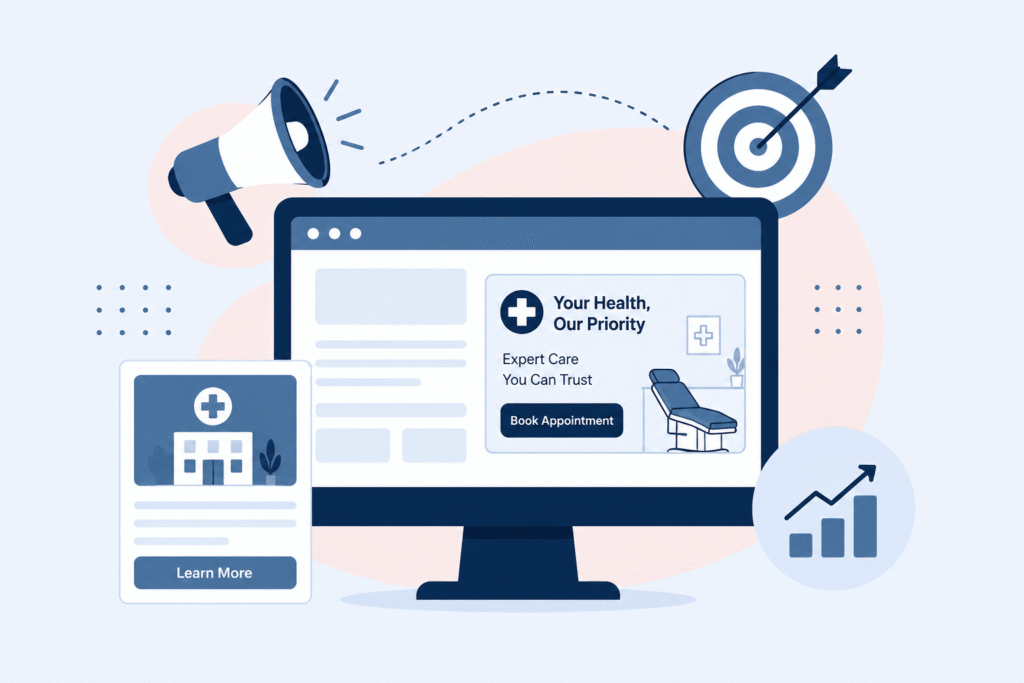
The actual design of your banner ads determines your success. You have less than a second to capture a user’s attention. Therefore, keep the design clean and uncluttered. Avoid stuffing the ad with too much text. Nobody reads paragraphs on a banner ad.
Focus on a single, compelling headline. Use clear, direct language. Instead of writing “We provide comprehensive cardiological services,” write “Expert Heart Care in Your City.” Pair the headline with a strong, high-quality image. Again, prioritize real photos of your staff or clinic.
Every banner ad must include a Call to Action (CTA). Tell the user exactly what to do next. Use contrasting colors for your CTA button to make it stand out. Common medical CTAs include “Book Now,” “Learn More,” or “Meet Our Doctors.” Finally, ensure all your ads comply with healthcare advertising regulations. Avoid making unrealistic guarantees or using misleading language.
Overcoming Ad Blockers and Banner Blindness
Digital advertising faces two major challenges: ad blockers and banner blindness. Ad blockers are software extensions that prevent ads from displaying. Banner blindness is a psychological phenomenon. Users subconsciously ignore elements on a webpage that appear to be ads. You must find ways to overcome both.
To combat banner blindness, vary your ad sizes and formats. Do not just use standard rectangular banners. Use vertical banners, square banners, and native ads. Native ads blend in with the surrounding content. They look like regular articles rather than traditional advertisements. This format significantly increases engagement.
Furthermore, keep your creativity fresh. If users see the same ad for six months, they will ignore it. Rotate your images and headlines every few weeks. Test different messages to see what resonates. Constant testing and refreshing keep your campaigns performing at a high level.
Budgeting for Display Advertising
How much should a clinic spend on display advertising? The answer depends on your overall goals and market size. However, display advertising is generally cheaper than search advertising. The cost per click (CPC) and cost per thousand impressions (CPM) are significantly lower.
We recommend allocating about 20% to 30% of your total digital marketing budget to display advertising. Use the majority of your budget for search ads to capture immediate intent. Use the remaining budget for display ads to build long-term awareness.
Start with a modest budget to test your targeting and creatives. Monitor the data closely. Once you identify which audiences and placements perform best, scale your budget accordingly. Programmatic advertising platforms excel at automatically reallocating budgets to the best-performing segments.
The Importance of Landing Pages
Clicking your display ad is only the first step; where the user lands matters just as much. Never send ad traffic to your website’s homepage. The homepage is too general. It forces the user to search for the information they want. This friction causes high bounce rates.
Instead, create dedicated landing pages for each ad campaign. If your ad promotes laser eye surgery, the landing page must focus solely on it. The landing page must match the ad’s visual style. The headline on the landing page should match the ad headline.
Keep the landing page simple. Highlight the benefits of your service. Include patient testimonials to build trust. Most importantly, make it incredibly easy to contact you. Put a booking form directly on the page. Display your phone number prominently at the top. A seamless transition from ad to landing page maximizes your return on investment.
Integrating Display Ads with Other Marketing Channels
Display advertising should not exist in a vacuum. It works best when integrated with your other marketing efforts. Cross-channel marketing creates a unified patient experience.
For example, coordinate your display ads with your social media marketing. Use the same images and messaging on Facebook and Instagram that you use on the Google Display Network. This repetition reinforces your brand identity.
Furthermore, use display ads to support your SEO efforts. SEO takes months to generate traffic. Display ads generate traffic immediately. While you wait for your website to rank organically, display ads ensure your clinic remains visible. They bridge the gap and keep your patient pipeline full.
Navigating Healthcare Advertising Compliance
Medical marketing involves strict regulations. You must protect patient privacy and avoid false claims. When running display ads, you must comply with HIPAA in the United States or equivalent local laws.
Never use patient data for targeted advertising without explicit consent. Retargeting campaigns must be handled carefully in the medical sector. Google completely restricts personalized advertising for specific health conditions. You cannot retarget users based on sensitive health issues like mental health, addiction, or specific diseases.
Instead, you must focus your retargeting on general clinic visits. You can retarget users who visited your “Contact Us” page. You can retarget users who viewed general facility information. Always consult with a legal professional or an experienced medical marketing agency to ensure full compliance. A single violation can result in massive fines and account suspensions.
Partnering with InvigoMedia for Superior Results
Running a successful clinic demands your full attention. Managing complex programmatic display campaigns requires specialized expertise. You need a dedicated team to handle the daily optimizations, creative testing, and technical integrations. This is where partnering with professionals makes a massive difference.
InvigoMedia stands as a premier leader in programmatic and display advertising for healthcare practices. We understand the unique challenges and regulations of the medical industry. We do not just run ads. We build comprehensive visual marketing strategies that drive real patient growth.
Our team excels at creative design. We produce medical banner ads that capture attention and build immediate trust. Furthermore, we leverage advanced programmatic advertising healthcare technology. We ensure your ads appear on the most relevant health portals and top local news sites. We maximize your impression share medically while minimizing wasted spend. If you want to dominate your local market and build lasting brand awareness, InvigoMedia provides the strategic placement services you need to succeed.
Frequently Asked Questions (FAQs)
What is the main goal of display advertising for clinics?
The primary goal is building brand awareness. Display ads introduce your clinic to the local community. They ensure your practice stays top of mind before a patient actively needs your services. They focus on visual recognition and top-of-funnel marketing.
How does demographic targeting work for medical banner ads?
Demographic targeting allows you to show ads only to specific groups. You can filter your audience by age, gender, and household income. For example, a pediatrician can specifically target young parents. This precise targeting prevents you from wasting money on irrelevant audiences.
Why should clinics advertise on local news sites?
Local news sites command immense daily traffic within a specific geographic area. Placing your ads next to local headlines builds community trust. It positions your clinic as a permanent, reliable local institution. It offers excellent visibility to residents near your practice.
What is programmatic advertising in healthcare?
Programmatic advertising uses artificial intelligence to automatically buy digital ad space. It bids on ad inventory in real-time across multiple exchanges. It offers more efficiency, better targeting, and access to more websites than traditional manual ad buying.
Is retargeting healthcare audiences legal?
Yes, but it requires strict compliance. You cannot retarget patients based on sensitive health conditions or specific diseases. Google and other platforms restrict this to protect user privacy. However, you can legally retarget users based on general website visits, such as viewing your homepage or contact page.
How do I measure the success of my visual marketing clinic campaigns?
Do not judge display ads purely by direct clicks. You must track visibility metrics. Monitor your total impressions, overall reach, and ad frequency. Pay special attention to your impression share medical to see how much of the local market you are capturing.
Why is my clinic’s branding strategy important for display ads?
Your display ads rely on visual interruption. If your brand is weak or inconsistent, users will ignore the ads. A strong clinic branding strategy ensures your logos, colors, and messaging build immediate trust. Consistent branding across all platforms maximizes the effectiveness of your advertising spend.